
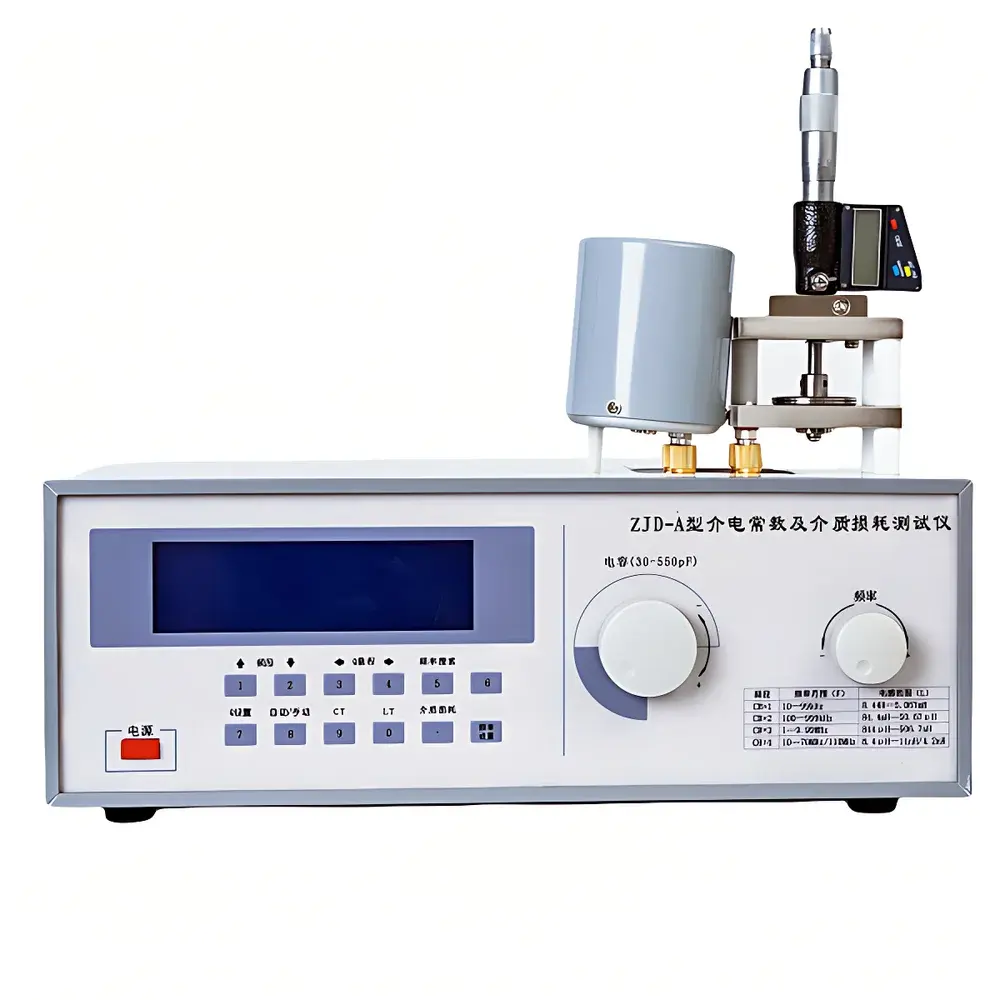
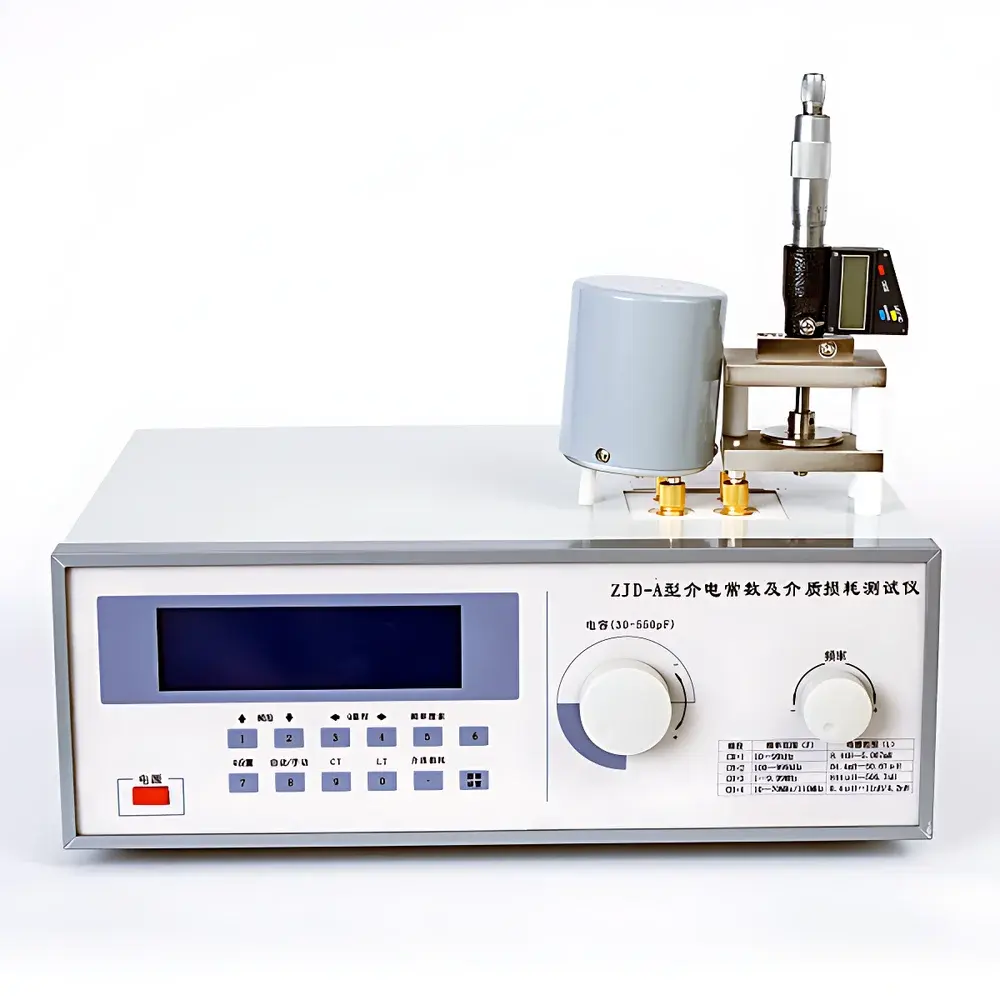
Aerospace ZJD-A Dielectric Constant and Dissipation Factor Analyzer
| Brand | Aerospace |
|---|---|
| Origin | Beijing, China |
| Model | ZJD-A Dielectric Constant and Dissipation Factor Analyzer |
| Frequency Range | 10 kHz – 60 MHz (DDS Synthesized) |
| Capacitance Tuning Range | 30–500 pF |
| Q Factor Range | 1–1000 |
| Q Resolution | 0.1 (4-digit effective) |
| Q Measurement Accuracy | < ±5% |
| Inductance Measurement Range | 15 nH – 8.4 H |
| Inductance Resolution | 0.1 nH |
| Inductance Accuracy | < ±5% |
| Frequency Accuracy | ±3×10⁻⁵ ±1 digit (6-digit display) |
| Frequency Coverage Ratio | 6000:1 |
| Standard Compliance | GB/T 1409, IEC 60250, JB 7770 |
Overview
The Aerospace ZJD-A Dielectric Constant and Dissipation Factor Analyzer is a precision LCR-based impedance analyzer engineered for the quantitative characterization of dielectric properties in insulating materials under alternating electric fields. It operates on the principle of series/parallel resonance measurement in a high-Q shielded bridge circuit, utilizing direct digital synthesis (DDS) to generate stable, low-phase-noise sinusoidal excitation signals across a continuous frequency range from 10 kHz to 60 MHz. Unlike broadband spectroscopic methods, the ZJD-A employs a tunable resonant cavity architecture—comprising a calibrated variable capacitor and selectable inductors—to determine complex permittivity (ε* = ε′ − jε″) by measuring resonant frequency shift and bandwidth broadening. This method delivers high sensitivity to small changes in dielectric loss (tan δ = ε″/ε′), particularly critical for evaluating polymer aging, moisture ingress in composites, or interfacial polarization in multilayer capacitors. Designed explicitly for compliance with GB/T 1409 (equivalent to IEC 60250) and JB 7770, the instrument supports standardized test configurations for solid sheets, films, and liquid samples—including transformer oil—using optional electrodes and standard ASTM D924-compatible cells.
Key Features
- DDS-based signal generation ensures frequency stability better than ±3×10⁻⁵ over full range, enabling repeatable permittivity mapping across frequency sweeps.
- Digital Fourier transform (DFT) filtering suppresses 50 Hz power-line interference and harmonic distortion, permitting reliable measurements in electromagnetically noisy laboratory or industrial environments.
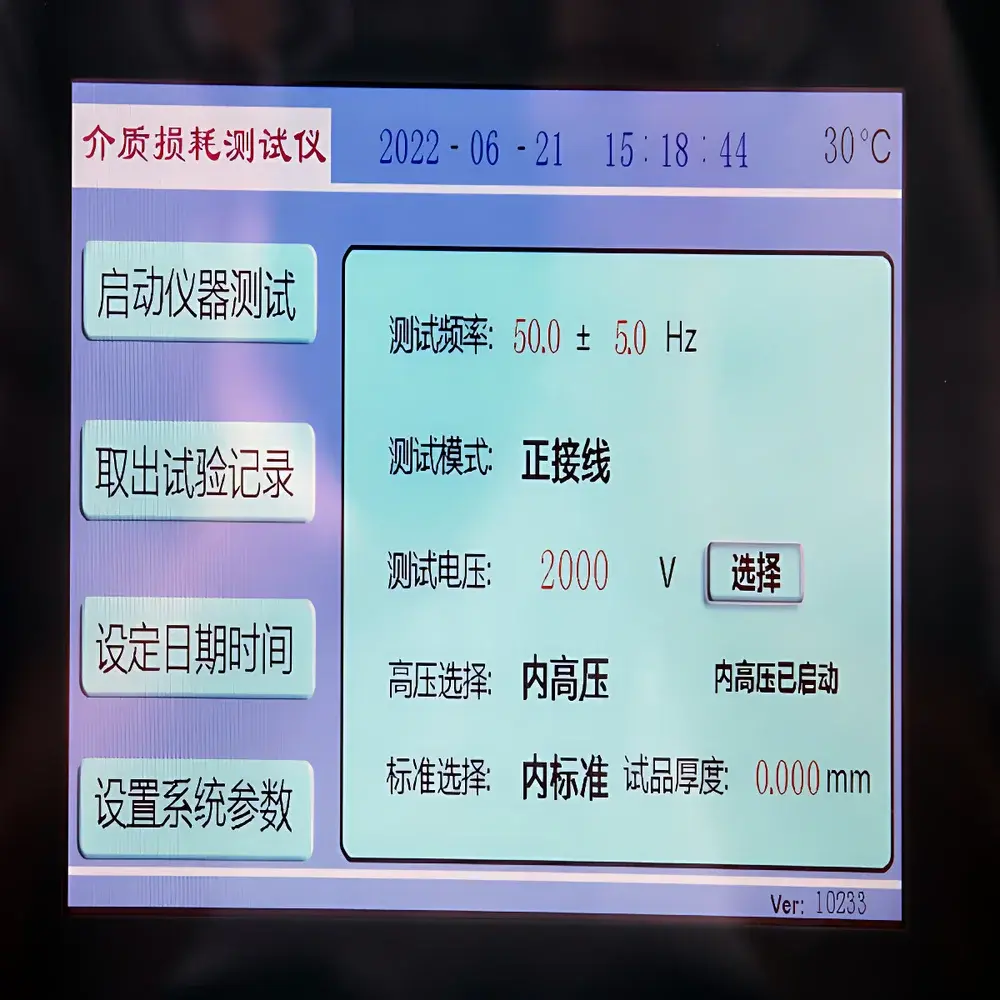
- Integrated high-voltage source (up to 2 kV, adjustable) and reference capacitor eliminate external cabling, reducing stray capacitance and improving measurement reproducibility.
- Auto-resonance search algorithm identifies f₀ and Δf within seconds; Q-factor, C, L, and tan δ are computed in real time and displayed simultaneously on a 7-inch capacitive touchscreen LCD.
- Onboard calendar chip and 2 GB non-volatile memory store timestamped test records—including operator ID, sample ID, temperature (via optional probe input), and raw resonance parameters—with automatic file naming and indexing.
- Ground-fault detection and overcurrent protection circuits enforce safety interlocks: HV output is disabled unless earth ground resistance falls below 10 Ω, and current limiting activates within 10 µs during flashover events.
Sample Compatibility & Compliance
The ZJD-A accommodates planar solid dielectrics (e.g., epoxy laminates, ceramic substrates, polyimide films) using parallel-plate or guarded-electrode fixtures per ASTM D150 and IEC 60250 Annex B. For liquids—including insulating oils, silicone fluids, and solvent dispersions—the system interfaces with standard ASTM D924 cup cells (25 mm diameter, 1 mm gap). Optional coaxial line adapters support RF-grade material testing up to 30 MHz. All hardware and firmware comply with electromagnetic compatibility (EMC) requirements per GB/T 18268.31 (IEC 61326-2-1) and electrical safety per GB 4793.1 (IEC 61010-1). Data integrity meets GLP audit trail requirements: each measurement log includes cryptographic hash, operator signature field, and immutable timestamps traceable to UTC via NTP synchronization when connected to LAN.
Software & Data Management
Measurement data export is supported via USB 2.0 interface to FAT32-formatted U disks. A Windows-compatible desktop application (ZJD-DataSuite v3.2) enables post-processing of ε′(f), tan δ(f), and Cole-Cole plots; batch statistical analysis (mean, SD, Cp/Cpk) across lot numbers; and automated report generation compliant with ISO/IEC 17025 documentation templates. The software enforces role-based access control (RBAC): “Operator” accounts can run tests but not modify calibration coefficients; “Engineer” accounts may perform sensor verification and update firmware; “Admin” credentials are required for audit log deletion. All exported CSV files include embedded metadata headers specifying instrument serial number, calibration due date, and measurement uncertainty budget per GUM (JCGM 100:2008).
Applications
- Quality assurance of high-frequency PCB substrates (e.g., Rogers RO4350B, Taconic RF-35) where ε′ drift >0.02 or tan δ increase >1×10⁻⁴ indicates resin degradation.
- Accelerated aging studies of cable insulation polymers (XLPE, EPR) tracking dipole relaxation shifts between 100 kHz–10 MHz.
- R&D validation of nanocomposite dielectrics (e.g., BaTiO₃/PVDF) quantifying interfacial polarization contributions via Havriliak-Negami fitting.
- Transformer oil condition monitoring: detection of oxidation byproducts and moisture content through tan δ elevation at 1 MHz per IEEE C57.104 guidelines.
- Thin-film ferroelectric characterization (PZT, SBT) using low-signal-level Q-enhancement mode for improved SNR in sub-100 nm thickness regimes.
FAQ
What standards does the ZJD-A officially support?
It is fully aligned with GB/T 1409–2006 (identical to IEC 60250:1969), JB 7770–1995, and ASTM D150–18 for solid dielectrics; ASTM D924–20 applies when used with standard oil cups.
Can it measure low-loss materials like fused quartz or sapphire?
Yes—its Q-factor resolution of 0.1 and auto-ranging bridge design enable accurate tan δ measurements down to 1×10⁻⁵ at 1 MHz when paired with guarded electrodes and environmental shielding.
Is firmware upgrade possible in the field?
Yes—upgrades are delivered as signed .bin packages via USB; the bootloader verifies digital signatures prior to flash programming to prevent unauthorized modifications.
Does the instrument support external temperature control integration?
Yes—RS-485 port accepts Modbus RTU commands from thermal chambers; temperature-compensated permittivity calculations are enabled in firmware v2.4+.
How is measurement uncertainty quantified?
Total uncertainty is calculated per GUM framework, combining Type A (repeatability SD from 10 repeated scans) and Type B components (frequency synth error, capacitor calibration certificate, electrode geometry tolerance). Typical expanded uncertainty (k=2) is ±1.8% for ε′ and ±3.2% for tan δ at 1 MHz.



