
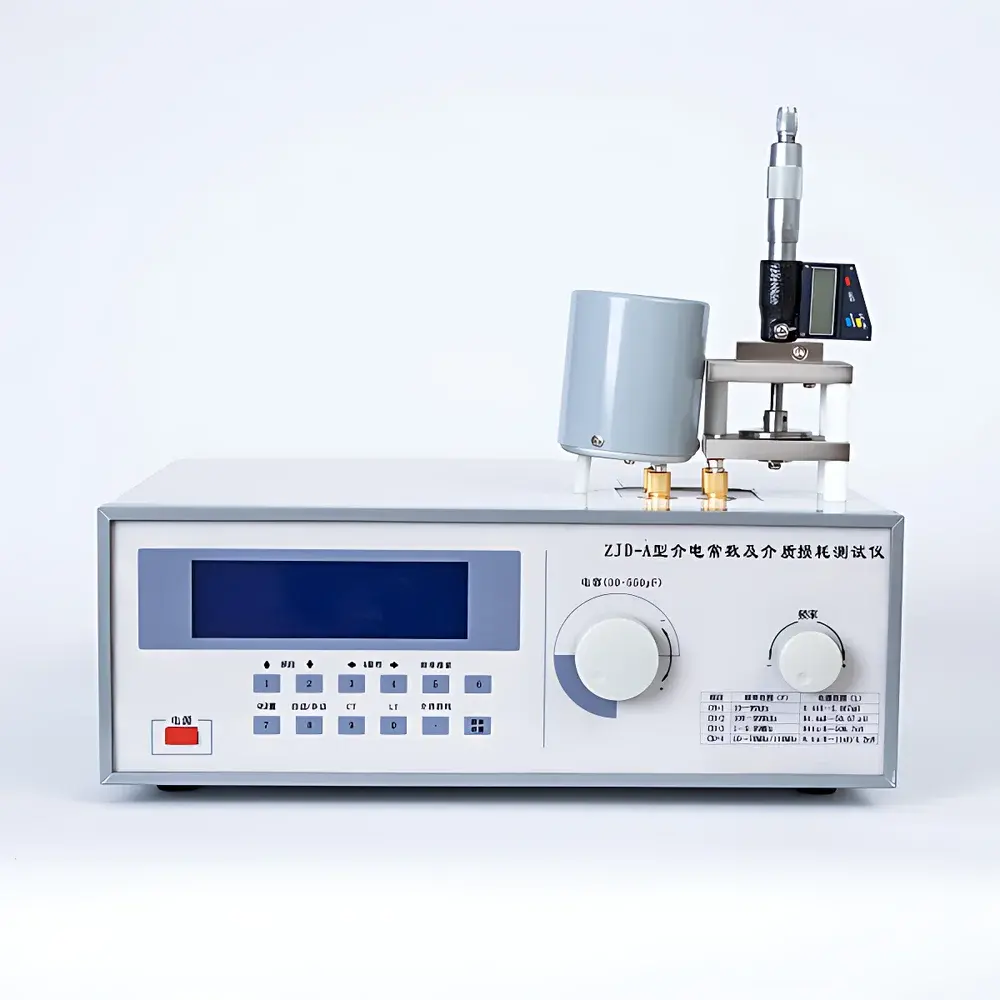
Aerospace ZJD-A Dielectric Constant and Impedance Analyzer
| Brand | Aerospace |
|---|---|
| Origin | Beijing, China |
| Manufacturer Type | Authorized Distributor |
| Model | ZJD-A Dielectric Constant and Impedance Analyzer |
| Frequency Range | 10 kHz – 70 MHz (DDS Synthesized) |
| Q Factor Range | 1–1000 (Auto/Manual Scaling) |
| Q Resolution | 0.1 (4-digit display) |
| Frequency Accuracy | ±3×10⁻⁵ ±1 digit (6-digit precision) |
| Inductance Measurement Range | 15 nH – 8.4 H |
| Capacitance Tuning Range | 30–500 pF |
| Capacitance Resolution & Error | ±1.5 pF or <1% |
| tanδ Measurement Capability | Yes |
| εᵣ (Relative Permittivity) Calculation | Supported via parallel-plate fixture |
| Fixture Electrode Diameter | Φ50 mm / Φ38 mm (selectable) |
| Electrode Spacing Adjustment | ≥15 mm |
| Micrometer Resolution | 0.001 mm |
| Fixture Loss Tangent (1 MHz) | ≤4×10⁻⁴ |
Overview
The Aerospace ZJD-A Dielectric Constant and Impedance Analyzer is a precision instrument engineered for high-frequency characterization of dielectric materials using the resonant cavity method—specifically, the series/parallel resonance technique based on high-Q LC circuit analysis. It operates across a broad frequency spectrum (10 kHz to 70 MHz), enabling accurate determination of complex permittivity (ε* = ε′ − jε″), dissipation factor (tan δ), quality factor (Q), inductance (L), capacitance (C), and distributed parasitic parameters. The instrument employs digital frequency synthesis (DDS), automatic resonance point scanning, real-time Q-range switching, and digitally locked frequency tracking to minimize residual inductance and improve measurement reproducibility. Its architecture integrates microprocessor-based control with analog signal conditioning optimized for low-noise, high-stability impedance measurements—making it suitable for both R&D laboratories and quality assurance environments where traceable, repeatable dielectric data are essential under ISO/IEC 17025-aligned workflows.
Key Features
- Dual-mode operation: Supports both manual tuning and fully automated resonance search with LCD-guided feedback.
- High-resolution parameter display: Simultaneous real-time readout of frequency (F), inductance (L), capacitance (C), Q factor, and operating band on integrated LCD.
- Calibrated parallel-plate fixture: Equipped with interchangeable electrodes (Φ50 mm or Φ38 mm), micrometer-driven spacing control (0.001 mm resolution), and verified low-loss performance (tan δ ≤ 4×10⁻⁴ at 1 MHz).
- Wide dynamic range: Measures Q from 1 to 1000 with <5% systematic error; inductance from 15 nH to 8.4 H; capacitance tuning from 30 pF to 500 pF.
- Frequency stability and accuracy: DDS source delivers ±3×10⁻⁵ frequency accuracy with six-digit resolution and 6000:1 frequency coverage ratio.
- Compliance-ready design: Includes Q-pass/fail threshold presetting (5–1000) with audible and visual alerts, supporting standardized pass/fail screening per ASTM D150 or IEC 60250 protocols.
Sample Compatibility & Compliance
The ZJD-A analyzer accommodates solid dielectrics—including ceramics (e.g., alumina, titanates), polymer films (PE, PVC, PMMA), insulating papers, and composite laminates—as well as low-conductivity liquids (e.g., transformer oils, silicone fluids) when used with appropriate containment fixtures. Sample thickness is determined by electrode spacing (adjustable ≥15 mm), while permittivity calculation assumes homogeneous, isotropic, and non-magnetic behavior within the test volume. The system meets foundational requirements for dielectric testing per ASTM D150 (Standard Test Method for Dielectric Constant and Dissipation Factor of Electrical Insulating Materials) and IEC 60250 (Measurement of the Dielectric Constant and Dissipation Factor of Solid Electrical Insulating Materials at Power, Audio and Radio Frequencies). While not inherently 21 CFR Part 11 compliant, its digital output interface supports integration into validated GLP/GMP data acquisition systems when paired with audit-trail-enabled software.
Software & Data Management
The ZJD-A operates as a standalone instrument with embedded firmware controlling all measurement sequences, calibration routines, and display logic. Raw data—including resonant frequency, Q, L, C, and calculated εᵣ and tan δ values—are displayed locally and may be manually recorded. For traceable documentation, users may connect the instrument’s RS-232 or USB-to-serial interface (optional adapter) to external PCs running custom or third-party data logging software. Exported datasets retain timestamped metadata and support post-processing in MATLAB, Python (NumPy/SciPy), or Excel for Cole-Cole plot generation, temperature-frequency sweeps, or comparative material benchmarking. No proprietary cloud platform or vendor-hosted software is required or bundled.
Applications
This analyzer serves critical roles in materials science research, electrical insulation qualification, and industrial process control. In academic and national metrology labs, it supports fundamental studies of polarization mechanisms in ferroelectrics, relaxor polymers, and nanocomposites. In manufacturing QA/QC settings—such as capacitor manufacturers, transformer oil refineries, or ceramic substrate producers—it verifies batch-to-batch consistency of εᵣ and tan δ against internal specifications or customer-facing datasheets. It further enables failure analysis of aged insulation systems by tracking tan δ increases indicative of moisture ingress or oxidative degradation. Applications extend to aerospace-grade composites (where low εᵣ and stable tan δ over wide temperature ranges are mandatory) and biomedical polymer development (where RF heating characteristics depend directly on ε″ and tan δ at 13.56 MHz or 27.12 MHz ISM bands).
FAQ
What physical principle does the ZJD-A use to determine dielectric constant?
It applies the resonant frequency shift and Q-factor change of a calibrated LC tank circuit upon insertion of a dielectric sample between parallel-plate electrodes—based on established relationships between resonance parameters and complex permittivity.
Can the ZJD-A measure loss tangent (tan δ) independently of εᵣ?
Yes. tan δ is derived directly from measured Q and reactance values at resonance, without requiring prior knowledge of εᵣ. Both parameters are computed simultaneously from the same measurement set.
Is calibration traceable to national standards?
The instrument includes factory calibration using NIST-traceable passive standards (inductors, capacitors, and precision resistors); end-user recalibration requires certified reference components and documented procedures aligned with ISO/IEC 17025.
Does the system support variable temperature or humidity-controlled testing?
No. The ZJD-A is designed for ambient-condition measurements only. Environmental control requires external chambers compatible with the fixture’s mechanical interface and electrical feedthroughs.
How is electrode spacing verified during operation?
The micrometer-driven stage features engraved scale markings and 0.001 mm resolution; final spacing is confirmed optically or via calibrated feeler gauges before data acquisition.
Related Products



