
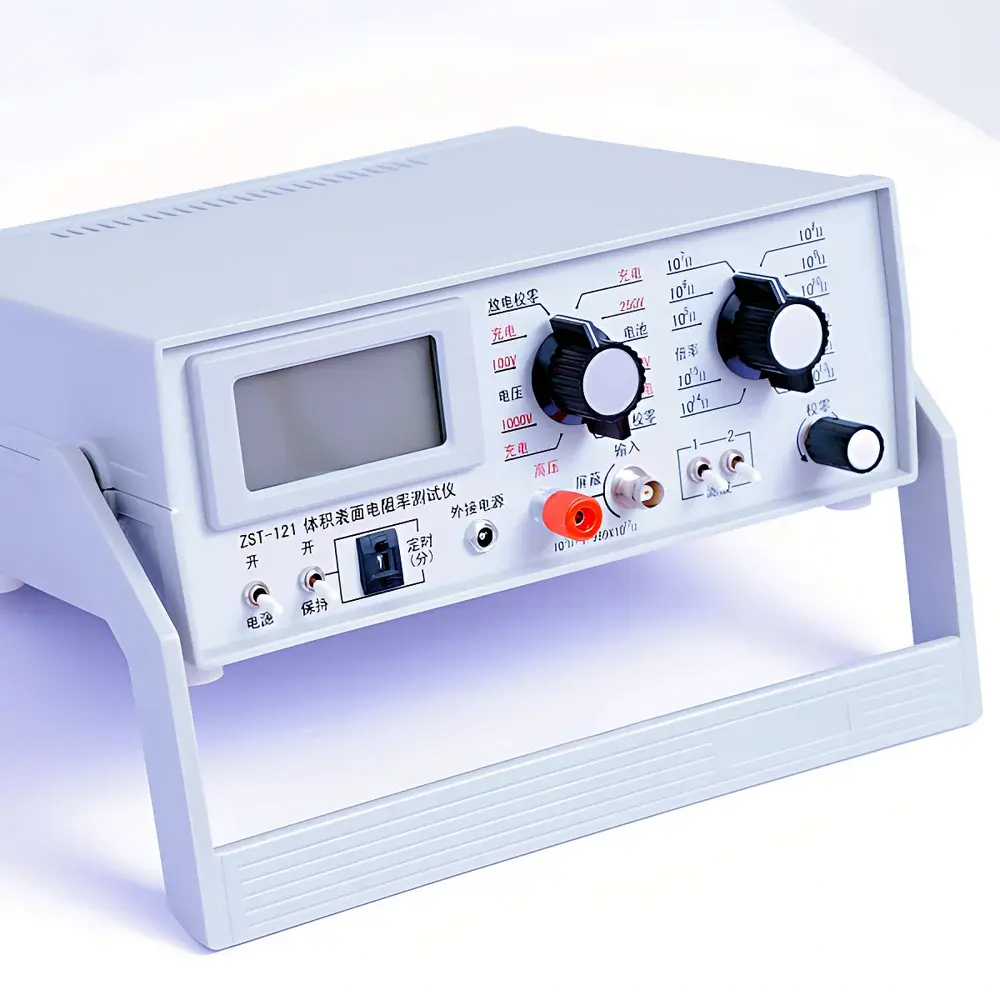
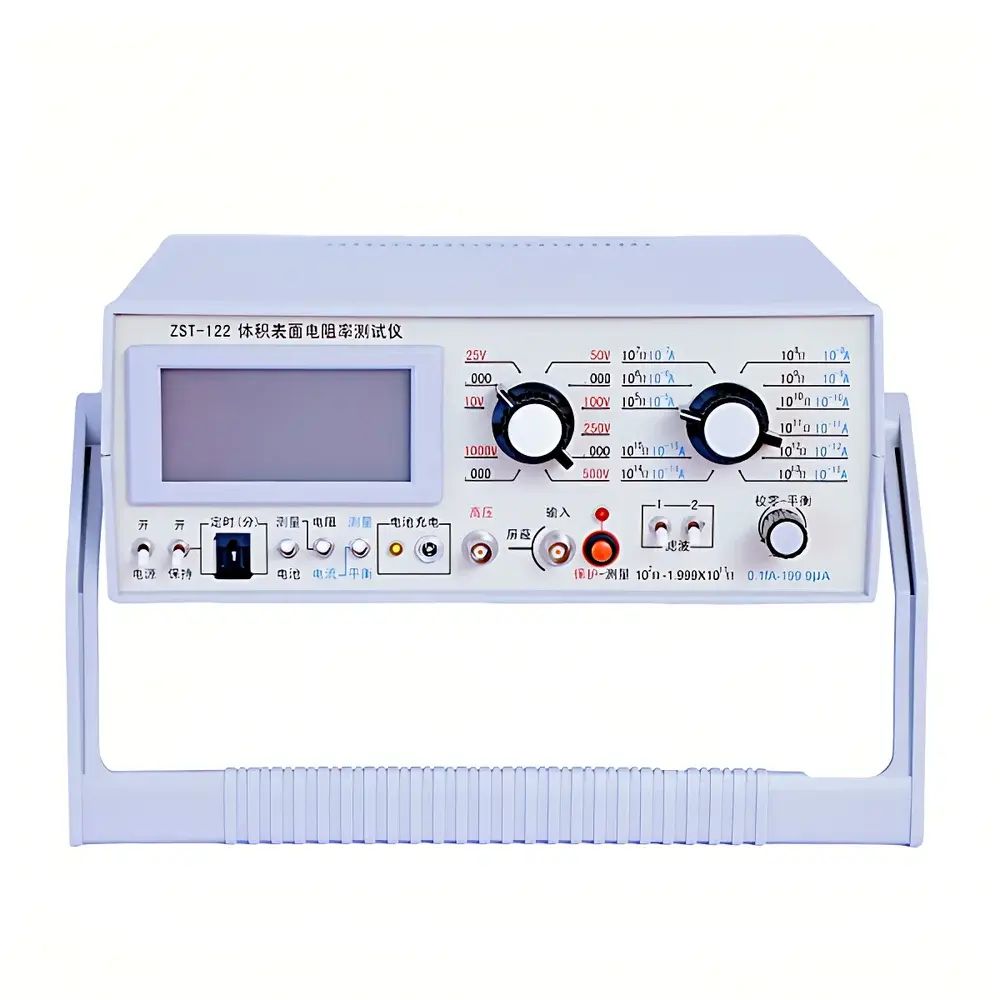
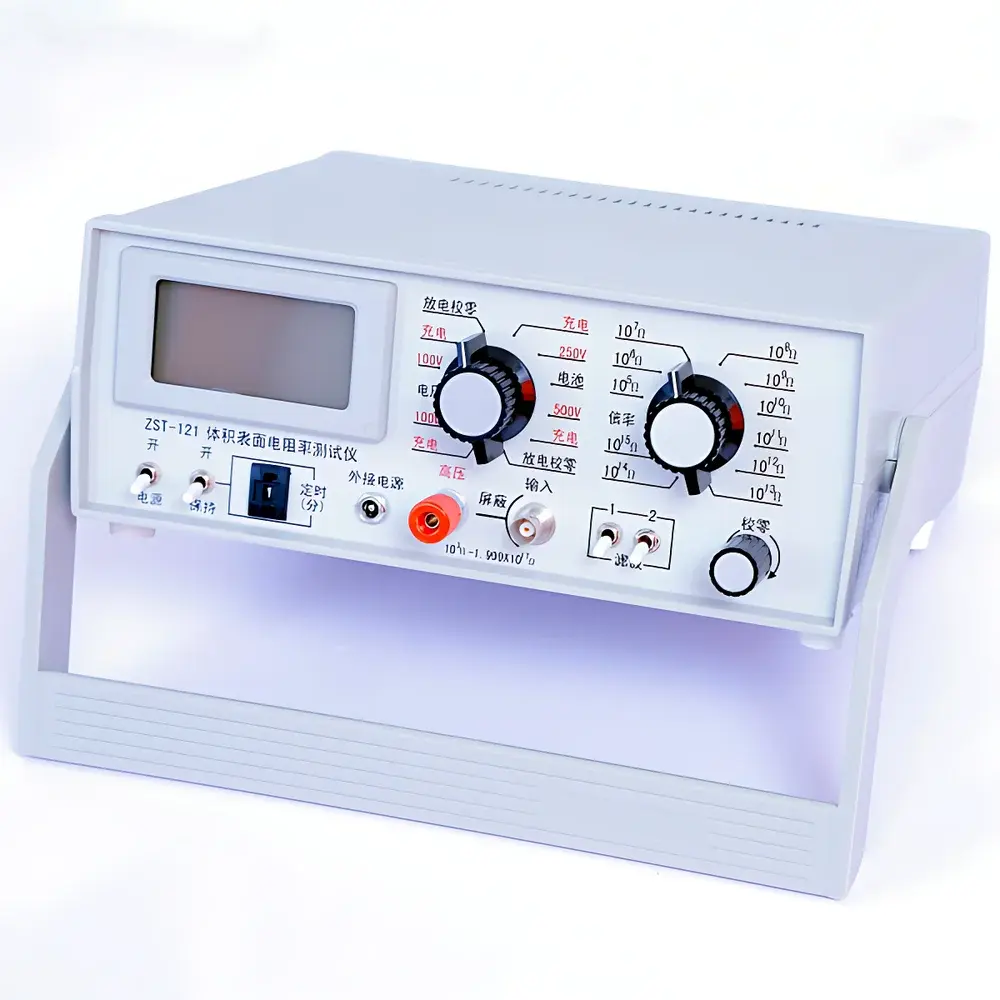
Aerospace ZST-121 Volume & Surface Resistivity Tester for Rubber and Plastics
| Brand | Aerospace |
|---|---|
| Origin | Beijing, China |
| Model | ZST-121 |
| Measurement Principle | Four-Terminal (Kelvin) Method with Guarded Electrode System |
| Voltage Range | 10 V – 1000 V (selectable in discrete steps) |
| Resistance Range | 10³ Ω·cm to 10¹⁸ Ω·cm |
| Current Resolution | 0.1 fA |
| Compliance Standards | ASTM D257, IEC 60093, GB/T 1410 |
| Operating Temperature | 0–40 °C |
| Relative Humidity | <80% RH (non-condensing) |
| Interface | RS485, USB |
| Safety Features | Overload protection, short-circuit protection, galvanic isolation, shielded enclosure (<5 µV residual noise) |
Overview
The Aerospace ZST-121 Volume & Surface Resistivity Tester is an engineered solution for quantitative electrical characterization of polymeric, elastomeric, and composite materials in R&D laboratories, quality control environments, and regulatory testing facilities. It operates on the guarded four-terminal (Kelvin) measurement principle—separating current-injection and voltage-sensing electrodes—to eliminate parasitic contact resistance and lead impedance errors. This architecture ensures traceable, high-reproducibility resistivity data across an ultra-broad dynamic range (10³ to 10¹⁸ Ω·cm), critical for evaluating both highly conductive additives (e.g., carbon-black-filled rubber) and ultra-insulating thermoplastics (e.g., fluorinated ethylene propylene). The instrument integrates a precision programmable voltage source (10–1000 V, step-adjustable), low-noise femtoampere current amplification, and real-time environmental monitoring (temperature/humidity) to support standardized test execution per ASTM D257 and IEC 60093.
Key Features
- Guarded three-electrode configuration (active electrode, guard ring, counter electrode) enabling simultaneous, independent acquisition of volume resistivity (ρv) and surface resistivity (ρs) in a single measurement cycle
- Four-terminal sensing architecture with automatic contact resistance compensation, delivering ±1% accuracy across full scale
- Programmable test voltage (10 V, 100 V, 250 V, 500 V, 1000 V) optimized for material class—low-voltage settings for semiconductive elastomers; high-voltage modes for insulating polymers
- Integrated environmental sensor suite (±0.5 °C temperature, ±3% RH) for real-time ambient correction and test condition logging
- Dual-mode operation: manual parameter entry for method development or preconfigured test sequences (up to 100 protocols) for high-throughput QC workflows
- Electromagnetic shielding enclosure with dual-layer copper-nickel laminate, achieving <5 µV internal noise floor and immunity to external EMI in industrial lab settings
Sample Compatibility & Compliance
The ZST-121 supports standardized electrode configurations per ASTM D257 and IEC 60093, including parallel-plate, concentric-ring, and guarded-electrode fixtures. Interchangeable electrode assemblies accommodate solid sheets (0.1–10 mm thickness), granular powders (with compression die), and viscous polymer melts (using heated guarded cell option). All mechanical interfaces comply with ISO/IEC 17025 documentation requirements for uncertainty budgeting. The system meets essential safety directives under IEC 61010-1 (Measurement Category II, Pollution Degree 2) and includes hardware-enforced interlocks for high-voltage operation. Test reports include metadata required for GLP/GMP audits: operator ID, timestamp, environmental conditions, calibration certificate traceability (NIST-traceable standard resistors), and raw current/voltage waveforms.
Software & Data Management
The instrument ships with PC-based analysis software compliant with FDA 21 CFR Part 11 (audit trail, electronic signature, role-based access control). Data export supports CSV, XML, and PDF formats with embedded metadata for LIMS integration. Software features include automated statistical reporting (mean, SD, CV%, outlier detection per ISO 5725), time-resolved current decay curve fitting (for polarization analysis), and humidity-temperature compensation algorithms. Remote operation via RS485 Modbus RTU or USB CDC allows integration into automated test benches. Firmware updates are digitally signed and version-locked to maintain regulatory compliance integrity.
Applications
- Electrical insulation validation of PCB laminates (FR-4, polyimide), conformal coatings, and potting compounds under thermal aging or humidity stress
- Quantitative assessment of conductive filler dispersion in carbon-black or graphene-loaded TPEs and EPDM compounds
- Quality assurance of lithium-ion battery separators—measuring ionic leakage resistance and detecting micro-defects affecting dendrite suppression
- EMI shielding effectiveness screening of aerospace-grade CFRP panels via surface resistivity mapping
- Regulatory certification testing for UL 746C (polymeric materials for electrical equipment) and IEC 60695-10-2 (fire hazard—resistivity after glow-wire exposure)
FAQ
What standards does the ZST-121 support for volume and surface resistivity testing?
ASTM D257, IEC 60093, GB/T 1410, and ISO 3915—all implemented via configurable electrode geometry, voltage ramp profiles, and dwell timing per clause requirements.
Can the instrument measure both volume and surface resistivity in one test sequence?
Yes. The guarded three-electrode system isolates bulk conduction paths from surface leakage currents, enabling concurrent ρv and ρs calculation without fixture reconfiguration.
Is environmental compensation mandatory for compliant reporting?
Per ASTM D257 Section 7.3, temperature and humidity must be recorded and reported. The ZST-121’s integrated sensors satisfy this requirement and enable optional correction using published material-specific coefficients.
How is calibration maintained for long-term traceability?
Calibration is performed using NIST-traceable standard resistors (10⁴–10¹² Ω); certificate includes uncertainty budget and as-found/as-left data. Annual recalibration is recommended, with built-in self-test diagnostics verifying HV source stability and current amplifier linearity.
Does the system support automated pass/fail evaluation against specification limits?
Yes. User-defined acceptance criteria (e.g., ρv > 1×10¹⁵ Ω·cm for Class H insulation) trigger visual alerts and auto-flag nonconforming results in exported reports.




