
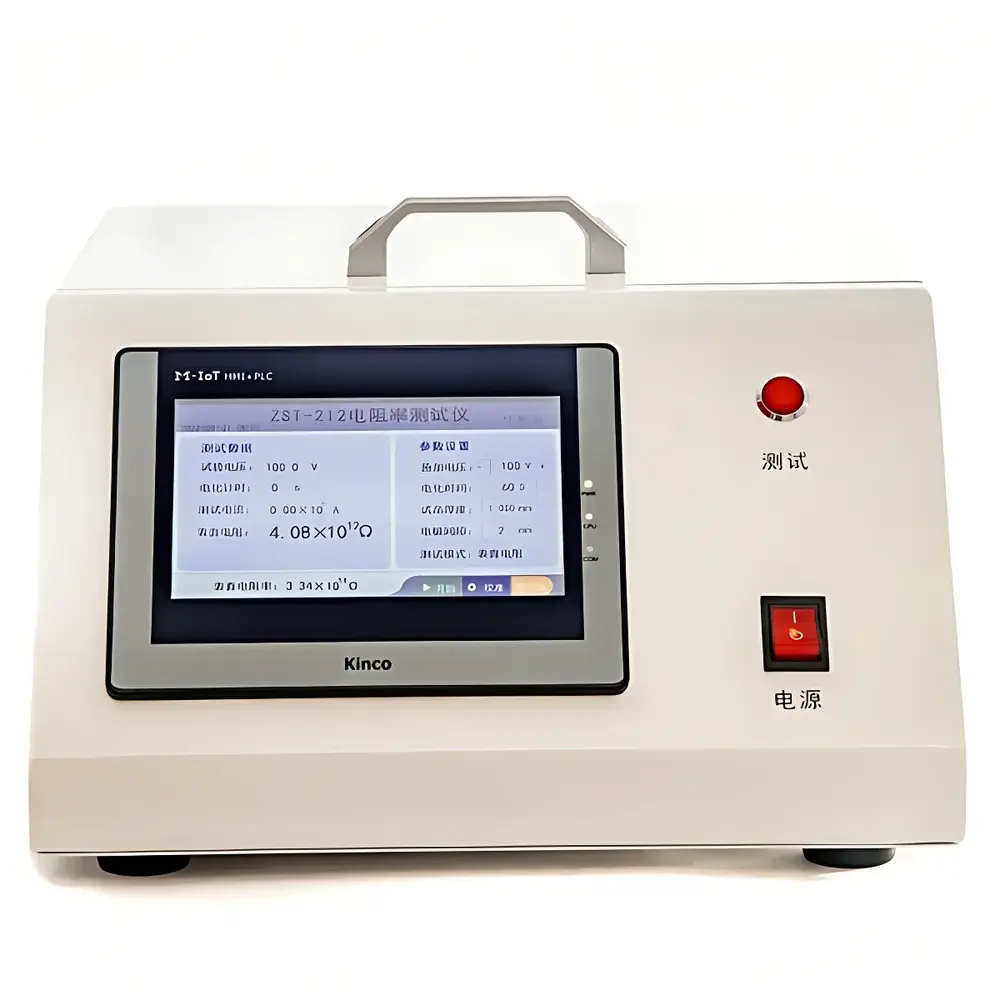
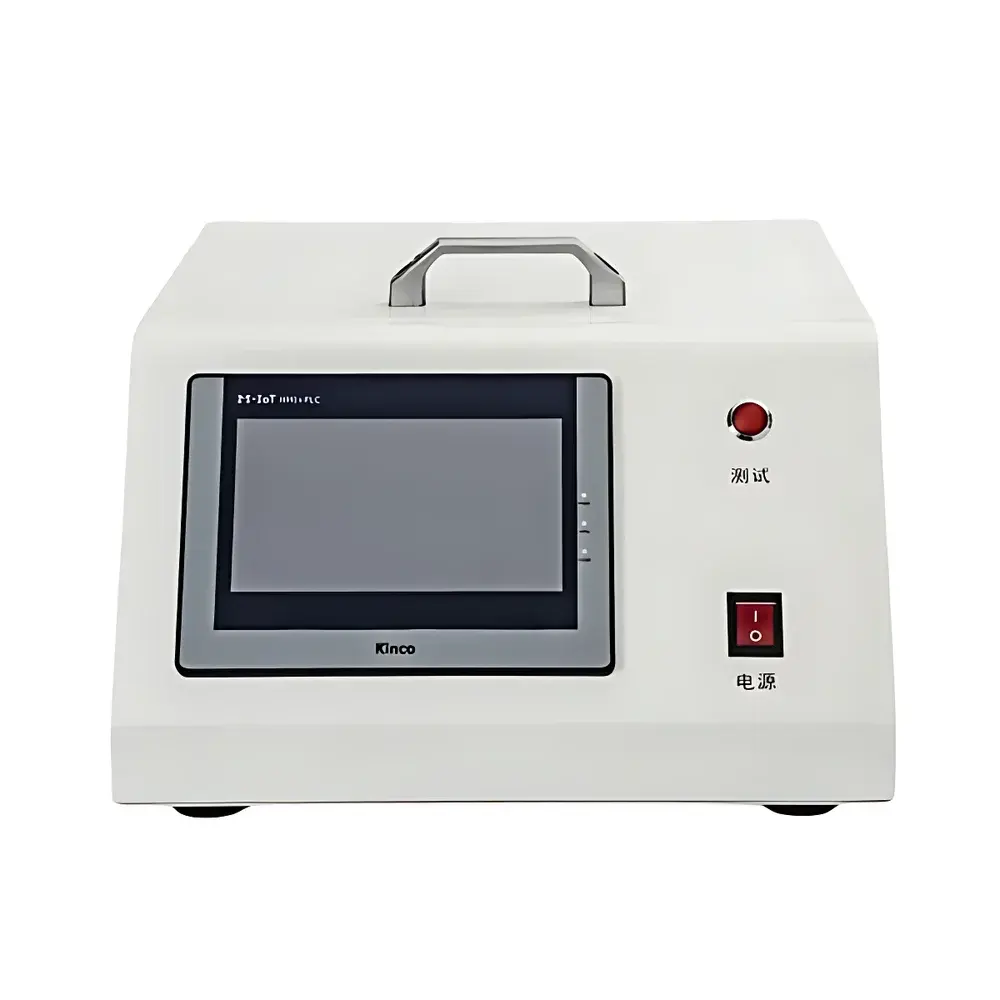
Aerospace ZST-212 Digital Volume & Surface Resistivity Tester
| Brand | Aerospace |
|---|---|
| Origin | Beijing, China |
| Model | ZST-212 |
| Resistance Range | 1×10⁴ Ω to 1×10¹⁸ Ω |
| Current Range | 2×10⁻⁴ A to 1×10⁻¹⁶ A |
| Test Voltages | 10 V / 50 V / 100 V / 250 V / 500 V / 1000 V (adjustable) |
| Accuracy | ±1% |
| Display | Digital LCD |
| Dimensions | 285 mm × 245 mm × 120 mm |
| Weight | 4.5 kg |
| Compliance | GB/T 1410–2006, ASTM D257–99, GB/T 10581–2006, GB/T 1692–2008, GB/T 2439–2001, GB/T 12703.4–2010, GB/T 10064–2006 |
Overview
The Aerospace ZST-212 Digital Volume & Surface Resistivity Tester is a precision electrometric instrument engineered for high-accuracy DC resistance and resistivity characterization of insulating and electrostatic-dissipative materials. It operates on the fundamental principle of simultaneous dual-parameter measurement: real-time acquisition of both applied test voltage (V) and resulting current (I) across the specimen, followed by digital computation of R = V/I via embedded high-stability analog-to-digital conversion and Intel-based signal processing architecture. Unlike conventional analog megohmmeters that rely on fixed-voltage, single-current sampling—yielding non-linear scale compression and poor resolution at high-resistance extremes—the ZST-212 eliminates scale distortion by digitizing the full dynamic range of voltage and current independently. This architecture ensures linear, traceable, and reproducible resistivity values across its full 14-decade resistance span (1×10⁴ Ω to 1×10¹⁸ Ω), making it suitable for R&D laboratories, quality control environments, and regulatory-compliant material certification workflows where metrological integrity is critical.
Key Features
- Simultaneous high-resolution voltage and current digitization with auto-ranging and real-time R = V/I calculation
- Adjustable DC test voltages: 10 V, 50 V, 100 V, 250 V, 500 V, and 1000 V—selectable per ASTM D257 and GB/T 1410 protocols
- Extended current measurement capability from 200 µA down to 100 fA (2×10⁻⁴ A to 1×10⁻¹⁶ A), enabling detection of ultra-low leakage currents in high-performance dielectrics
- Digital LCD display with direct readout of resistance (Ω), resistivity (Ω·cm or Ω/sq), and current (A)—no manual scaling or interpolation required
- Compact benchtop design (285 × 245 × 120 mm; 4.5 kg) with low power consumption (~5 W) and universal AC 220 V / 50 Hz input
- Integrated guarding and shielding circuitry to minimize surface leakage and electromagnetic interference during high-impedance measurements
- Thermally stabilized internal reference and low-drift operational amplifiers ensure long-term stability and repeatability under ambient lab conditions (0–40 °C, RH < 80%)
Sample Compatibility & Compliance
The ZST-212 supports volume resistivity (ρv) and surface resistivity (ρs) determination across heterogeneous material forms—including rigid solids (e.g., polymer sheets, ceramic substrates), flexible films, powders, viscous pastes, and homogeneous liquids—when paired with standardized electrode configurations (e.g., concentric ring, guarded two-terminal, or parallel plate fixtures per IEC 62631-3-1). Its measurement methodology and uncertainty budget are fully aligned with internationally recognized standards: GB/T 1410–2006 (equivalent to IEC 60093), ASTM D257–99 (Reapproved 2020), GB/T 10581–2006 (high-temperature resistivity), GB/T 1692–2008 (vulcanized rubber), GB/T 2439–2001 (conductive elastomers), GB/T 12703.4–2010 (textile electrostatics), and GB/T 10064–2006 (solid insulation resistance). The instrument’s ±1% basic accuracy—verified at multiple points across its range—is documented in factory calibration reports traceable to national metrology institutes.
Software & Data Management
While the ZST-212 operates as a stand-alone, self-contained instrument with no mandatory PC dependency, its analog output interface (0–2 V proportional to log10(R)) enables integration into automated test systems for batch logging and SPC analysis. All displayed parameters—including test voltage, measured current, computed resistance/resistivity, and elapsed test time—are retained in non-volatile memory for immediate recall. For laboratories operating under GLP or GMP frameworks, external data capture via RS-232 or USB-to-serial adapters (optional) supports audit-ready export to CSV or Excel formats. Though not natively 21 CFR Part 11 compliant, the system’s deterministic measurement sequence, immutable display history, and absence of user-modifiable firmware align with foundational data integrity principles required for ISO/IEC 17025-accredited testing facilities.
Applications
- Volume and surface resistivity verification of polymeric insulators (e.g., PTFE, PE, silicone rubber) per aerospace and automotive OEM specifications
- Quality assurance of ESD-safe packaging films, cleanroom garments, and conductive flooring systems (ANSI/ESD S20.20)
- Characterization of nanocomposite dielectrics and antistatic additives in R&D settings
- Resistivity profiling of battery separator membranes and solid electrolytes under controlled humidity
- Baseline measurement of dark current in photodetector diodes and optoelectronic sensor qualification
- High-temperature resistivity studies of thermosetting resins and ceramic coatings (with optional environmental chamber coupling)
- Teaching labs for fundamental semiconductor physics, electrostatics, and metrology principles
FAQ
What electrode configurations are required to measure volume vs. surface resistivity?
Volume resistivity requires a three-terminal guarded electrode system (e.g., ASTM D257 Figure A1) to exclude surface leakage paths; surface resistivity uses a concentric ring electrode (Figure A2) to confine current flow along the specimen surface.
Can the ZST-212 be used for conductivity measurements?
Yes—conductivity (σ) is the reciprocal of resistivity (σ = 1/ρ); the instrument’s direct resistivity readout allows immediate derivation of conductivity in S/cm or S/sq when geometric constants are entered manually.
Is calibration traceable to NIST or other national standards?
Factory calibration is performed using certified reference resistors traceable to CNAS-accredited metrology laboratories; NIST-traceable calibration certificates are available upon request with additional lead time.
Does the instrument support timed resistance measurements (e.g., for dielectric absorption or insulation resistance trends)?
No—ZST-212 performs single-point DC measurements only; for time-dependent polarization studies, a dedicated insulation resistance tester with ramp-and-hold functionality is recommended.
How is electrical guarding implemented in this design?
The internal guard driver actively maintains the guard electrode at the same potential as the measuring electrode, diverting surface leakage current away from the measurement path—critical for accurate >10¹⁵ Ω readings on hygroscopic or contaminated samples.



