
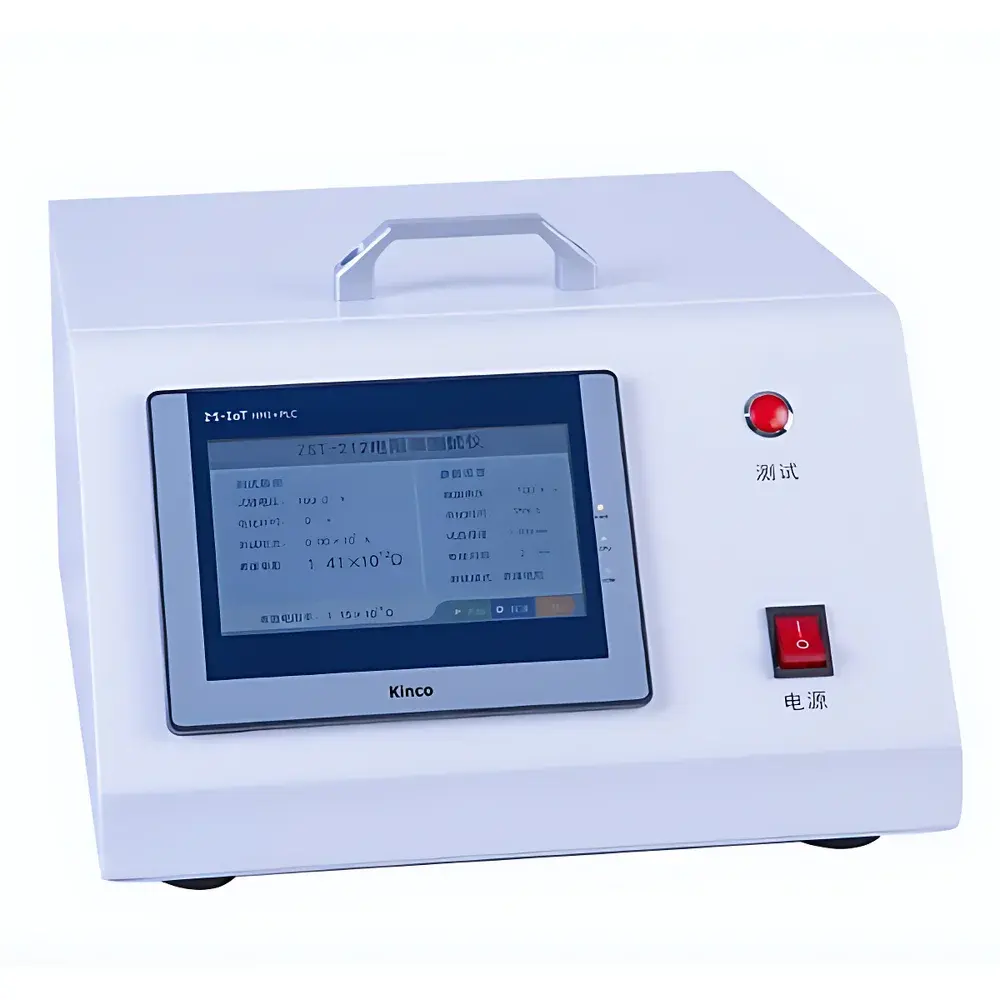
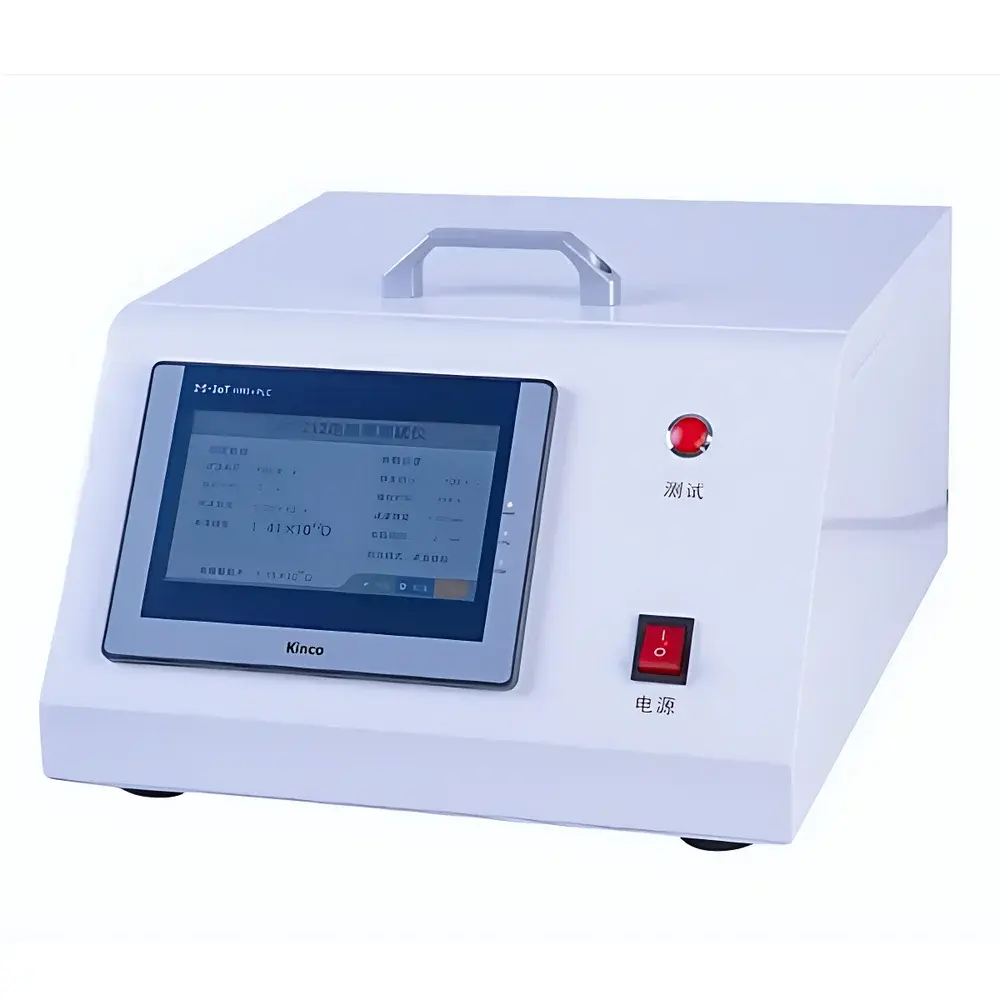
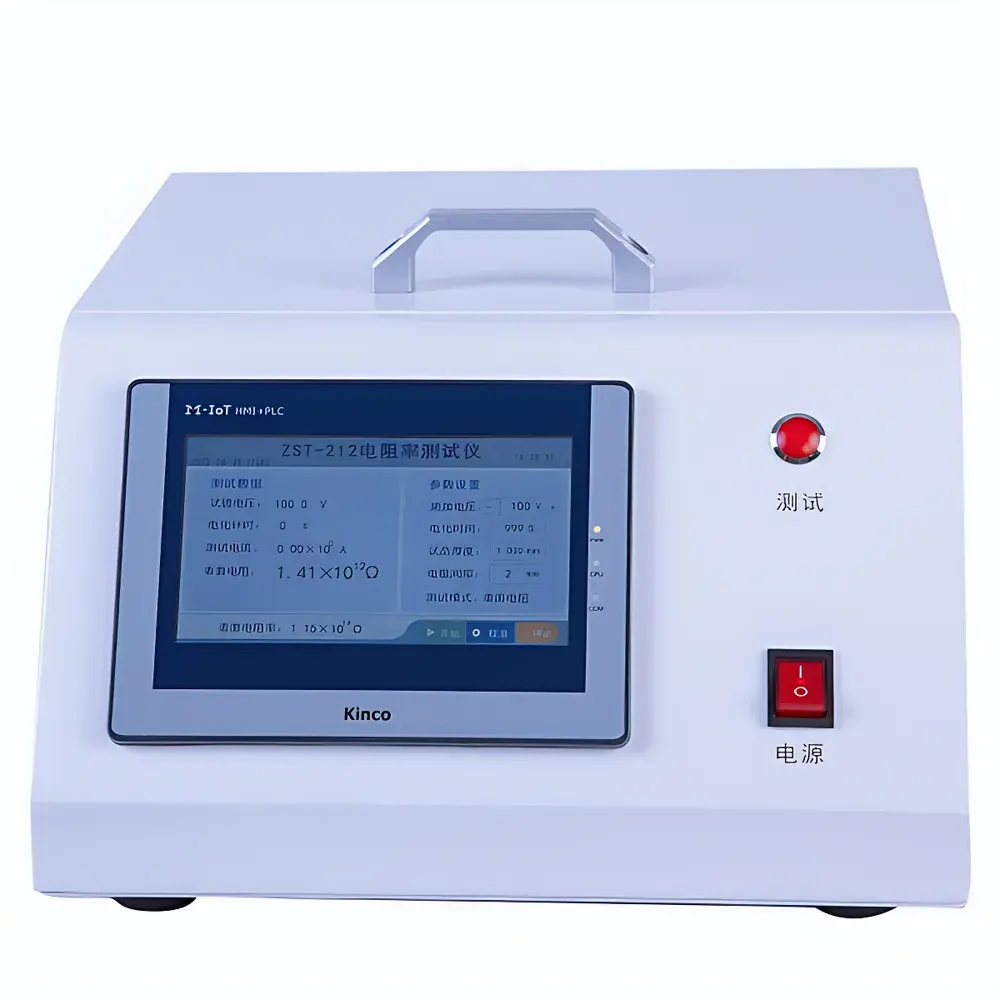
Aerospace ZST-212 Volume Resistivity Tester for Insulating Materials
| Brand | Aerospace |
|---|---|
| Model | ZST-212 |
| Origin | Beijing, China |
| Category | Physical Property Testing Instrument |
| Price Range | USD 2,800 – 7,000 |
| Measurement Principle | Guarded DC Voltage Method (Three-Electrode System) |
| Compliance | ASTM D257, IEC 60093, GB/T 1410 |
| Resistance Range | 10⁴ Ω·m to 10¹⁶ Ω·m |
| Test Voltage | 10 V – 1000 V DC (adjustable in 10 V steps) |
| Environmental Control | Supports optional temperature/humidity chamber integration (23 °C ± 1 °C, 50 % RH ± 3 % RH) |
Overview
The Aerospace ZST-212 Volume Resistivity Tester is a precision-engineered instrument designed for the quantitative determination of volume resistivity (ρv) in solid insulating materials—such as elastomers, ceramics, thermosetting resins, laminates, and polymer composites—according to internationally recognized standards including ASTM D257, IEC 60093, and GB/T 1410. Volume resistivity is defined as the electrical resistance between opposite faces of a unit cube of material, expressed in ohm-meters (Ω·m), and serves as a fundamental intrinsic property reflecting bulk conduction behavior under steady-state DC conditions. Unlike surface conduction pathways, volume resistivity isolates current flow through the material’s interior lattice, thereby enabling evaluation of inherent dielectric integrity independent of surface contamination or environmental adsorption effects. The ZST-212 employs a guarded three-electrode configuration—comprising a guarded high-voltage electrode, a guarded current-sensing electrode, and an outer guard ring—to actively suppress surface leakage currents and ensure measurement fidelity. This architecture eliminates parasitic parallel conduction paths, delivering high reproducibility (<±3% RSD at 10¹² Ω·m) across repeated measurements on homogeneous samples ≥1 mm thick.
Key Features
- Triple-electrode measurement system with active guarding circuitry compliant with ASTM D257 Section 6.2 and IEC 60093 Clause 4.3
- Programmable DC test voltage output (10 V to 1000 V in 10 V increments), digitally stabilized with <0.1% line regulation
- Auto-ranging electrometer capable of resolving resistivity values from 10⁴ Ω·m to 10¹⁶ Ω·m with 12-bit analog-to-digital conversion
- Integrated sample holder with precision-machined stainless-steel electrodes and PTFE insulation spacers (dielectric constant εr < 2.1)
- Front-panel digital display with real-time resistance, resistivity, and applied voltage readouts; optional RS-232/USB interface for external data logging
- Compliance-ready design: supports GLP audit trails when paired with validated PC software (optional)
Sample Compatibility & Compliance
The ZST-212 accommodates flat, rigid, or semi-rigid specimens with dimensions ≥50 mm × 50 mm and thickness between 1.0 mm and 10 mm. Samples must exhibit uniform density and absence of voids or delaminations to ensure valid volumetric current path definition. For non-planar or irregular geometries, custom electrode fixtures may be commissioned per ISO/IEC 17025 calibration protocols. Regulatory alignment includes full traceability to NIST-traceable resistance standards, and the system meets essential requirements for use in quality control laboratories operating under ISO 9001, IATF 16949, and aerospace-grade material qualification workflows (e.g., SAE AMS3675, MIL-DTL-87177). Surface resistivity measurements are supported via two-electrode mode (per ASTM D257 Annex A2), though this function requires strict environmental conditioning—typically 23 °C ± 1 °C and 50% RH ± 3% RH per ISO 291—and surface cleaning per ASTM D2651 prior to testing.
Software & Data Management
When operated with the optional ZST-Control Suite v3.1 (Windows 10/11 compatible), the instrument enables automated test sequencing, multi-point resistivity mapping, statistical process control (SPC) charting, and export to CSV, PDF, or XML formats. All measurement sessions include timestamped metadata: operator ID, ambient T/RH, electrode configuration, applied voltage, dwell time, and raw current/resistance values. Audit trail functionality complies with FDA 21 CFR Part 11 requirements when configured with electronic signatures and role-based access controls. Raw data files retain unprocessed electrometer outputs for retrospective reanalysis, supporting root-cause investigations during nonconformance reviews or supplier qualification audits.
Applications
- Qualification of high-voltage cable insulation (XLPE, EPR, silicone rubber) per IEEE 400.2 and CIGRE TB 724
- Process validation of ceramic substrates used in power electronics packaging (e.g., Al₂O₃, AlN, Si₃N₄)
- QC release testing of aerospace composite layups (carbon-fiber-reinforced polymers with epoxy or BMI matrices)
- Development of antistatic additives in polymeric films and molded enclosures
- Accelerated aging studies correlating volume resistivity decay with thermal cycling or gamma irradiation exposure
FAQ
What distinguishes volume resistivity from surface resistivity, and why is three-electrode geometry necessary?
Volume resistivity quantifies bulk conduction through the material’s interior and requires suppression of surface leakage paths—hence the guard electrode’s role in diverting stray currents away from the measurement circuit. Surface resistivity, measured using two parallel electrodes, evaluates conduction along the air–material interface and is highly sensitive to humidity and contamination.
Can the ZST-212 be used for thin films (<1 mm) or conductive composites?
No. Specimens must be ≥1 mm thick to satisfy the geometric assumptions of ASTM D257’s volume resistivity calculation. Conductive composites with ρv < 10⁴ Ω·m fall outside the instrument’s validated dynamic range and require four-point probe or eddy-current methods.
Is calibration certification included with shipment?
Yes—a factory-issued calibration certificate traceable to NIST Standard Reference Material (SRM) 1900 is provided. Optional annual recalibration services are available with ISO/IEC 17025 accreditation.
Does the system support compliance with GMP/GLP documentation requirements?
When integrated with ZST-Control Suite and configured with user authentication, electronic signatures, and audit trail logging, it satisfies core elements of GLP (OECD Principles) and GMP (ICH Q7) for regulated environments.



