
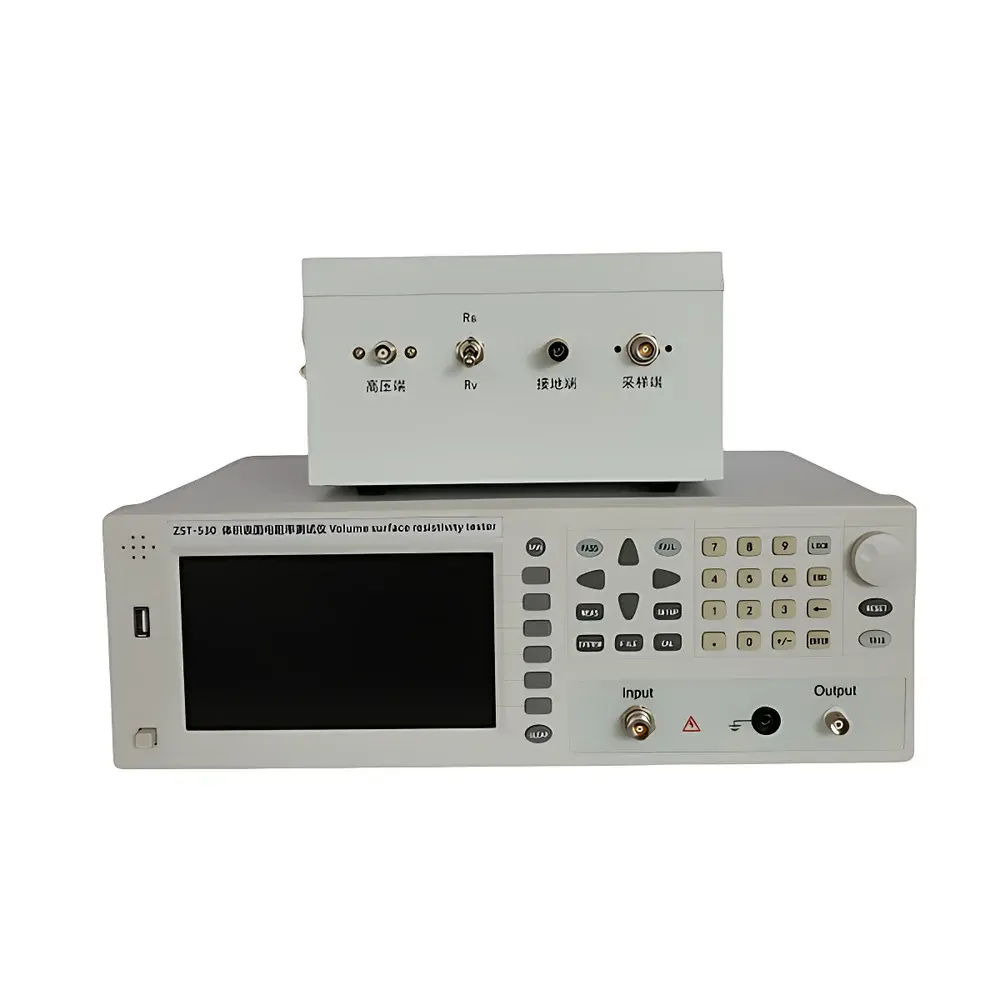
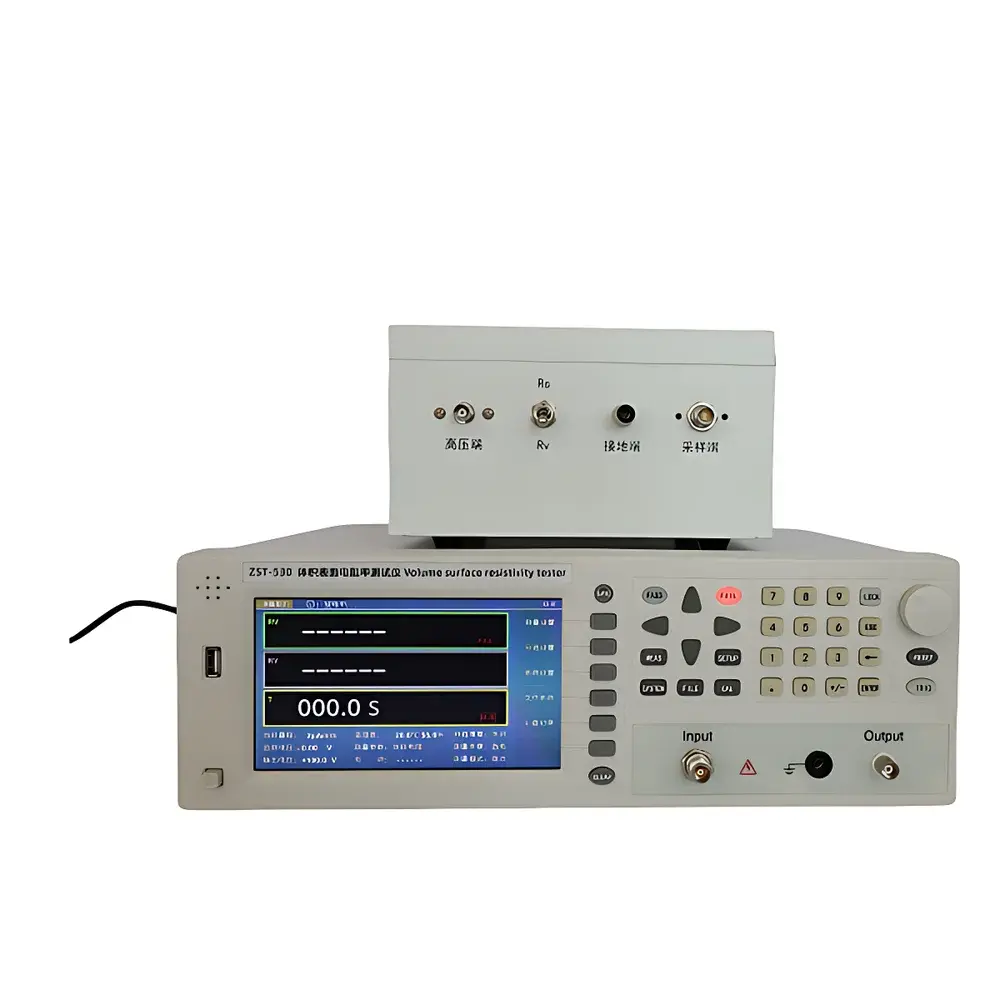
Aerospace ZST-530 Volume & Surface Resistivity Tester for Rubber and Plastics
| Brand | Aerospace |
|---|---|
| Origin | Beijing, China |
| Model | ZST-530 |
| Volume Resistivity Range | 1.0×10⁴ to 1.0×10¹⁸ Ω·cm |
| Surface Resistivity Range | 1.0×10⁴ to 1.0×10¹⁷ Ω |
| Resolution (Volume) | 1.0×10³ Ω·cm |
| Resolution (Surface) | 1.0×10³ Ω |
| Accuracy | ±10% at 100 V |
| Test Voltages | 10 V, 50 V, 100 V, 250 V, 500 V, 1000 V |
| Sample Thickness (Volume) | 0.01–30 mm |
| Sample Dimension (Surface) | ≥50 mm diameter or side length |
| Compliance | GB/T 1410-2006, ASTM D257-14 |
Overview
The Aerospace ZST-530 Volume & Surface Resistivity Tester is a precision DC resistance measurement system engineered for quantitative characterization of electrical insulation performance in polymeric materials—specifically rubber, thermoplastics, elastomers, and filled composites. It operates on the fundamental principles of Ohm’s Law and standardized electrode geometry, enabling calculation of volume resistivity (ρv) and surface resistivity (ρs) from measured current under controlled DC bias. Volume resistivity quantifies bulk charge transport through material thickness, while surface resistivity reflects lateral conduction along the interface—both critical parameters for ESD-safe compound development, antistatic additive validation, and functional polymer qualification in automotive, aerospace, and medical device manufacturing. The instrument employs guarded two-terminal measurement architecture with electrometer-grade input impedance (>1016 Ω), minimizing leakage errors and ensuring stability during ultra-high-resistance measurements up to 1018 Ω·cm.
Key Features
- Multi-range DC voltage sourcing (10 V to 1000 V) with programmable step selection to match material conductivity class and avoid dielectric breakdown
- Dual-mode electrode configuration supporting both volume (parallel-plate) and surface (two-probe concentric ring or linear electrode) test geometries per GB/T 1410-2006 and ASTM D257-14
- High-input-impedance electrometer circuitry with auto-ranging current measurement (fA to µA), optimized for low-current integrity in high-resistivity regimes
- Integrated digital display with real-time resistance, resistivity, and current readouts; manual or timed measurement modes
- Modular electrode set including stainless steel parallel plates (25 mm & 50 mm dia), guarded concentric ring electrodes (ASTM D257 compliant), and adjustable sample holders accommodating thicknesses from 0.01 mm to 30 mm
- Factory-calibrated using NIST-traceable standard resistors; includes calibration certificate and verification protocol documentation
Sample Compatibility & Compliance
The ZST-530 is validated for solid insulating specimens per ISO 60093, IEC 62631-3-1, and national standards GB/T 1410-2006 and ASTM D257-14. It supports rigid and semi-flexible sheets, films, molded plaques, and compression-molded discs with minimum dimensions of 50 mm × 50 mm (surface) or 10 mm × 10 mm (volume). Electrode contact uniformity is ensured via spring-loaded pressure mechanisms and PTFE-insulated fixtures to suppress edge leakage. All measurement procedures adhere to environmental conditioning requirements specified in ASTM D618 (23 °C / 50% RH, 48 h minimum equilibration). Data output conforms to GLP documentation standards, with manual entry of sample ID, test voltage, dwell time, and ambient conditions—enabling full traceability for internal QA audits or regulatory submissions.
Software & Data Management
While the ZST-530 operates as a standalone benchtop instrument with embedded firmware, it supports optional RS-232 or USB-to-serial interface for external data logging into laboratory information management systems (LIMS) or Excel-based QC databases. Measurement records include timestamp, applied voltage, measured current, calculated Rv/Rs, derived ρv/ρs, and operator ID fields. Raw current values are retained for post-hoc reprocessing if geometric corrections (e.g., electrode area, spacing, thickness) require revision. The system does not implement FDA 21 CFR Part 11 electronic signature functionality; however, its manual entry workflow—including signed paper logbooks and version-controlled SOPs—is fully compatible with GMP-aligned quality systems when deployed within documented analytical procedures.
Applications
- Formulation screening of carbon-black-, metal-flake-, or CNT-filled conductive rubbers and thermoplastics
- Quality control of ESD-safe packaging films and cleanroom flooring materials
- Validation of antistatic coatings on injection-molded housings for electronics enclosures
- Research on humidity-dependent resistivity drift in hygroscopic polymers (e.g., nylon, PET)
- Comparative aging studies tracking resistivity degradation under thermal, UV, or ozone exposure
- Compliance testing for UL 94, IEC 61340-2-3 (electrostatics), and MIL-STD-1686 (ESD control programs)
FAQ
What is the difference between volume and surface resistivity?
Volume resistivity characterizes bulk conduction through material thickness and is expressed in Ω·cm; surface resistivity measures lateral conduction across the top layer and is reported in Ω (often normalized to Ω/sq). Both are essential for distinguishing bulk doping effects from surface contamination or migration.
Can the ZST-530 measure resistivity of liquids or powders?
No—the instrument is designed exclusively for solid, self-supporting specimens. Liquid or powder resistivity requires alternative methods such as conductivity cells or compressed pellet configurations with specialized fixtures.
Is temperature control integrated into the ZST-530?
The base unit does not include environmental chamber integration; however, it is compatible with external temperature-controlled stages (e.g., Linkam THMS600) when used with appropriate electrode feedthroughs and shielding.
How often should calibration be performed?
Annual calibration against certified reference resistors is recommended; additional verification before critical batches or after mechanical shock is advised per ISO/IEC 17025 guidelines.
Does the instrument support automatic calculation of resistivity from raw resistance readings?
Yes—once electrode geometry (area, spacing, thickness) is entered manually, the ZST-530 applies standard formulas per GB/T 1410-2006 to compute and display ρv and ρs directly.






