
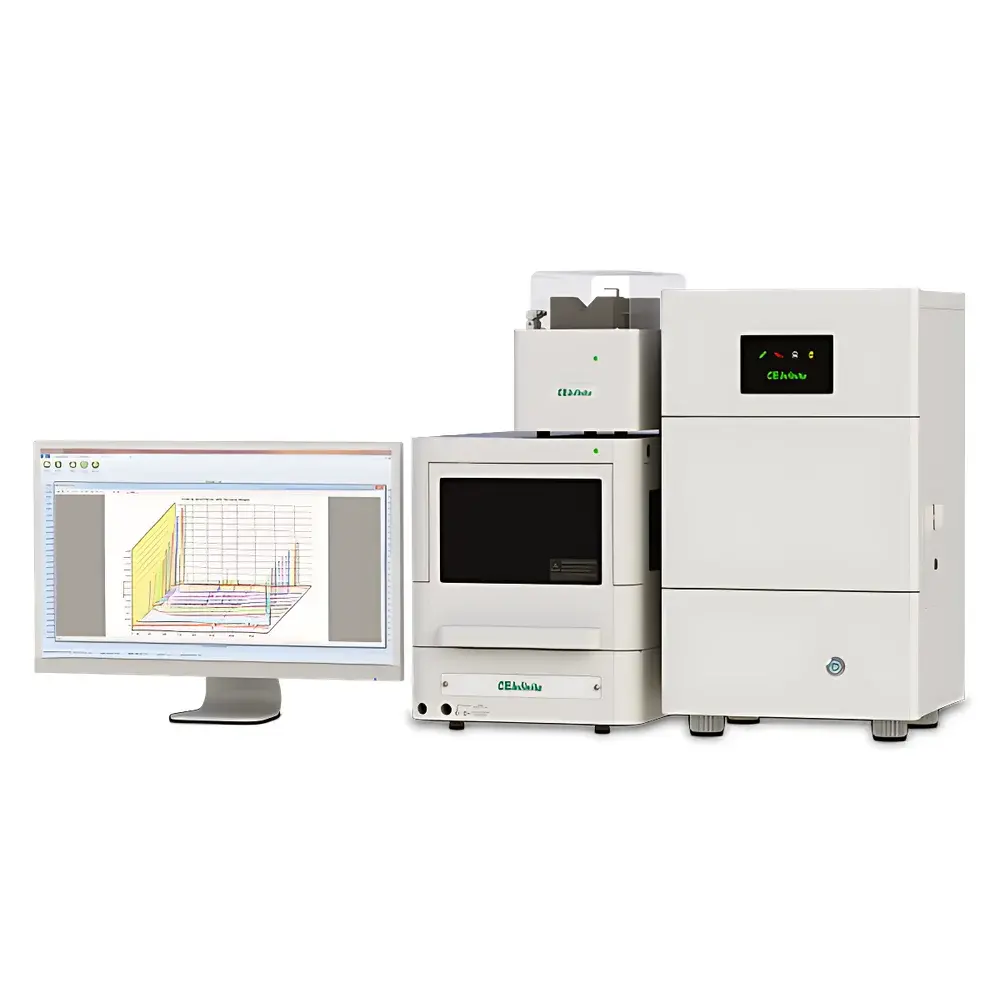
AES CEInfinite Full-Column Imaging Capillary Isoelectric Focusing System
| Brand | AES |
|---|---|
| Origin | Canada |
| Manufacturer Type | Authorized Distributor |
| Origin Category | Imported |
| Model | CEInfinite |
| Voltage Input | 100/240 VAC, 50–60 Hz |
| Cooling Method | Liquid-based Thermostatic Control |
| Sample Temperature Range | 4–10 °C |
| Detector | Scientific CMOS (sCMOS) Imaging Sensor |
| Separation Mode | Voltage Gradient iCIEF |
| Sample Introduction | Automated Capillary Injection |
Overview
The AES CEInfinite Full-Column Imaging Capillary Isoelectric Focusing (iCIEF) System is an engineered platform for high-resolution, quantitative charge heterogeneity analysis of therapeutic proteins. Based on the fundamental principle of isoelectric focusing—where proteins migrate in a pH gradient until reaching their isoelectric point (pI) and cease electrophoretic mobility—the CEInfinite system integrates full-column sCMOS imaging to capture spatially resolved, real-time electropherograms without zone distortion or mobilization artifacts. Unlike traditional capillary electrophoresis systems requiring post-focusing mobilization, the CEInfinite operates in true “no-mobilization” mode, preserving native conformational integrity and enabling direct downstream characterization—including mass spectrometry coupling, activity assays, and structural analysis. Designed specifically for biopharmaceutical development and quality control, it meets the analytical rigor required for regulatory submissions under ICH Q5E, USP , and FDA/EMA guidelines on charge variant assessment.
Key Features
- Patented full-column sCMOS imaging detection with sub-pixel resolution, enabling simultaneous visualization of all focused zones across the entire capillary length (up to 10 cm)
- Integrated liquid-based thermostatic control maintaining sample temperature at 4–10 °C throughout separation—critical for preventing protein denaturation and ensuring reproducible pI migration
- Automated capillary injection and voltage-gradient programming, eliminating manual method optimization for routine iCIEF runs
- Proprietary cartridge-based capillaries pre-coated with hydrophilic or hydrophobic surface chemistries—eliminating polymer additives (e.g., methylcellulose) and urea, reducing background interference and enhancing MS compatibility
- On-line iCIEF-MS coupling capability via standard ESI interfaces; compatible with Thermo Fisher, Waters, Bruker, and Agilent mass spectrometers without source modification
- Automated fraction collection with >90% purity recovery of individual charge variants—enabling downstream peptide mapping, functional assays, and toxicity profiling from single-run separations
Sample Compatibility & Compliance
The CEInfinite system supports a broad range of therapeutic protein formats, including monoclonal antibodies (mAbs), antibody-drug conjugates (ADCs), fusion proteins, bispecifics, and viral vector-associated proteins. Its validated workflow aligns with ICH Q5E requirements for charge variant characterization and supports GLP/GMP-compliant environments through audit-trail-enabled software (21 CFR Part 11 compliant). All consumables—including HR, SH, and UH series ampholytes—are manufactured under ISO 9001-certified processes and supplied with CoA documentation. AES provides traceable pI markers certified for UV (280 nm) and fluorescence detection, supporting method transfer across labs and regulatory inspections (FDA, EMA, NMPA).
Software & Data Management
Control and analysis are performed using AES iCIEF Suite v4.x—a validated, multi-user desktop application supporting method storage, sequence scheduling, peak integration (using second-derivative algorithms), pI calibration, and automated reporting. Raw image data are stored in vendor-neutral TIFF format with embedded metadata (temperature, voltage, time, capillary ID). The software includes built-in tools for overlay comparison, batch processing, and statistical evaluation of charge variant profiles across stability studies or process changes. Export options include CSV, PDF, and XML for integration into LIMS and electronic lab notebooks (ELN). Audit trails record all user actions, parameter changes, and report generations—fully compliant with 21 CFR Part 11 and Annex 11 requirements.
Applications
- Charge heterogeneity profiling of mAbs during cell line selection, upstream process development, and purification optimization
- Characterization of ADC drug-to-antibody ratio (DAR) distribution and conjugation site heterogeneity
- Assessment of deamidation, oxidation, C-terminal lysine clipping, and other post-translational modifications (PTMs)
- Stability-indicating assay for forced degradation studies (thermal, acidic, basic stress)
- Multi-Attribute Method (MAM) implementation—simultaneous monitoring of charge variants, purity, and impurities within a single analytical framework
- Preparative isolation of charge variants for structure-function correlation studies (e.g., SPR binding affinity, cell-based potency assays)
FAQ
Does the CEInfinite require mobilization steps to detect focused zones?
No. It uses full-column imaging to detect stationary focused bands in situ—eliminating mobilization-related band broadening and enabling direct fraction collection.
Can I use my existing ESI-MS system with the CEInfinite?
Yes. The system interfaces directly with commercial ESI sources via standard capillary connections; no hardware modification or specialized ionization optics are required.
What ampholyte systems are supported for complex proteins like ADCs?
AES supplies SH and UH series ampholytes—engineered for extended pH range coverage (pH 3–10), low UV absorbance, and enhanced resolution of highly heterogeneous samples such as ADCs and fusion proteins.
Is the CEInfinite suitable for GMP release testing?
Yes. When operated with validated methods, qualified instruments, and controlled consumables, it supports regulatory filings and routine QC release testing per ICH Q5E and USP .
How is data integrity ensured during long-term deployment?
The system enforces role-based access control, electronic signatures, and immutable audit trails—meeting 21 CFR Part 11 and EU Annex 11 requirements for data reliability and traceability.







