
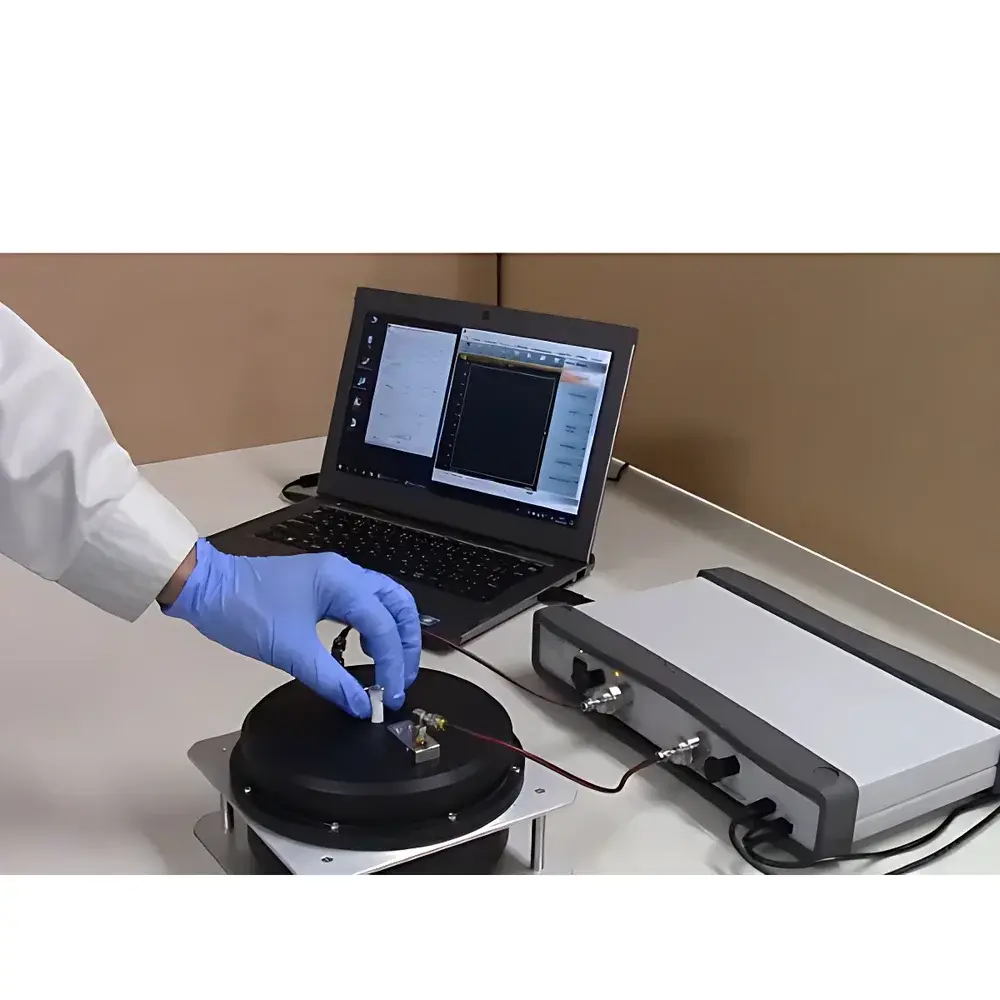
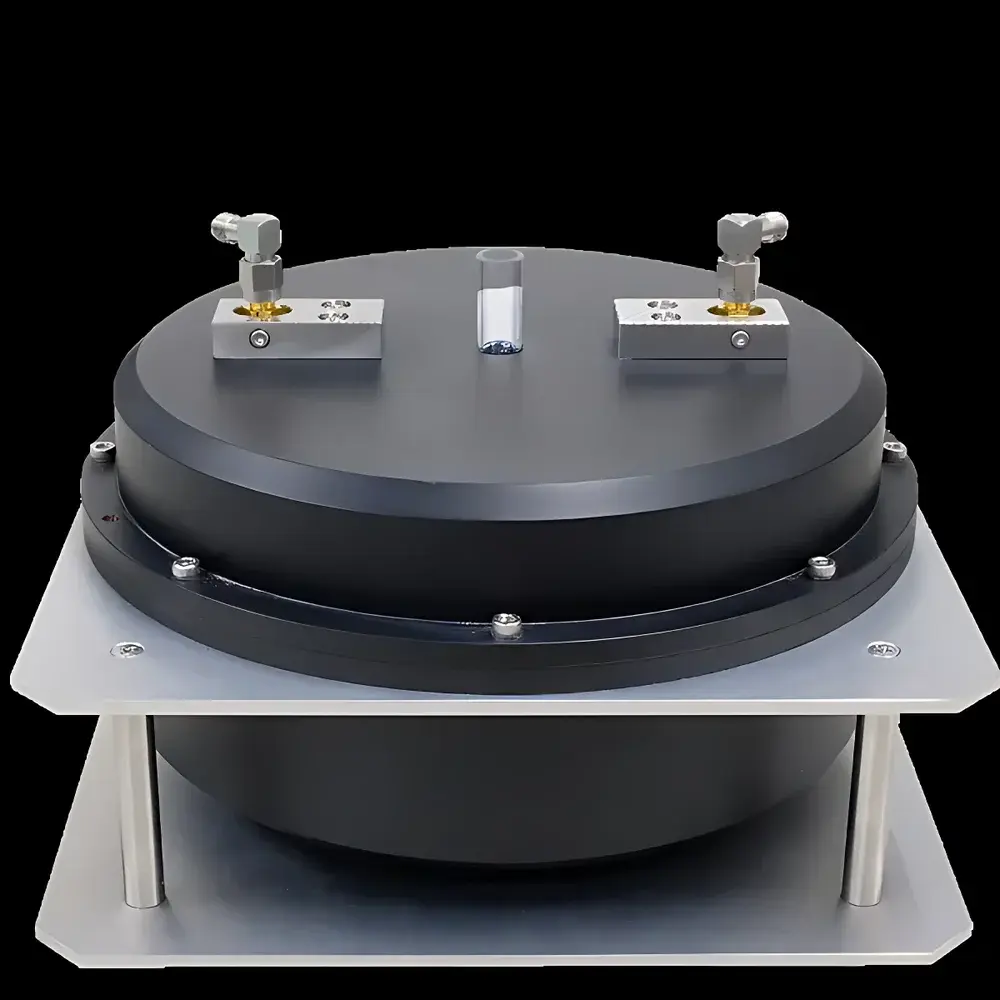
AET Powder Resonant Cavity Dielectric Constant Analyzer
| Brand | AET |
|---|---|
| Origin | Japan |
| Model | Powder Resonant Cavity System |
| Frequency Range | 1–10 GHz |
| Permittivity Range | ε′ = 1–6 |
| Permittivity Accuracy | ±1% |
| Loss Tangent Range | tan δ = 0.001–0.01 |
| Loss Tangent Accuracy | ±5% |
| Minimum Sample Diameter | ≥5.5 mm |
| Sample Form | Powders (quartz tube loaded) and Low-Polarity Liquids |
Overview
The AET Powder Resonant Cavity Dielectric Constant Analyzer is a precision microwave characterization instrument engineered for non-destructive, high-frequency dielectric property measurement of solid powders and low-loss liquid samples. It operates on the fundamental principle of cavity perturbation theory within a high-Q resonant waveguide or cylindrical TE011-mode cavity. When a dielectric sample is introduced into the electric field maximum region of the cavity, shifts in the resonant frequency (Δf) and quality factor (ΔQ) are quantitatively correlated to the real part of complex permittivity (ε′) and loss tangent (tan δ), respectively. Unlike broadband transmission-line or open-ended coaxial probe methods, this resonant cavity approach delivers superior sensitivity and repeatability—particularly critical for low-loss, low-permittivity materials such as fluoropolymers, silica aerogels, and hydrocarbon-based solvents—where conventional techniques suffer from signal-to-noise limitations above 1 GHz.
Key Features
- High-sensitivity resonant cavity architecture optimized for 1–10 GHz operation, enabling trace-level detection of permittivity and dielectric loss in sub-milligram powder volumes.
- Dedicated quartz sample tube assembly with integrated vibratory densification module ensures reproducible packing density and eliminates air-gap artifacts during powder loading.
- Automated density correction algorithm uses true material density input to decouple bulk packing effects from intrinsic dielectric response—yielding ε′ and tan δ values representative of the powder phase alone.
- Calibration traceable to NIST-traceable reference standards (e.g., fused quartz, polyethylene, methanol) across the full operating band.
- Robust mechanical design with temperature-stabilized cavity housing minimizes thermal drift during extended measurement sequences.
- Modular configuration supports interchangeable cavity inserts for liquid cell adaptation—enabling dual-mode operation without hardware reconfiguration.
Sample Compatibility & Compliance
The system accommodates free-flowing, cohesive, and nanostructured powders—including ceramics (Al2O3, BaTiO3), semiconductor precursors (SiC, GaN), polymer fillers (PTFE, PEI), and battery electrode materials (LiCoO2, graphite)—provided minimum particle dimension exceeds 5.5 mm when packed in the standardized quartz tube (ID: 4.0 mm, length: 25 mm). For liquids, compatibility extends to non-polar and weakly polar solvents (e.g., cyclohexane, toluene, chloroform) with ε′ < 3.0 and tan δ < 0.005. All measurement protocols comply with ASTM D2520 (Standard Test Method for Dielectric Constant of Solid Electrical Insulating Materials at Microwave Frequencies) and align with IEC 60250 Annex B guidelines for cavity-based permittivity determination. Data acquisition workflows support audit-ready documentation per FDA 21 CFR Part 11 requirements when paired with optional compliant software licensing.
Software & Data Management
The embedded control interface provides real-time cavity tuning visualization, automatic resonance tracking, and one-click calculation of ε′, ε″, and tan δ using cavity perturbation equations derived from electromagnetic field theory. Raw S-parameter data (S21) is exportable in CSV and Touchstone (.s2p) formats for third-party modeling (e.g., CST Studio Suite, HFSS). The optional AET-Dielectrics Suite adds GLP-compliant features: electronic signatures, user-access tiering, change history logging, and automated report generation conforming to ISO/IEC 17025 documentation standards. All calibration coefficients and material density inputs are stored with timestamped metadata to ensure full measurement traceability.
Applications
- Development and QC of low-loss substrate materials for 5G/mmWave PCB laminates (e.g., PTFE-glass composites, ceramic-filled hydrocarbons).
- Characterization of dielectric resonator antennas (DRAs) and filter dielectrics requiring precise ε′ homogeneity and minimal tan δ dispersion.
- Structure–property correlation studies in functional ceramics, where grain boundary polarization and porosity directly influence microwave loss mechanisms.
- Quality control of nanoparticle dispersions and colloidal suspensions used in printed electronics and thin-film dielectrics.
- Validation of solvent purity in semiconductor cleaning processes—detecting trace polar contaminants via anomalous tan δ elevation.
- Research into metamaterial unit cells and tunable dielectrics where permittivity modulation under external stimuli must be quantified at operational frequencies.
FAQ
What sample preparation is required for powder measurements?
Powders must be loaded into the supplied quartz tube (4.0 mm ID) and compacted using the integrated vibratory module until a stable height is achieved; no binder or pressing is needed.
Can the system measure anisotropic or layered samples?
No—the cavity geometry assumes isotropic, homogeneous dielectric loading; anisotropy requires custom cavity design or complementary vector network analyzer (VNA) mapping.
Is temperature-controlled measurement supported?
The base system operates at ambient temperature; optional cavity temperature chambers (−40 °C to +150 °C) are available with PID-controlled thermal management and vacuum sealing.
How is calibration validated across the 1–10 GHz range?
Three-point calibration uses certified reference materials spanning ε′ = 2.1 (polyethylene), ε′ = 3.8 (fused quartz), and ε′ = 5.7 (alumina), with interpolation verified against cavity Q-factor stability metrics.
Does the system meet regulatory requirements for pharmaceutical excipient characterization?
Yes—when configured with Part 11-compliant software and operated under documented SOPs, it satisfies USP and ICH Q5C recommendations for dielectric assessment of lyophilized formulations and dry powder inhalers.



