
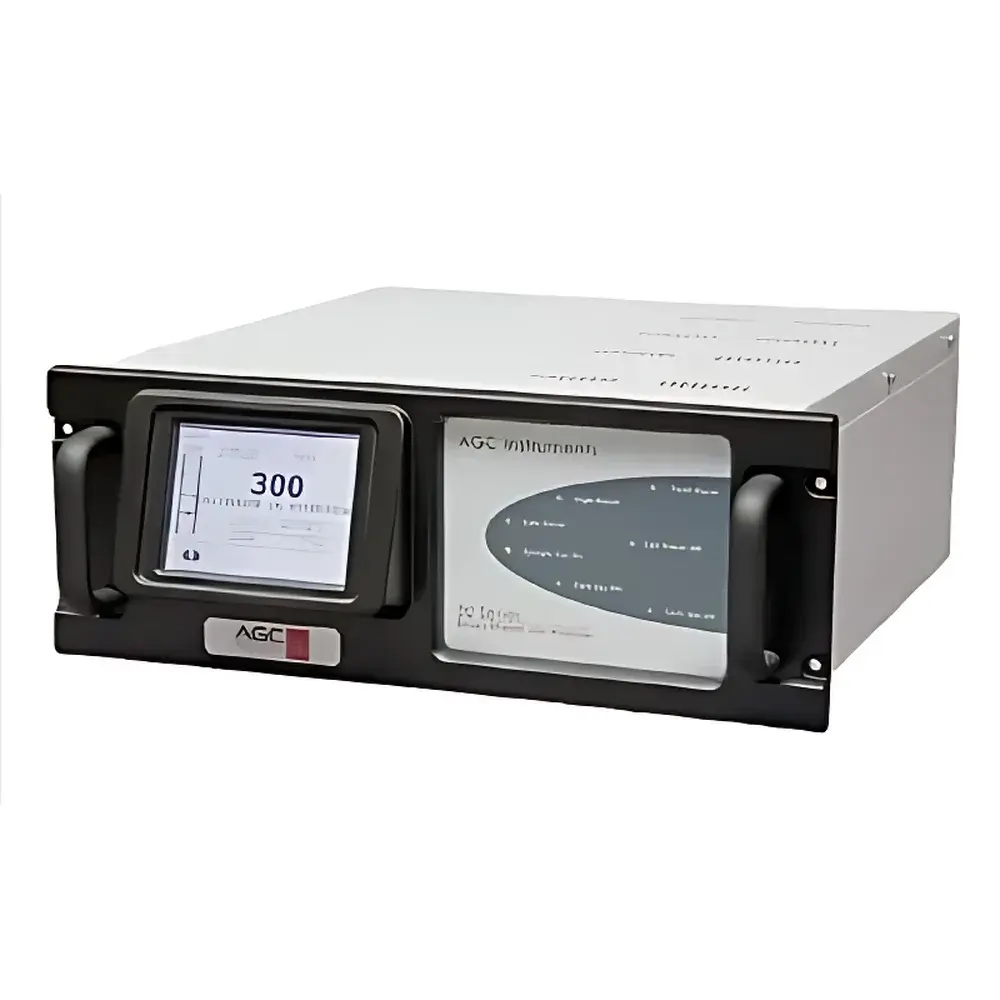
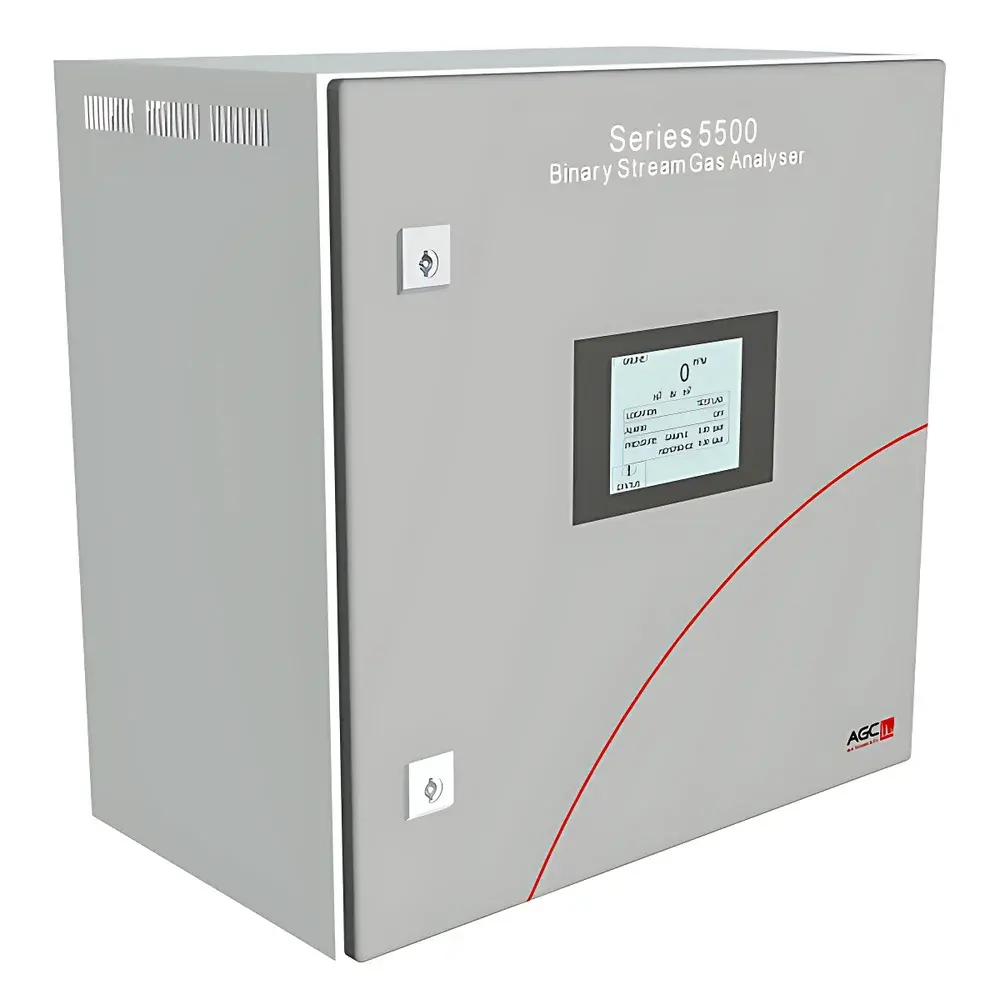
AGC AGC50 Binary Gas Analyzer
| Brand | AGC |
|---|---|
| Origin | Ireland |
| Model | AGC50 |
| Detection Principle | Thermal Conductivity Detection (TCD) |
| Configuration | Online Fixed-Installation Analyzer |
| Response Time (t90) | <30 s |
| Repeatability | ±0.5% FS for H₂, He, CO₂, and other binary gas mixtures or high-purity gases |
| Display | 5.7″ QVGA LCD with real-time status, alarm, diagnostic, and measurement readouts |
| Flow Measurement | Integrated high-accuracy mass flow sensor (displayed in real time) |
| Detector Design | Temperature-controlled TCD with adjustable setpoint, housed in thermally stabilized metal enclosure |
| Zero Reference | Electromechanically actuated solenoid valve for periodic zero-gas introduction |
| Drift Stability | <1% full-scale drift over 24 h at constant ambient and sample conditions |
| Sample Compatibility | Binary gas mixtures and ultra-high-purity gases (e.g., N₂/H₂, Ar/He, O₂/CO₂, air/N₂) |
Overview
The AGC AGC50 Binary Gas Analyzer is an online, fixed-installation thermal conductivity detector (TCD)-based analyzer engineered for continuous, high-stability compositional monitoring of binary gas mixtures and high-purity carrier gases. Operating on the fundamental principle of differential thermal conductivity, the instrument measures relative heat transfer from a heated sensing element—either a tungsten-rhenium wire or platinum RTD—to a temperature-regulated metal housing as sample gas flows across it. Since thermal conductivity varies significantly between common industrial gases (e.g., H₂: 180 mW/m·K; He: 152 mW/m·K; CO₂: 16.6 mW/m·K; N₂: 25.9 mW/m·K), the AGC50 delivers robust, linear response to concentration changes in well-defined two-component systems. Its design emphasizes long-term baseline stability and minimal calibration dependency—critical for unattended operation in process-critical environments such as air separation units and cryogenic liquefaction trains.
Key Features
- Temperature-controlled TCD sensor with user-adjustable setpoint (typically 80–120 °C), ensuring consistent thermal gradient and minimizing ambient-induced drift.
- Integrated mass flow meter with real-time digital display on the 5.7″ QVGA LCD—enabling immediate verification of sample flow integrity and supporting flow-compensated concentration calculation where required.
- Automated zero-reference function via precision solenoid valve, introducing certified zero gas at scheduled intervals to correct for baseline drift without manual intervention.
- Thermally isolated detector housing fabricated from high-conductivity aluminum alloy, actively stabilized to ±0.1 °C, achieving <1% full-scale drift over 24 hours under stable operating conditions.
- Embedded diagnostics including heater current monitoring, flow validation, sensor resistance trending, and valve cycle logging—all accessible via front-panel interface or optional Modbus RTU output.
- IP65-rated enclosure with NEMA 4X compatibility, suitable for installation in industrial control rooms, analyzer shelters, or semi-outdoor process areas.
Sample Compatibility & Compliance
The AGC50 is validated for use with binary gas pairs where one component exhibits significantly higher thermal conductivity than the other—such as H₂/N₂, He/Ar, CO₂/N₂, O₂/CO₂, and air/CH₄. It is not intended for multicomponent (>2) or reactive gas analysis (e.g., Cl₂, NH₃, H₂S). The analyzer complies with IEC 61000-6-2 (EMC immunity) and IEC 61000-6-4 (EMC emissions), and its electrical design conforms to ATEX II 2G Ex d IIB T4 Gb (optional) for hazardous area deployment. While not inherently 21 CFR Part 11 compliant, audit-trail-capable data logging (via optional RS-485/Modbus) supports GLP/GMP-aligned record retention when integrated into validated SCADA or DCS architectures.
Software & Data Management
The AGC50 operates autonomously without external PC dependency. All configuration, calibration, and diagnostic functions are managed through its intuitive menu-driven interface. Optional analog outputs (4–20 mA, isolated) provide direct integration with PLCs or distributed control systems. For centralized fleet management, the unit supports Modbus RTU over RS-485, enabling remote readout of concentration values, flow rate, sensor temperature, valve status, and system alarms. Logged events—including zero cycles, alarm triggers, and sensor health flags—are timestamped and retained for ≥30 days in non-volatile memory. Data export requires serial connection and vendor-provided terminal utility; no cloud connectivity or proprietary software installation is required.
Applications
- Air Separation Plants: Continuous monitoring of nitrogen purity in high-purity N₂ product streams or O₂ enrichment in waste nitrogen.
- Cryogenic Liquefaction Facilities: Verification of helium recovery efficiency in LNG boil-off gas processing loops.
- Power Generation: Hydrogen coolant purity assurance in turbo-generator seal oil systems (H₂/N₂ or H₂/air).
- Industrial Refrigeration: Leak detection and composition verification in ammonia-free refrigerant blends (e.g., CO₂/R-290).
- Chemical Synthesis Units: Inert gas blanketing verification (e.g., N₂/CH₄ ratio in reactor headspace).
- Electronics Manufacturing: High-purity argon or nitrogen certification prior to wafer processing chamber purge.
FAQ
What binary gas combinations are supported by the AGC50?
The analyzer is optimized for two-gas systems with >3× difference in thermal conductivity—e.g., H₂/N₂, He/Ar, CO₂/N₂, O₂/CO₂, and air/CH₄. It does not support ternary or higher-order mixtures.
Is field calibration required after installation?
A single-point span calibration using certified reference gas is recommended at commissioning. Subsequent zero correction is fully automated; routine recalibration is typically needed only every 3–6 months depending on process cleanliness and exposure history.
Can the AGC50 be installed in explosive atmospheres?
Yes—when specified with ATEX-certified explosion-proof housing (II 2G Ex d IIB T4 Gb), it meets Zone 1 requirements for Group IIB gases including hydrogen and ethylene.
Does the instrument support analog or digital communication protocols?
Standard configuration includes isolated 4–20 mA analog outputs. RS-485 Modbus RTU is available as an option for digital integration with DCS, SCADA, or historian systems.
What maintenance is required for long-term reliability?
No consumables are used. Recommended preventive maintenance includes quarterly visual inspection of inlet filters, annual verification of zero-valve actuation timing, and biannual check of flow meter linearity using a calibrated rotameter or bubble meter.
Related Products







