
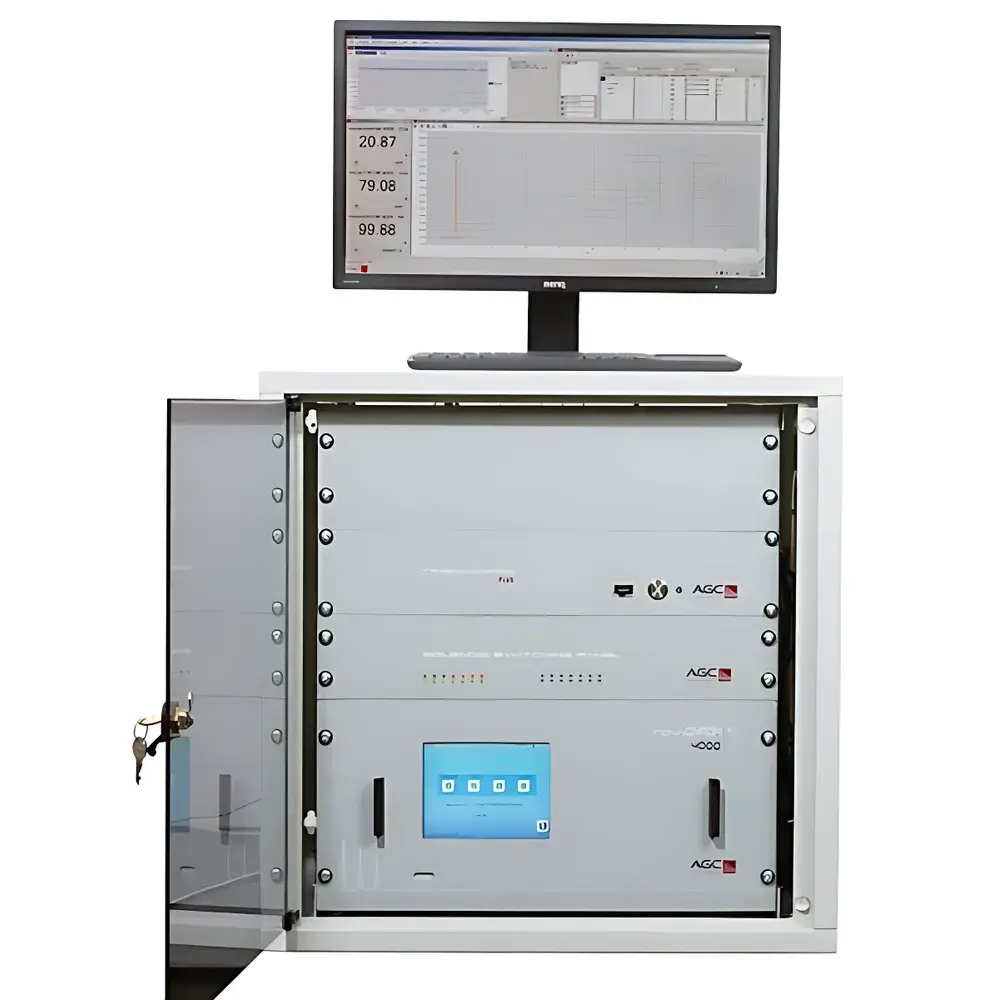
AGC NC1000 High-Purity Silane Analysis Gas Chromatograph with Helium Ionization Detection (DID)
| Brand | AGC |
|---|---|
| Origin | Ireland |
| Model | AGC NC1000 |
| Instrument Type | Laboratory Gas Chromatograph |
| Application | Ultra-High-Purity Semiconductor Gas Analysis |
| Temperature Control Range | 0–300 °C |
| Ramp Rate | 0.1–40 °C/min (0.1 °C increment) |
| Cool-down Time | ~5 min (300 °C → 50 °C) |
| Carrier Gas Flow Range | 0–900 mL/min |
| Carrier Gas Pressure Range | 0–700 kPa |
| Injector Max Temp | 450 °C |
| Injector Pressure Setpoint Range | 0–700 kPa |
| Injector Total Flow Setpoint Range | 0–500 mL/min |
| Detector | Pulsed Helium Discharge Ionization Detector (DID) |
| Detection Range | ppb to % level |
| Accuracy | ±1% of full scale |
| Response Time (90%) | 0.5 s |
| Warm-up Time | 60 min |
| Display | 6.5″ color LCD with resistive touchscreen |
| Dimensions (W×H×D) | 483 mm × 219 mm × 564 mm (19″ rack-mount, 5U) |
| Weight | 25 kg |
| Carrier Gas | Ultra-high-purity helium (N6.0, 20–60 mL/min) |
| Sample Flow | 10–500 mL/min (recommended: 200 mL/min) |
| Drive Gas | Dry, oil-free air at 300 kPa |
| Electronic Pressure/Flow Control | 0–5 bar output (5–10 bar input) |
| Output Signals | 0–1 V analog |
| Compliance | Designed for ASTM D7527, ISO 8573-5, IEC 61511, and aligned with USP <621>, FDA 21 CFR Part 11 data integrity requirements for electronic records |
Overview
The AGC NC1000 is a purpose-engineered laboratory gas chromatograph optimized for the quantitative analysis of ultra-high-purity (UHP) silane (SiH₄) and associated trace impurities in semiconductor-grade process gases. It employs pulsed helium discharge ionization detection (DID), a non-destructive, universal detection principle based on electron impact ionization within a metastable helium plasma. Unlike flame-based detectors, DID delivers stable, linear response across ppb-level contaminants—including H₂, O₂, N₂, CH₄, CO, CO₂, H₂O, NH₃, PH₃, BCl₃, Cl₂, NF₃, and other hydrides and halides—without requiring combustion gases or catalytic converters. The instrument’s architecture follows a dual-column, multi-zone thermal management strategy, enabling simultaneous separation of permanent gases and reactive species under precisely controlled isothermal or programmed conditions. Its design adheres to the analytical rigor demanded by electronic specialty gas standards including GB/T 15909–2009 (silane), GB/T 21287–2007 (NF₃), and IEC 60721-3-3 environmental class 3K3 (industrial indoor operation).
Key Features
- Independent multi-zone oven control: Three thermally isolated column compartments allow concurrent optimization of retention, resolution, and peak symmetry for complex UHP gas matrices.
- Regenerable dual-stage purification system: Integrated getter cartridges remove residual moisture, oxygen, and hydrocarbons from carrier and sample streams, ensuring baseline stability and detector longevity.
- Modular detector configuration: Supports interchangeable DID, ADD (Argon Discharge Detector), TCD, FID, and FPD modules—each calibrated and validated per ISO/IEC 17025 traceability protocols.
- Rack-mount 19″ 5U chassis: Designed for integration into centralized gas analysis skids or cleanroom utility cabinets with front-access service panels and rear I/O termination.
- Real-time diagnostics engine: Continuous self-monitoring of detector voltage, column head pressure, flow deviation (>±3%), temperature drift (>±0.5 °C), and valve actuation cycles—loggable with timestamped event flags.
- Electronically actuated pneumatic control: Precision mass flow controllers (MFCs) and pressure controllers (PCs) with 0.01 psi resolution ensure reproducible method transfer between instruments and laboratories.
Sample Compatibility & Compliance
The NC1000 is validated for direct injection of compressed gases up to 10 MPa via certified stainless-steel (316L EP) Swagelok® and VCR fittings. It complies with ISO 8573-5:2010 for purity class 1–2 compressed air/gas testing and supports audit-ready reporting per GLP and GMP Annex 11 requirements. All firmware and method files are digitally signed; audit trails record user login, parameter changes, calibration events, and report generation with immutable timestamps. The system meets electromagnetic compatibility (EMC) per EN 61326-1:2013 and safety standards per EN 61010-1:2010. Regulatory alignment includes GB/T 16945–2009 (Ar), GB/T 14604–2009 (O₂), and SEMI F57-0302 for silicon precursor gas certification.
Software & Data Management
TrendVision PLUS software provides full instrument control, sequence definition, real-time chromatogram visualization, and automated peak integration using AIA/CDF-compliant algorithms. It supports 21 CFR Part 11–compliant user authentication (role-based access), electronic signatures, and secure data archiving with SHA-256 hashing. Raw data files (.cdf) and processed reports (.pdf/.xlsx) are stored in hierarchical directories with configurable retention policies. Optional OPC UA server enables bidirectional integration with DCS/SCADA platforms (e.g., Emerson DeltaV, Siemens PCS7) for alarm forwarding, setpoint updates, and trend export via Modbus TCP or Profibus DP.
Applications
- Quantification of silane (SiH₄) purity and trace contaminants (e.g., GeH₄, AsH₃, B₂H₆) per SEMI C37 and GB/T 15909–2009 specifications.
- Residual moisture and oxygen monitoring in bulk silane delivery systems prior to LPCVD/PECVD tool connection.
- Batch release testing of cylinder-filling stations for photovoltaic and display manufacturing supply chains.
- Leak detection verification in gas distribution networks using tracer compounds (e.g., SF₆, CF₄) co-analyzed with process gases.
- Stability studies of silane decomposition products (SiH₂, Si₂H₆) under accelerated thermal aging protocols.
FAQ
What carrier gas is required for optimal DID performance?
Ultra-high-purity helium (N6.0, ≤10 ppb O₂/H₂O) delivered at 20–60 mL/min is mandatory. Nitrogen or argon are incompatible and will quench the helium plasma.
Can the NC1000 analyze corrosive gases such as HCl or Cl₂ without hardware modification?
Yes—when equipped with passivated 316L stainless-steel flow paths, sapphire-lined valves, and dedicated acid-resistant columns (e.g., MXT-100), validated per GB/T 14602–93 and GB/T 18994–2003.
Is remote diagnostics and firmware update supported over Ethernet?
Yes—via embedded web server (HTTPS) and SSHv2. Firmware updates require digital signature verification and rollback capability.
How is calibration traceability maintained for regulatory submissions?
Certified gas standards (NIST-traceable) are used for initial calibration; subsequent verifications employ internal standard addition with documented uncertainty budgets per ISO/IEC 17025 Clause 6.4.
What is the mean time between failures (MTBF) for the DID detector under continuous operation?
≥12,000 hours, based on accelerated life testing under 45 °C ambient and 100% duty cycle, with scheduled anode replacement every 24 months.



