
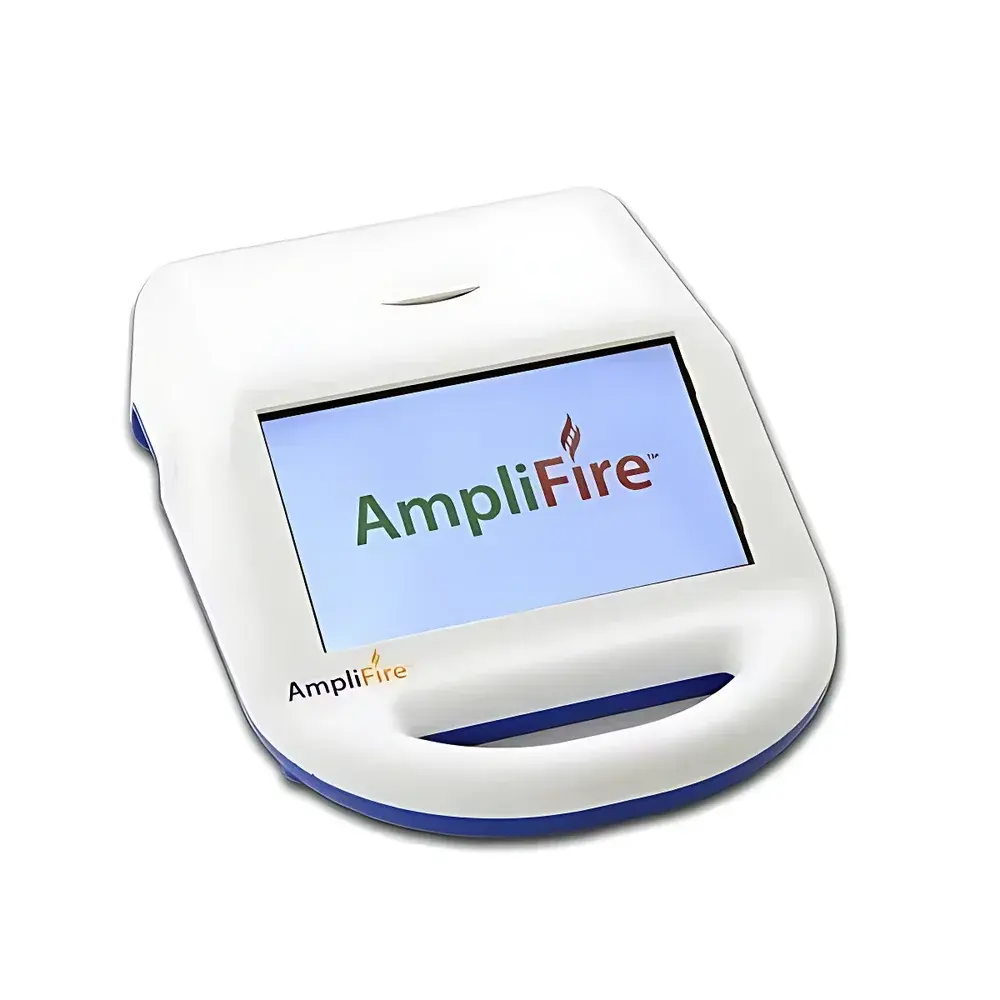
AGDIA AmpliFire® RF1604 Portable Isothermal Fluorescence Detection System
| Brand | AGDIA |
|---|---|
| Origin | USA |
| Manufacturer Type | Authorized Distributor |
| Product Origin | Imported |
| Model | RF1604 |
| Sample Throughput | 8 samples per run |
| Heating Rate | 1°C per 10 seconds |
| Temperature Accuracy | ±0.1°C |
| Well-to-Well Temperature Uniformity | ±0.1°C |
Overview
The AGDIA AmpliFire® RF1604 is a compact, battery-powered isothermal fluorescence detection system engineered for rapid, field-deployable nucleic acid analysis using Recombinase Polymerase Amplification (RPA) and other isothermal amplification chemistries. Unlike thermal-cycling PCR instruments that rely on repeated heating and cooling cycles, the RF1604 maintains precise, stable temperature control across all eight reaction wells—enabling real-time fluorescent monitoring of DNA or RNA target amplification at a single, user-defined temperature (typically 37–42°C). Its core architecture integrates a high-sensitivity optical module with narrow-band excitation/emission filters, calibrated photodiodes, and low-noise signal processing to ensure robust detection of low-abundance targets without cross-well interference. Designed for decentralized testing environments—including agricultural extension labs, biosurveillance field units, clinical triage points, and resource-limited settings—the RF1604 delivers quantitative or qualitative results in ≤10 minutes post-sample loading, supporting time-critical decision-making in plant pathology, food safety, human infectious disease screening, and GMO verification.
Key Features
- Battery-operated design with up to 6 hours of continuous operation on a single charge—ideal for mobile diagnostics and off-grid deployment.
- Integrated 3-channel fluorescence detection (FAM/HEX/Cy5-compatible) enabling multiplexed assay development and internal control validation within a single run.
- Touchscreen interface with intuitive, icon-driven workflow navigation—no software installation or external computer required.
- Onboard barcode scanner for rapid, error-resistant sample ID entry and traceability; supports GS1-compliant barcodes and custom label formats.
- Precise thermal control architecture delivering ±0.1°C accuracy and ±0.1°C well-to-well uniformity—critical for reproducible isothermal kinetics and low-Ct variability.
- Real-time amplification curve visualization with automatic threshold-based endpoint calling and Cq estimation; raw fluorescence data exportable via USB or Bluetooth.
Sample Compatibility & Compliance
The RF1604 is validated for use with AGDIA’s proprietary AmpliFire® RPA reagent kits and third-party isothermal chemistries including LAMP, NASBA, and HDA—provided they conform to standard 0.2 mL tube or 8-well strip formats. It accommodates lyophilized and liquid-format master mixes, as well as crude lysates from plant tissue, swab eluates, serum, and environmental water samples. The instrument meets IEC 61010-1:2010 safety standards for laboratory equipment and complies with FCC Part 15 Class B and CE electromagnetic compatibility requirements. While not FDA-cleared as an IVD device, the RF1604 supports GLP-compliant documentation workflows when used with analytically validated assays and is compatible with 21 CFR Part 11–enabled data management systems via optional firmware upgrades.
Software & Data Management
The embedded firmware includes a full-featured analysis engine capable of baseline correction, sigmoidal curve fitting, and dynamic threshold adjustment. All runs generate timestamped .csv and .pdf reports containing amplification curves, Cq values, confidence intervals, and pass/fail flags based on user-defined cutoffs. Data export supports USB mass storage mode and Bluetooth 4.2 BLE pairing with Windows/macOS/Linux hosts. Optional AmpliFire Connect™ desktop software (v3.2+) enables centralized instrument fleet monitoring, audit trail generation, QC charting (Levey-Jennings), and integration with LIMS via HL7 or RESTful API endpoints. Raw fluorescence intensity logs are stored with metadata including ambient temperature, battery level, and calibration history—facilitating retrospective troubleshooting and regulatory review.
Applications
- Rapid detection of plant viruses (e.g., Tobacco mosaic virus, Tomato spotted wilt virus) in greenhouse and field scouting programs.
- Screening for foodborne pathogens (Salmonella, Listeria monocytogenes) and allergens (soy, peanut, gluten) in processing facilities.
- Point-of-need identification of genetically modified organisms (GMOs) in seed lots and grain shipments per ISO 21569 and EN ISO 21570 protocols.
- Surveillance of zoonotic and human respiratory pathogens—including SARS-CoV-2—using CE-IVDR–marked isothermal assay kits with documented LOD ≤10 copies/µL.
- Environmental monitoring of aquatic pathogens and biothreat agents in wastewater and surface water matrices.
FAQ
What isothermal amplification methods are supported by the RF1604?
The RF1604 is optimized for RPA but fully compatible with LAMP, NASBA, and HDA chemistries requiring constant-temperature incubation between 35°C and 45°C.
Does the RF1604 require external calibration or routine maintenance?
No routine calibration is needed; factory calibration is retained across power cycles. Optical alignment and thermal validation are performed during annual service—recommended every 12 months or after 500 runs.
Can the RF1604 be connected to a laboratory information management system (LIMS)?
Yes, via AmpliFire Connect™ desktop software with configurable HL7 v2.x message templates or direct database ingestion using ODBC/JDBC drivers.
Is the instrument suitable for CLIA-waived or near-patient testing environments?
When paired with FDA-authorized or CE-IVDR–certified assay kits and operated under defined SOPs, the RF1604 meets technical prerequisites for CLIA-waived classification under 42 CFR §493.1703(b)(2).
How is data integrity ensured during offline operation?
All run data—including raw fluorescence traces, timestamps, operator IDs, and instrument diagnostics—are written to encrypted internal flash memory and mirrored upon first successful USB/Bluetooth connection.
Related Products



