
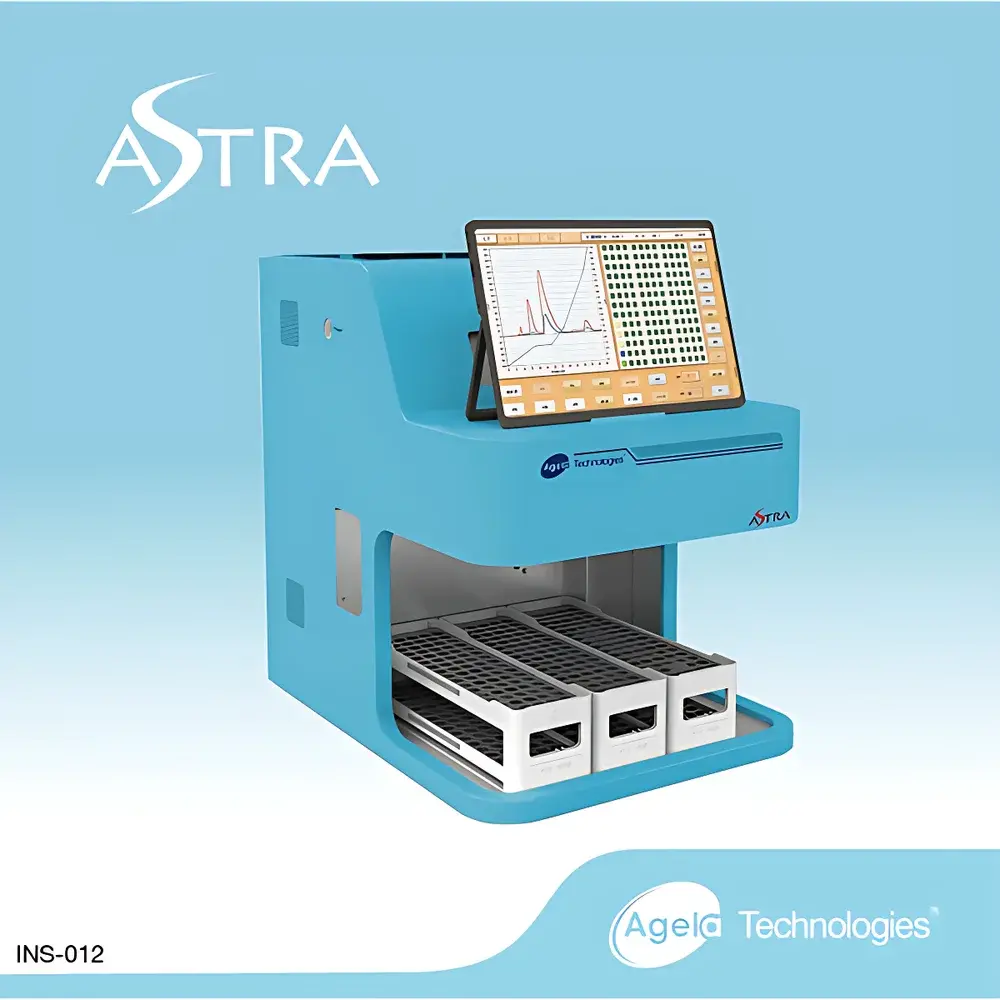
Agela ASTRA Fast Medium-Pressure Preparative Chromatography System
| Brand | Agela |
|---|---|
| Origin | Tianjin, China |
| Manufacturer Type | Authorized Distributor |
| Product Category | Domestic |
| Model | ASTRA |
| Application Level | Laboratory Grade |
| Instrument Type | Medium-Low Pressure Preparative Liquid Chromatograph |
| Flow Rate Range | 1–200 mL/min |
| Maximum Operating Pressure | 200 psi |
| UV-Vis Detection | PDA Detector, 200–800 nm |
| Gradient Capability | Quaternary Solvent Selection |
| Column Compatibility | Normal- & Reversed-Phase Columns (4–800 g), Max. Sample Load: 80 g |
| Fraction Collection Modes | Full Collection, Peak-Based Collection, Manual Trigger, Time-Window Collection |
Overview
The Agela ASTRA Fast Medium-Pressure Preparative Chromatography System is an engineered solution for scalable, reproducible compound isolation in synthetic chemistry, natural product research, and pharmaceutical process development. Built upon a robust medium-pressure liquid chromatography architecture, the ASTRA system operates within a defined pressure envelope of up to 200 psi—optimized for reliable performance with standard silica- and polymer-based preparative columns ranging from 4 g to 800 g. Its core separation principle relies on differential partitioning of analytes between mobile and stationary phases under controlled gradient elution, enabling high-resolution fractionation of complex mixtures without requiring ultra-high-pressure infrastructure. Unlike analytical HPLC systems, the ASTRA prioritizes throughput and method adaptability over sub-micron resolution, making it especially suited for early-stage purification where rapid method scouting, iterative optimization, and gram-scale recovery are critical operational requirements.
Key Features
- Quaternary gradient solvent delivery with independent control of four mobile phase reservoirs, supporting both isocratic and linear/non-linear gradient methods.
- Programmable gradient editing interface allowing real-time point insertion, drag-and-drop profile adjustment, and offline method simulation prior to run initiation.
- PDA (Photodiode Array) detection across 200–800 nm with baseline stability suitable for tracking multiple chromophores simultaneously during multi-component separations.
- Four configurable fraction collection modes: full-collection (continuous), peak-triggered (based on threshold or derivative criteria), manual override (user-initiated), and time-window (predefined retention intervals).
- Real-time color-coded tube mapping: each detected peak is assigned a unique RGB identifier synchronized with physical collection tubes, streamlining post-run identification and reducing handling errors.
- Integrated flow path design with low-dead-volume fittings and chemically resistant wetted materials (e.g., PEEK, stainless steel, sapphire) compatible with common organic solvents including hexane, ethyl acetate, methanol, acetonitrile, and aqueous buffers.
Sample Compatibility & Compliance
The ASTRA system supports both normal-phase (e.g., silica, amino, cyano) and reversed-phase (e.g., C18, C8, phenyl-hexyl) preparative columns, accommodating sample loads up to 80 g per injection depending on column dimensions and matrix complexity. It complies with general laboratory safety standards for solvent-handling instrumentation and meets mechanical integrity requirements outlined in ISO 17025 for calibration traceability of flow and pressure transducers. While not certified for GMP manufacturing environments, its software architecture supports audit-ready operation when configured with timestamped method logs, user-access controls, and electronic signature capability—aligning with GLP documentation expectations for non-clinical research laboratories. All firmware and method files are stored locally with optional network backup, ensuring data sovereignty and version control.
Software & Data Management
ASTRA Control Software provides a Windows-based graphical interface with intuitive workflow navigation, real-time chromatogram visualization, and integrated method editor. Raw detector data (absorbance vs. time/wavelength) and system parameter logs (flow rate, pressure, valve position, collection events) are saved in vendor-neutral .csv and .xml formats for third-party analysis. The software includes built-in tools for peak integration, retention time alignment, and comparative overlay of sequential runs—facilitating method transfer and robustness assessment. For regulated environments, optional 21 CFR Part 11-compliant modules enable role-based access, electronic signatures, and immutable audit trails covering all method modifications and run executions.
Applications
- Rapid purification of synthetic intermediates and final APIs during medicinal chemistry campaigns.
- Isolation of bioactive constituents from plant extracts, fermentation broths, or marine-derived samples.
- Desalting and buffer exchange of peptides and oligonucleotides prior to characterization.
- Method development for downstream scale-up to industrial SFC or flash chromatography platforms.
- Supporting academic teaching labs in chromatographic theory instruction through hands-on gradient optimization and fraction analysis.
FAQ
What column sizes and chemistries are supported by the ASTRA system?
The system accommodates standard preparative columns from 4 g to 800 g capacity, including silica, diol, amino, C18, C8, phenyl, and mixed-mode phases—compatible with both normal- and reversed-phase elution schemes.
Can the ASTRA be used for method transfer to analytical or production-scale systems?
Yes—its gradient fidelity, flow accuracy, and UV spectral consistency allow direct translation of retention behavior and selectivity to analytical HPLC or larger-scale flash systems, minimizing re-optimization effort.
Is remote monitoring or network integration possible?
The system supports Ethernet connectivity for local area network access; remote desktop control is permitted within institutional IT policies, though cloud-based telemetry is not implemented.
Does the PDA detector support spectral library matching?
Spectral acquisition is fully supported; however, library search functionality requires export to third-party cheminformatics platforms such as ACD/Labs or OpenChrom.
What maintenance protocols are recommended for long-term reliability?
Routine checks include pump seal inspection every 500 hours, UV lamp replacement every 2,000 hours, and annual calibration of flow and pressure sensors using NIST-traceable standards.






