
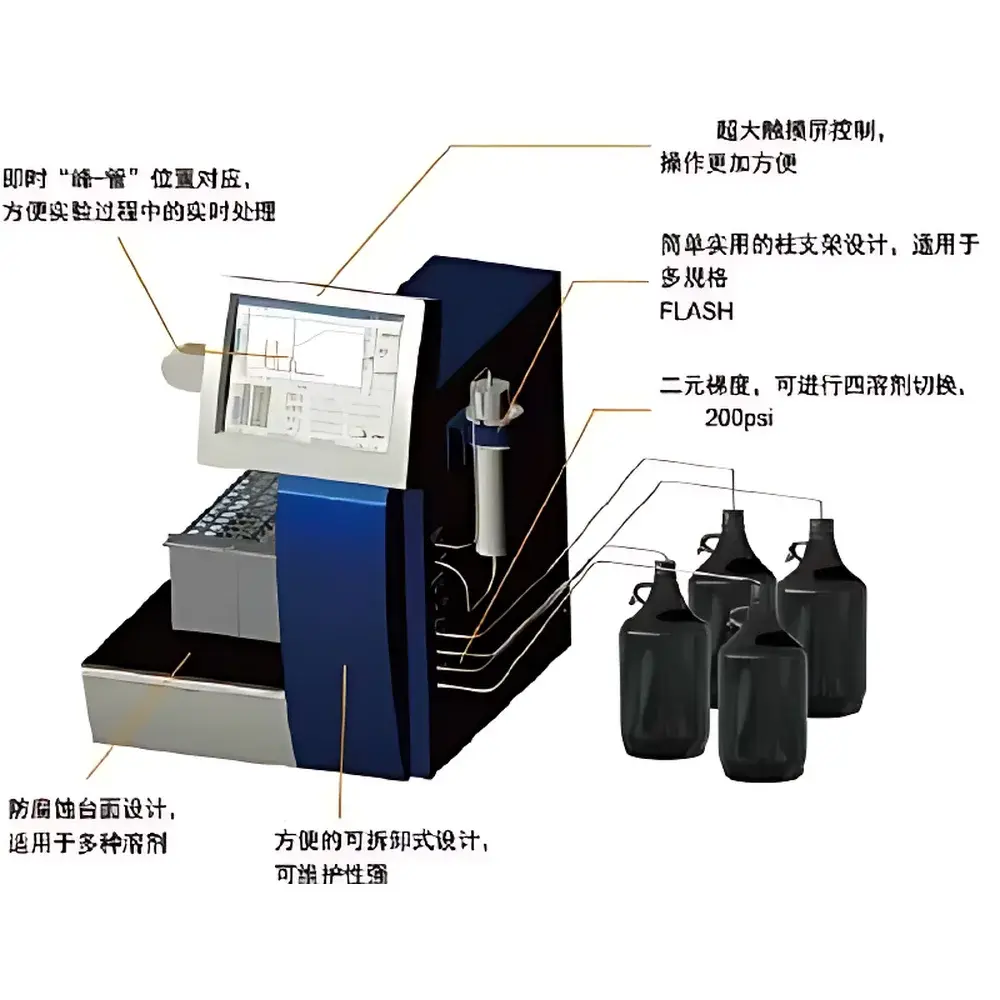
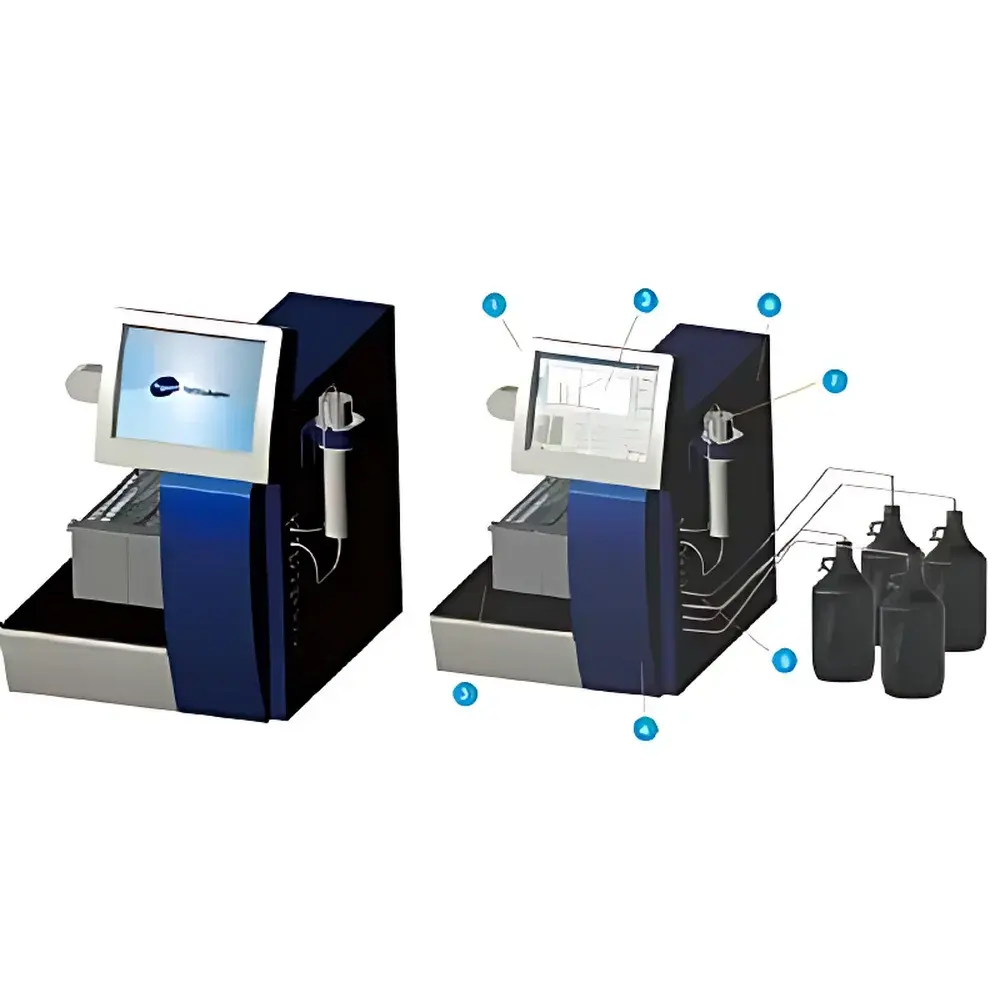
Agela CHEETAH MP200 Medium-Pressure Preparative Liquid Chromatography System
| Brand | Agela |
|---|---|
| Origin | Tianjin, China |
| Model | CHEETAH MP200 |
| Application Level | Laboratory-Scale |
| Instrument Type | Medium-Low Pressure Preparative HPLC |
| Flow Rate Range | 1–200 mL/min |
| Flow Accuracy | ±2% |
| Flow Precision | ±2% |
| Maximum Operating Pressure | 200 psi |
| Wavelength Range | 200–400 nm (standard detector), 200–800 nm (optional dual-range detector) |
| Wavelength Accuracy | ±1 nm |
| Wavelength Repeatability | ±1 nm |
| Baseline Noise | ≤3×10⁻⁴ AU |
| Data Acquisition Rate | 3 Hz |
| Gradient Configuration | Binary or Quaternary |
| Detection Modes | Single-Wavelength, Dual-Wavelength (independent collection & monitoring), Ratio-Based Triggering |
| Fraction Collection | Integrated 2D Fraction Collector with Adjustable Rack Mapping |
| Solvent Compatibility | All Common HPLC-Grade Organic and Aqueous Solvents |
| Safety Features | Real-Time Pressure Monitoring, Leak Detection with Audible/Visual Alert |
Overview
The Agela CHEETAH MP200 is a medium-pressure preparative liquid chromatography system engineered for robust, reproducible isolation of target compounds from complex mixtures at laboratory scale. Operating within a pressure range up to 200 psi, the system bridges the performance gap between low-pressure flash chromatography and high-pressure preparative HPLC—delivering enhanced resolution and loading capacity without requiring ultra-high-pressure infrastructure. Its core architecture integrates a precision dual-piston solvent delivery module, a UV-Vis absorbance detector with configurable wavelength ranges (200–400 nm standard; 200–800 nm optional), and a fully programmable two-dimensional fraction collector. Designed around the principles of gradient elution chromatography, the CHEETAH MP200 supports both isocratic and multi-step linear or nonlinear gradients, enabling method development and scalable purification across natural product isolation, synthetic intermediate purification, pharmaceutical impurity separation, and analytical reference standard preparation.
Key Features
- High-flow binary or quaternary gradient pumping system with flow rates adjustable from 1 to 200 mL/min and accuracy maintained within ±2% across the full range
- Dual-wavelength UV-Vis detection capability: simultaneous monitoring at two independent wavelengths—enabling real-time peak tracking while triggering fraction collection based on alternate spectral response (e.g., monitoring at 254 nm while collecting at 280 nm)
- Integrated 2D fraction collector with software-defined rack mapping—supports standard test tube formats (13 mm, 15 mm, 18 mm, 25 mm OD) and large-volume containers up to 1 L, including continuous-loop collection for extended runs
- In-run parameter modification: users may adjust gradient profiles, flow rate, or collection logic without interrupting active separation—critical for adaptive method optimization during purification
- Multi-detector support: native communication protocol allows synchronized control of optional secondary detectors (e.g., ELSD, CAD) alongside UV-Vis within the same acquisition interface
- Flexible sample introduction: accommodates both liquid injection (via loop or syringe) and direct solid-phase loading onto prepacked or custom-packed columns
- Comprehensive safety architecture: embedded pressure transducers provide continuous feedback with automatic shutdown upon exceeding preset thresholds; integrated leak sensors trigger visual and audible alerts with system pause functionality
Sample Compatibility & Compliance
The CHEETAH MP200 is compatible with silica-based and reversed-phase preparative columns (typically 10–50 mm ID, packed with 5–25 µm particles), as well as polymeric and specialty stationary phases used in normal-phase, ion-exchange, and size-exclusion applications. It accepts standard HPLC-grade solvents—including acetonitrile, methanol, ethanol, THF, dichloromethane, and aqueous buffers—without corrosion or seal degradation. From a regulatory standpoint, the system supports audit-trail-enabled operation when paired with compliant software configurations (e.g., timestamped method logs, user-access controls, electronic signatures). While not pre-certified for GMP environments, its architecture aligns with foundational elements of FDA 21 CFR Part 11, ISO/IEC 17025, and USP <621> chromatographic system suitability requirements—particularly in data integrity, repeatability, and instrument qualification documentation.
Software & Data Management
Control and data acquisition are managed through Agela’s proprietary CHEETAH Control Suite—a Windows-based application supporting method creation, real-time chromatogram visualization, automated fraction triggering, and post-run integration with common cheminformatics platforms (e.g., ChemDraw, OpenBabel via CSV export). The software implements hierarchical user permissions, encrypted method storage, and automatic generation of PDF reports containing chromatograms, collection maps, and system performance metrics (e.g., retention time stability, peak asymmetry, baseline noise summary). Raw data files are stored in vendor-neutral .csv and .chd formats, ensuring long-term accessibility independent of software version updates. All acquisition events—including gradient changes, pressure excursions, and fraction switch commands—are logged with millisecond timestamps and operator IDs, fulfilling GLP-aligned record-keeping expectations.
Applications
The CHEETAH MP200 serves diverse purification workflows across academic, industrial, and contract research laboratories. Typical use cases include: isolation of bioactive constituents from plant extracts under normal-phase conditions; purification of peptide intermediates following solid-phase synthesis; removal of closely eluting genotoxic impurities in API synthesis; recovery of chiral isomers using polysaccharide-based CSPs; and parallel purification of compound libraries prior to biological screening. Its ability to handle 10–500 mg loadings per injection—combined with programmable collection logic—makes it especially suitable for iterative fractionation strategies where offline analysis informs subsequent collection parameters.
FAQ
What column dimensions and particle sizes are recommended for optimal performance?
Columns with internal diameters of 10–30 mm and particle sizes ranging from 10–25 µm are routinely employed; larger-bore columns (up to 50 mm ID) may be used with flow-rate adjustments to maintain appropriate linear velocity.
Can the system be validated for regulated environments?
Yes—the hardware design permits IQ/OQ/PQ execution per ASTM E2500 and ISO 9001 guidelines; software validation packages and URS templates are available upon request.
Is remote monitoring supported?
The system supports TCP/IP-based network connectivity, enabling secure remote access to status screens and log files via authenticated VNC or RDP sessions—subject to local IT policy compliance.
What maintenance intervals are recommended for pump seals and UV lamp replacement?
Pump seals should be inspected every 500 hours of operation or semiannually, whichever occurs first; deuterium lamps are rated for ≥1,000 hours and display usage time in the software diagnostics panel.
Does the fraction collector support custom container geometries beyond standard racks?
Yes—through the “Custom Rack Editor” module, users define XY coordinates, height offsets, and orientation for non-standard vessels, including microtiter plates, vial trays, and custom 3D-printed holders.




