
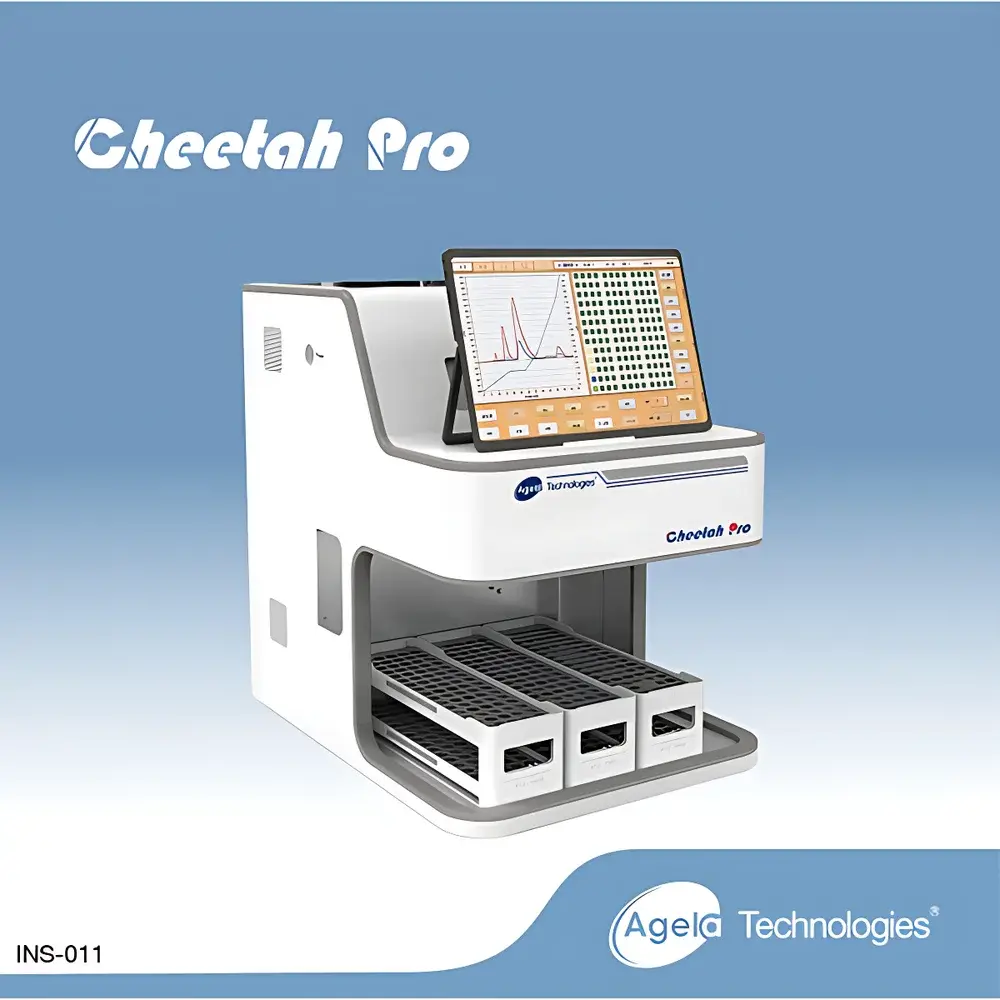
Agela CHEETAH Pro CH-200P Medium-Pressure Preparative Liquid Chromatography System
| Brand | Agela |
|---|---|
| Origin | Tianjin, China |
| Model | CH-200P |
| Application Level | Laboratory Grade |
| Instrument Type | Medium-to-Low Pressure Preparative LC |
| Maximum Operating Pressure | 200 psi (1.38 MPa) |
| Flow Rate Range | 1–200 mL/min |
| UV Detection Wavelength Range | 200–600 nm |
| Gradient Capability | Binary Gradient |
| Column Compatibility | Flash columns (4–800 g silica/C18), max. sample load: 80 g |
| Collection Modes | Full collection, peak-based collection, manual collection, time-window collection |
| Real-time Fraction Mapping | Color-coded tube assignment per detected peak |
| Purge Function | Integrated air pump module for manual/automated column purging |
| Interface | Touchscreen GUI with transparent fluidic pathway visualization |
Overview
The Agela CHEETAH Pro CH-200P is a medium-pressure preparative liquid chromatography system engineered for reproducible, scalable purification of organic compounds, natural products, and synthetic intermediates in research and development laboratories. It operates on the principle of differential partitioning between a mobile phase (eluent) and a stationary phase (silica or reversed-phase media), enabling high-resolution separation under controlled pressure and flow conditions. Designed for flexibility and method transparency, the system features an open, surface-mounted architecture with fully visible PEEK and fluoropolymer tubing—allowing real-time monitoring of solvent flow, gradient formation, and column loading status. Its 200 psi maximum pressure rating positions it between traditional flash chromatography and high-pressure preparative HPLC, offering improved resolution over gravity-fed systems while maintaining compatibility with standard flash cartridges and custom-packed columns ranging from 4 g to 800 g.
Key Features
- Binary Gradient Delivery: Dual-solvent pumping system with precise flow control (1–200 mL/min) and programmable gradient profiles; supports linear, step, and custom-shaped gradients.
- UV Detection & Spectral Flexibility: Fixed-wavelength UV detector with selectable wavelengths across 200–600 nm, optimized for detection of aromatic, conjugated, and heterocyclic compounds without requiring lamp replacement or recalibration.
- Intuitive Gradient Editing Interface: Touchscreen-based method editor allows both online and offline modification of gradient programs—including point insertion, drag-and-drop segment adjustment, and real-time preview—reducing method development time.
- Four Fraction Collection Modes: Configurable collection logic includes full-run collection, threshold-triggered peak collection, operator-initiated manual collection, and time-based window collection—each supporting customizable tube rack mapping.
- Real-Time Peak-to-Tube Mapping: Software assigns distinct color identifiers to each resolved chromatographic peak and synchronizes them with corresponding fraction tubes, enabling rapid visual correlation during post-run analysis.
- Integrated Column Purge Module: Built-in air pump delivers regulated compressed air for solvent displacement and column drying; purge sequences can be scheduled automatically or triggered manually prior to column storage or solvent exchange.
Sample Compatibility & Compliance
The CHEETAH Pro CH-200P accommodates both normal-phase (e.g., hexane/ethyl acetate) and reversed-phase (e.g., water/acetonitrile) elution schemes, making it suitable for isolating polar, nonpolar, and zwitterionic analytes. It supports industry-standard flash cartridges (e.g., GraceResolv, Biotage KP-Sil, Interchim PuriFlash) as well as user-packed glass or stainless-steel columns. While not certified for GMP manufacturing environments, the system meets common laboratory quality requirements: its data acquisition logs include timestamped method parameters, detector signals, and collection events—supporting GLP-compliant recordkeeping when paired with secure network storage and user-access controls. All wetted parts are chemically resistant (PEEK, sapphire, fused silica), ensuring compatibility with aggressive solvents including DCM, THF, and TFA-containing mobile phases.
Software & Data Management
The embedded control software provides local instrument operation, method storage, and basic chromatogram review. Raw data files (ASCII-based .csv format) contain retention time, absorbance values at selected wavelength(s), flow rate, and fraction assignment metadata. Exported datasets are compatible with third-party analytical tools (e.g., Chromeleon, OpenChrom, MATLAB) for peak integration, purity assessment, and spectral deconvolution. Audit trail functionality records user login/logout events, method modifications, and collection actions—aligning with internal SOPs for traceability. No cloud connectivity or FDA 21 CFR Part 11 compliance is built-in; however, the system supports integration into validated lab networks via external file synchronization protocols.
Applications
This system is routinely deployed in medicinal chemistry labs for intermediate purification prior to NMR or MS characterization; in natural product isolation workflows for sequential fractionation of crude plant extracts; and in polymer synthesis labs for removing catalyst residues or unreacted monomers. Its 80 g maximum loading capacity enables gram-scale purification of APIs or reference standards under non-denaturing conditions. The combination of binary gradient control, real-time visualization, and flexible collection logic makes it particularly effective for optimizing separation conditions during early-stage route scouting—where rapid iteration between column packing, solvent selection, and gradient slope is essential.
FAQ
What column formats are supported?
Standard commercial flash cartridges (4–800 g), custom-packed glass columns (ID 10–50 mm), and stainless-steel prep columns up to 25 mm ID.
Can the UV detector be upgraded to a variable-wavelength or diode-array unit?
No—the CH-200P integrates a fixed-wavelength UV detector optimized for routine flash applications; no field-upgrade path exists for spectral scanning capability.
Is the system compatible with automated fraction collectors from other vendors?
Only the native Agela fraction collector is fully synchronized for peak-triggered and color-mapped collection; third-party collectors may receive TTL triggers but lack tube-color mapping and real-time feedback.
What maintenance intervals are recommended for the air purge module?
The integrated air pump requires quarterly inspection of filter elements and annual lubrication of moving parts per Agela’s service manual (Rev. 3.1).
Does the system support method transfer from analytical HPLC methods?
Yes—gradient slopes and %B profiles can be scaled using standard volumetric scaling rules; however, retention time translation requires empirical adjustment due to differences in column efficiency and extra-column volume.





