
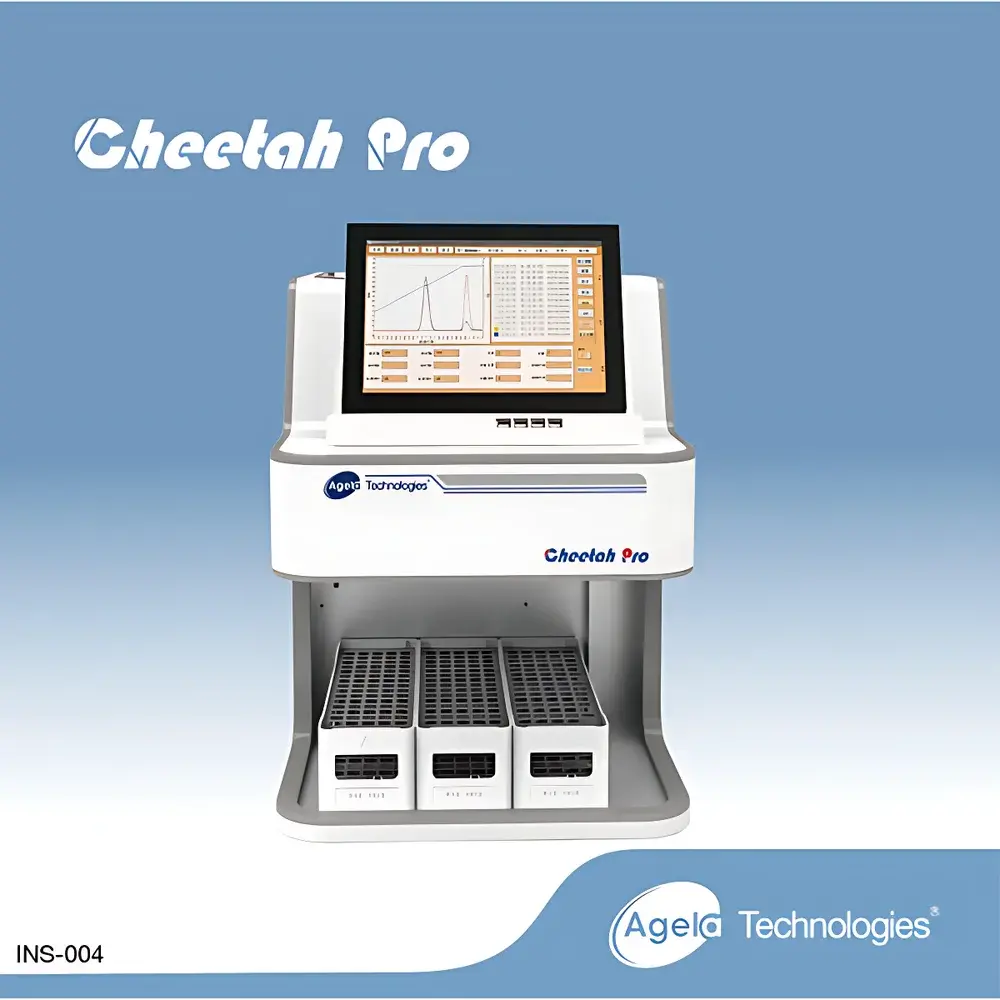
Agela CHEETAH Pro CH-200PII Medium-Pressure Preparative Liquid Chromatography System
| Brand | Agela |
|---|---|
| Origin | Tianjin, China |
| Manufacturer Type | Authorized Distributor |
| Regional Classification | Domestic (China) |
| Model | CH-200PII |
| Application Level | Laboratory-Scale |
| Instrument Type | Medium-Low Pressure Preparative LC System |
| Flow Rate Range | 1–200 mL/min |
| Maximum Operating Pressure | 200 psi (1.38 MPa) |
| UV Detection Wavelength Range | 200–600 nm |
| Gradient Capability | Binary Gradient |
| Column Compatibility | Normal-Phase & Reversed-Phase Flash Columns (4–800 g), Max. Sample Load: 80 g |
| Collection Modes | Full Collection, Peak-Based Collection, Manual Collection, Time-Window Collection |
| Real-Time Fraction Mapping | Color-Coded Tube Assignment per Detected Peak |
| Optional Air-Purge Module | Integrated Air Pump for Manual/Automatic Flash Column Purging (CH-200PII-Air Variant) |
Overview
The Agela CHEETAH Pro CH-200PII is a dedicated medium-pressure preparative liquid chromatography (PLC) system engineered for robust, reproducible isolation and purification of organic compounds, natural products, pharmaceutical intermediates, and synthetic molecules at laboratory scale. Operating on classical column chromatography principles—utilizing controlled solvent delivery, UV-absorbance detection, and fraction collection—the system delivers precise gradient elution under stable pressure conditions up to 200 psi (1.38 MPa), bridging the performance gap between traditional flash chromatography and high-pressure preparative HPLC. Its modular architecture supports both normal-phase (e.g., hexane/ethyl acetate) and reversed-phase (e.g., water/acetonitrile) separations, making it suitable for diverse compound polarities without hardware reconfiguration.
Key Features
- Binary gradient solvent delivery with real-time flow and pressure monitoring, enabling accurate method transfer from analytical to preparative scale.
- UV-Vis detector with fixed-wavelength operation across 200–600 nm, optimized for broad-spectrum compound detection including aromatic systems, conjugated enones, and heterocycles.
- Intuitive industrial PC-based control interface with touchscreen-enabled gradient editing: users may add, delete, or drag gradient points online during method development or offline prior to run initiation.
- Four programmable fraction collection modes—full-run collection, peak-triggered collection, manual trigger, and time-window collection—supporting flexible workflow adaptation for both routine purifications and exploratory separations.
- Real-time peak-to-tube mapping: each resolved chromatographic peak is automatically assigned a unique color-coded identifier in the software interface, synchronizing visual tube labeling with fraction collection for unambiguous sample tracking.
- Optional CH-200PII-Air configuration includes an integrated oil-free air pump module, enabling automated or manual nitrogen- or air-assisted column purging post-elution—reducing solvent consumption and accelerating column equilibration between runs.
Sample Compatibility & Compliance
The CHEETAH Pro CH-200PII accommodates standard commercial flash columns ranging from 4 g to 800 g silica or C18 media, with maximum single-run loading capacity of 80 g for crude mixtures. Its flow path employs chemically inert black PEEK tubing and static-dissipative components, minimizing electrostatic interference and ensuring compatibility with low-conductivity solvents (e.g., dichloromethane, diethyl ether). The system conforms to general laboratory safety standards for solvent-handling instrumentation (IEC 61010-1) and supports audit-ready operation when paired with validated SOPs. While not inherently 21 CFR Part 11-compliant out-of-the-box, its software architecture permits integration with third-party electronic lab notebook (ELN) or LIMS platforms supporting ALCOA+ data integrity principles.
Software & Data Management
Control and data acquisition are managed via a Windows-based industrial PC platform with native support for .csv and .txt export of chromatograms, gradient profiles, and collection logs. All method parameters—including flow rate, gradient table, UV wavelength, collection logic, and purge timing—are saved as encrypted project files with timestamped revision history. Raw detector signals are acquired at ≥10 Hz sampling rate, ensuring adequate resolution for narrow peaks in fast-gradient applications. Software permits overlay comparison of multiple runs, baseline correction, and peak integration using tangent skim or valley-to-valley algorithms—facilitating quantitative assessment of fraction purity prior to downstream analysis (e.g., NMR, MS).
Applications
This system is routinely deployed in synthetic organic chemistry labs for rapid purification of reaction mixtures following Suzuki, Heck, or amidation reactions; in natural product labs for fractionation of plant extracts prior to structural elucidation; and in early-stage pharmaceutical development for impurity isolation and reference standard preparation. Its 200 psi pressure rating enables efficient use of higher-flow-rate columns (e.g., 25–50 µm particle silica), reducing run times versus gravity-driven flash systems while avoiding the capital and maintenance overhead of preparative HPLC. The air-purge option is particularly valuable for labs processing moisture-sensitive compounds or performing sequential polarity-switching protocols.
FAQ
What column formats are supported?
Standard disposable flash cartridges (4–800 g) from major vendors (e.g., Silicycle, Biotage, Grace) are fully compatible—no adapters required.
Can the system be used for reversed-phase purification of peptides?
Yes, when equipped with C18 or C8 columns and aqueous/organic mobile phases; however, extended exposure to >95% TFA or HFIP requires post-run system flushing with IPA/water to prevent seal degradation.
Is method validation support available?
Agela provides IQ/OQ documentation templates aligned with ISO/IEC 17025 and GLP expectations; full PQ must be performed by the end user based on application-specific acceptance criteria.
Does the UV detector support wavelength scanning?
No—it operates at a single user-selected fixed wavelength within the 200–600 nm range; spectral identification requires off-line analysis (e.g., HPLC-DAD or LC-MS).
How is data integrity ensured during long overnight runs?
The embedded controller maintains continuous acquisition even during brief network interruptions; all raw data are written directly to local SSD storage with periodic auto-save intervals configurable down to 1 second.




