
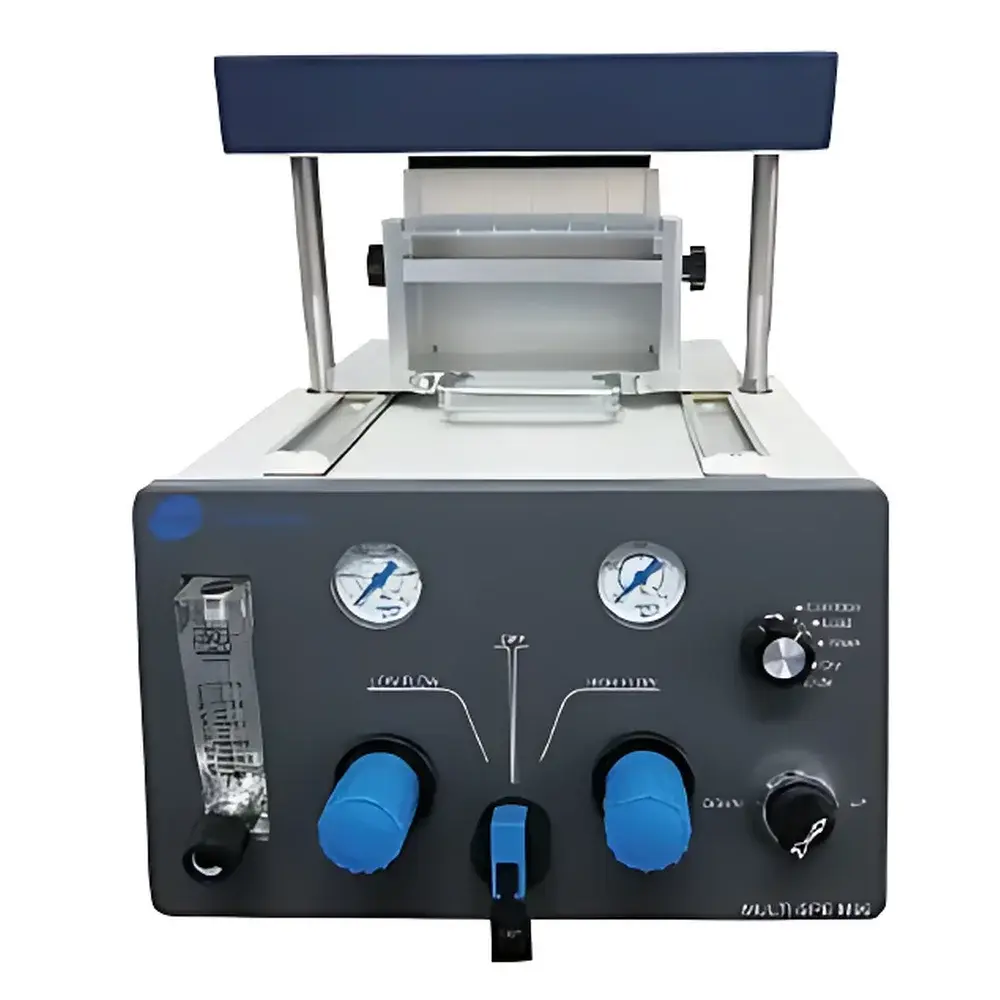
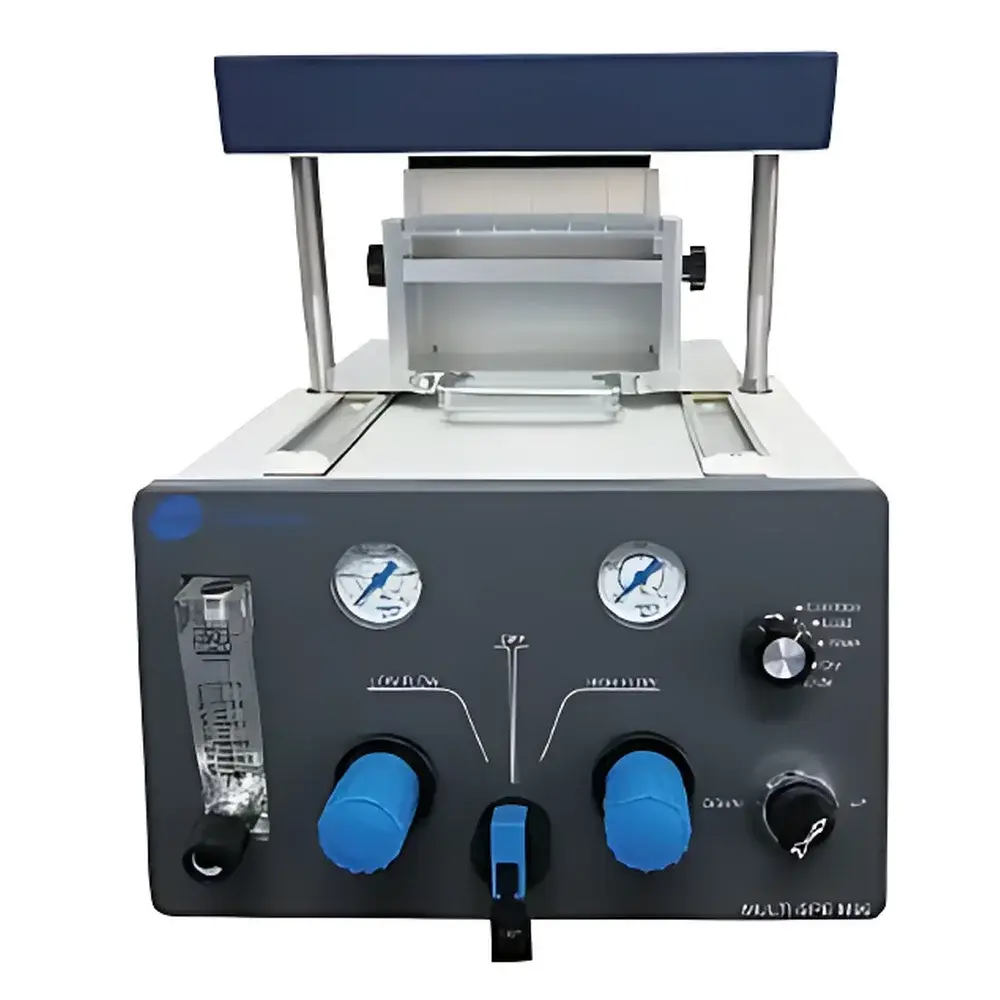
Agela Cleanert M96 High-Throughput Positive-Pressure Solid Phase Extraction System
| Brand | Agela |
|---|---|
| Origin | Tianjin, China |
| Model | SPE-M96 |
| Automation Level | Semi-Automatic |
| Channel Configuration | 96-Channel Parallel |
| SPE Format | Column-Based (96-Well Plate Compatible) |
| Pressure Delivery | Positive Pressure (Up to 60 psi) |
| Flow Control | Manual Regulator |
| Solvent Selection | Manual Solvent Switching |
| Sample Capacity | Up to 96 Samples per Run |
| Sample Loading | Manual |
| Wetted Materials | PTFE (Polytetrafluoroethylene) |
| Gas Source Required | Compressed Air or Nitrogen |
Overview
The Agela Cleanert M96 is a high-throughput, positive-pressure solid phase extraction (SPE) system engineered for reproducible, parallel sample preparation in regulated and research-intensive laboratories. Unlike vacuum-driven SPE platforms—whose performance degrades significantly with viscous or particulate-laden matrices—the Cleanert M96 applies uniform, controllable positive pressure across all 96 channels via a centralized gas manifold. This architecture eliminates channel-to-channel flow variance inherent in negative-pressure systems, ensuring consistent bed penetration, elution kinetics, and analyte recovery across the entire plate. Its design adheres to core principles of fluid dynamics in packed-bed chromatography: laminar flow, minimal backpressure fluctuation, and predictable residence time distribution. The system is particularly suited for bioanalytical workflows where matrix complexity demands robustness—such as therapeutic drug monitoring (TDM), pharmacokinetic (PK) studies, and clinical toxicology screening involving whole blood, plasma, serum, and tissue homogenates.
Key Features
- Uniform 96-channel positive pressure delivery (0–60 psi), enabling reliable processing of high-viscosity biological samples including hemolyzed blood and protein-rich plasma
- Dual-stage pressure regulation: coarse adjustment for method setup and fine-tuning for critical elution steps, supporting multi-step SPE protocols (conditioning, loading, washing, elution)
- PTFE-wetted fluid path throughout the manifold, valves, and sealing interfaces—ensuring chemical inertness against aggressive organic solvents (e.g., acetonitrile, methanol, dichloromethane) and acidic/basic aqueous buffers
- Integrated step indicator LEDs that visually guide operators through each SPE stage (e.g., “Load”, “Wash”, “Elute”), reducing procedural deviation and training overhead
- Compact footprint (≤45 cm × 35 cm) optimized for benchtop integration in QC labs, core facilities, and GLP-compliant bioanalytical units
- Nitrogen-compatible operation for oxygen-sensitive analytes or volatile compound stabilization during evaporation-integrated workflows
Sample Compatibility & Compliance
The Cleanert M96 accommodates standard 1 mL and 3 mL SPE cartridges mounted on commercially available 96-well collection plates (e.g., Agela Cleanert® columns, Waters Oasis®, Thermo HyperSep™). It supports both reversed-phase (C18, C8), mixed-mode (WCX, MAX, MCX), and silica-based sorbents. All wetted materials comply with USP Class VI biocompatibility standards and exhibit no detectable leachables under ICH Q5A stress conditions. While the instrument itself does not carry CE or FDA 510(k) certification, its operational parameters align with method validation requirements outlined in FDA Bioanalytical Method Validation Guidance (2018) and EMA Guideline on Bioanalytical Method Validation (2022). When deployed within validated SOPs—including documented gas source calibration, pressure verification, and operator qualification—it meets audit readiness criteria for ISO/IEC 17025 and GLP environments.
Software & Data Management
As a semi-automatic platform, the Cleanert M96 operates without embedded firmware or proprietary software. Pressure settings, timing, and solvent switching are manually executed per protocol—ensuring full transparency and eliminating black-box algorithm dependencies. This architecture facilitates complete traceability: all procedural parameters (gas pressure values, dwell times, solvent lot numbers) are recorded directly in laboratory notebooks or LIMS entries. For labs requiring electronic records compliant with 21 CFR Part 11, integration is achieved via external digital loggers (e.g., calibrated pressure transducers with timestamped CSV export) or validated ELN modules. No password protection, audit trail, or electronic signature functionality is built-in—consistent with its classification as a laboratory accessory rather than a regulated analytical instrument.
Applications
- Routine extraction of small-molecule drugs (e.g., immunosuppressants, antiepileptics, antibiotics) from human plasma prior to LC-MS/MS analysis
- Pre-concentration and cleanup of endogenous steroids and vitamin D metabolites from dried blood spots (DBS)
- Removal of phospholipids and heme interference in whole-blood PK assays
- High-throughput sample prep for biomarker discovery workflows involving large cohort serum banks
- Method development support for orthogonal SPE-LC coupling where column-to-column consistency is critical
FAQ
Does the Cleanert M96 require electrical power?
No—only a clean, oil-free compressed air or nitrogen supply (regulated to ≤100 psi inlet) is required.
Can it be used with 384-well SPE plates?
No—the mechanical interface and pressure distribution manifold are designed exclusively for standard 96-well plate dimensions (SBS format).
Is PTFE the only material contacting solvents?
Yes—all fluid-contact components—including manifold blocks, sealing gaskets, and gas distribution lines—are constructed from virgin PTFE; no stainless steel, brass, or elastomer surfaces are exposed to solvents.
How is channel-to-channel pressure uniformity verified?
Agela provides a factory calibration certificate confirming ≤±1.5 psi variation across all 96 ports at 30 psi setpoint, measured using NIST-traceable digital manometers.
What maintenance is required?
Quarterly inspection of PTFE seals and annual replacement of pressure regulator diaphragms—no routine lubrication or recalibration needed.



