
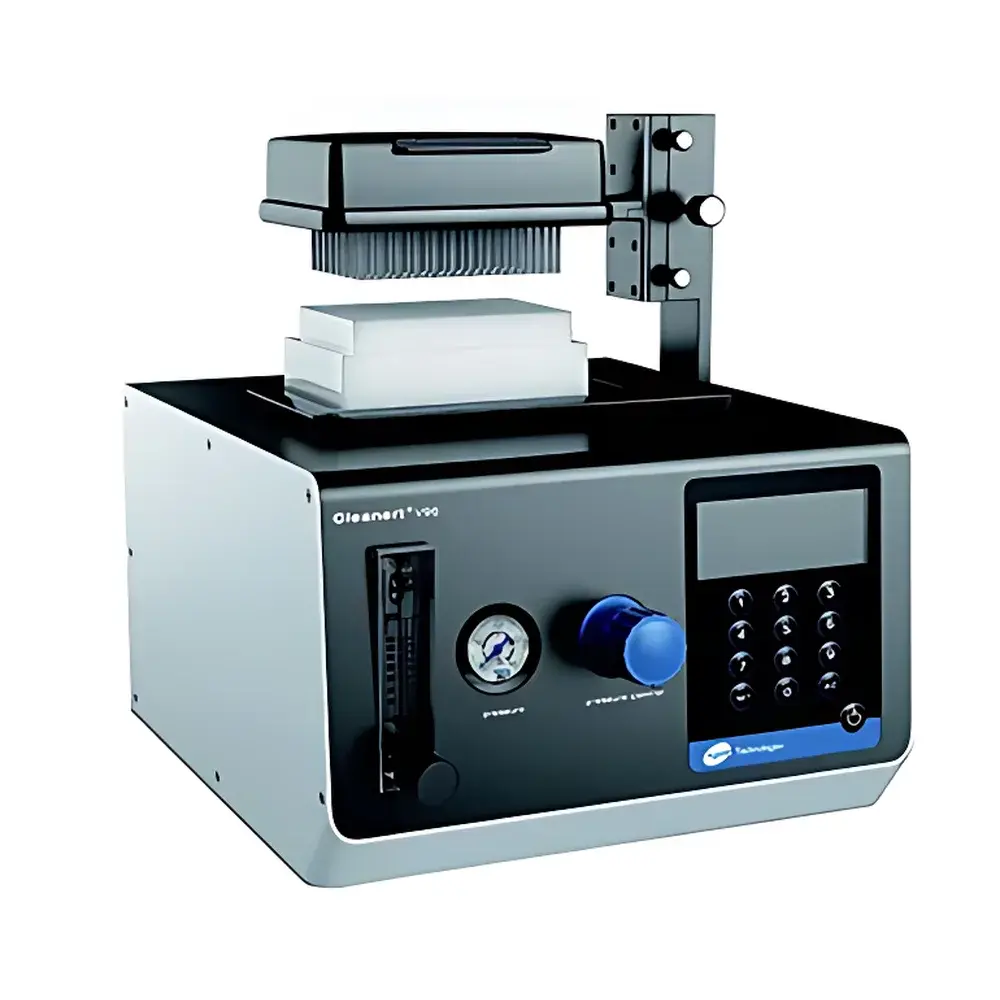
Agela Cleanert V96 96-Well Nitrogen Evaporator
| Brand | Agela |
|---|---|
| Origin | Tianjin, China |
| Model | Cleanert V96 |
| Heating Method | Dry-block heating |
| Temperature Range | Ambient +5°C to 80°C |
| Temperature Uniformity | ±1°C |
| Sample Format | 96-well microplate |
| Gas Flow Rate | 0–80 L/min |
| Heating Power | 450 W |
| Sample Capacity | 96 positions |
| Gas Heating Uniformity | Optimized for consistent thermal delivery across all wells |
| Adjustable Gas Manifold Height | Yes |
| Removable Gas Manifold | Yes |
Overview
The Agela Cleanert V96 96-Well Nitrogen Evaporator is an engineered solution for high-throughput solvent removal from biological, pharmaceutical, and environmental samples housed in standard 96-well microplates. Unlike traditional water-bath or open-air evaporation methods, the Cleanert V96 employs precisely controlled, dry-block-heated nitrogen gas directed perpendicularly onto each well surface. This design leverages convective heat transfer and inert gas displacement to accelerate solvent volatilization while minimizing thermal degradation of thermolabile analytes—such as peptides, metabolites, and labile small molecules. The system operates without direct contact between heating elements and samples, eliminating cross-contamination risks and enabling rapid thermal equilibration upon gas shutoff. Its architecture conforms to routine laboratory workflows requiring GLP-compliant sample preparation prior to LC-MS, GC-MS, ELISA, or HPLC analysis.
Key Features
- Dry-block heating system with PID-controlled temperature regulation (ambient +5°C to 80°C), ensuring stable thermal environment across all 96 positions
- ±1°C temperature uniformity verified across the entire heating block surface, critical for inter-well reproducibility in quantitative workflows
- Adjustable-height gas manifold accommodates diverse plate heights—including deep-well, shallow-well, and PCR plates—without tooling
- Gas flow range of 0–80 L/min, independently regulated via calibrated flow meters; flow optimized to prevent sample splashing while maintaining efficient evaporation kinetics
- Modular, removable gas distribution manifold with individual stainless-steel nitrogen needles—designed for easy cleaning, sterilization, and replacement
- Compact footprint (≤30 cm × 30 cm) suitable for benchtop integration in fume hoods or laminar flow cabinets
- 450 W heating power enables rapid ramp-up to target temperature, reducing cycle time without compromising control fidelity
Sample Compatibility & Compliance
The Cleanert V96 supports all ANSI/SBS-standard 96-well plates (e.g., polypropylene, polystyrene, skirted/unskirted formats) and is routinely deployed in regulated environments preparing samples for USP , ICH Q2(R2), and ASTM D7097-22 compliant assays. Its dry-heating architecture avoids water contamination and eliminates condensation-related variability—a known source of error in humidity-sensitive extractions. While not intrinsically 21 CFR Part 11 compliant, the instrument’s operational parameters (temperature setpoint, gas flow, duration) are fully documentable via external loggers or integrated LIMS interfaces, supporting audit-ready traceability when paired with procedural SOPs. No moving parts beyond manual height adjustment ensure long-term mechanical reliability under continuous use.
Software & Data Management
The Cleanert V96 operates as a stand-alone hardware platform with analog temperature and flow controls—intentionally omitting embedded firmware or touchscreen interfaces to maximize robustness and minimize validation burden. All operational settings (temperature, flow rate, dwell time) are manually configured and recorded externally per method protocol. This design aligns with laboratories adhering to Annex 11 (EU GMP) principles where simplicity, verifiability, and minimal electronic records reduce qualification scope. Users may integrate the unit into broader digital workflows via external data acquisition systems that capture ambient temperature, gas supply pressure, and operator timestamps during method execution.
Applications
- Routine concentration of plasma, urine, and tissue homogenates prior to LC-MS/MS bioanalysis
- High-throughput cleanup of QuEChERS extracts in pesticide residue testing (AOAC 2007.01, EN 15662)
- Preparative evaporation in pharmacokinetic (PK) and toxicokinetic (TK) sample banks
- Concentration of nucleic acid eluates post-solid-phase extraction (SPE) or magnetic bead purification
- Parallel solvent exchange steps in oligonucleotide synthesis QC workflows
- Environmental analysis workflows involving PAHs, PCBs, and phthalates extracted from soil/water matrices
FAQ
What is the recommended inlet gas pressure for optimal performance?
A regulated inlet pressure of ~4 kg/cm² (≈400 kPa or 58 psi) is advised at the instrument’s gas inlet port. Excessive pressure may cause turbulent flow or needle misalignment; insufficient pressure limits maximum achievable flow rate.
Can the Cleanert V96 accommodate 384-well plates?
No—it is specifically engineered for 96-well format compatibility. Use of non-standard plates may result in uneven gas coverage, inconsistent evaporation, or physical interference with the manifold.
Is calibration documentation provided with the unit?
Agela supplies a factory-verified temperature uniformity report and flow calibration certificate for the primary gas manifold. User-performed periodic verification against NIST-traceable thermometers and rotameter standards is recommended per ISO/IEC 17025 guidelines.
How often should the nitrogen needles be cleaned or replaced?
Cleaning with 70% ethanol or isopropanol is recommended after each batch when processing viscous or protein-rich matrices. Replacement intervals depend on usage intensity but typically range from 6–12 months under daily operation in regulated labs.
Does the unit require external exhaust ventilation?
Yes—nitrogen gas displacement must be conducted within a certified chemical fume hood or with dedicated local exhaust to maintain safe O₂ levels and prevent accumulation of displaced solvents in the workspace.



