
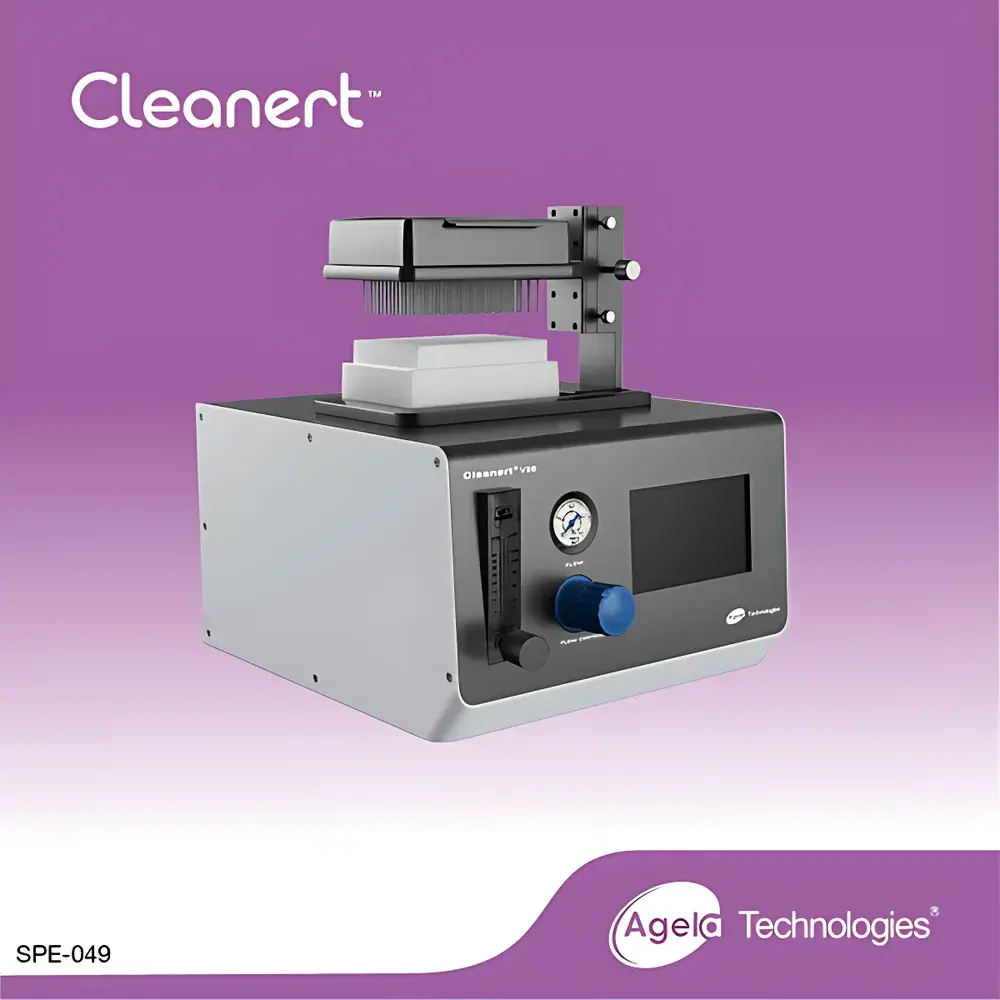
Agela Cleanert V96 Nitrogen Evaporator
| Brand | Agela |
|---|---|
| Origin | Tianjin, China |
| Model | Cleanert V96 |
| Heating Method | Dry-block heating |
| Temperature Control Range | 10°C to 30°C ambient operating environment |
| Temperature Setting Range | Room temperature +5°C to 80°C |
| Temperature Stability | ±0.5°C (typical at setpoint) |
| Gas Flow Rate | 10–100 L/min (adjustable per channel) |
| Sample Capacity | Configurable for 24-, 48-, or 96-well formats via modular gas manifolds |
| Dimensions (W×D×H) | 360 mm × 287 mm × 367 mm |
| Compliance | Designed for ISO/IEC 17025-compliant laboratories |
Overview
The Agela Cleanert V96 Nitrogen Evaporator is a precision-engineered dry-block evaporator system designed for high-throughput, reproducible solvent removal from biological, environmental, and pharmaceutical samples in 96-well microplate format. It operates on the principle of gentle, inert nitrogen gas displacement combined with precisely regulated conductive heating—eliminating direct flame or steam exposure while minimizing analyte degradation, oxidation, or cross-contamination. Unlike water-bath-based systems, the V96’s aluminum dry-block heater ensures rapid thermal equilibration, uniform well-to-well temperature distribution (<±0.5°C), and zero risk of water ingress or bath contamination. Its architecture supports seamless integration into automated sample preparation workflows, particularly when paired with Agela’s Cleanert M96 positive-pressure SPE manifold and standard SBS-format 96-well plates—enabling end-to-end parallel processing from extraction to concentration without manual tube transfer.
Key Features
- Dry-block heating module with PID-controlled temperature regulation across 10°C above ambient to 80°C, optimized for volatile organic solvents (e.g., acetonitrile, methanol, ethyl acetate) and thermolabile compounds.
- Modular gas distribution system supporting scalable configurations: factory-default 96-channel output, with optional field-upgradable 24- or 48-channel manifolds for method flexibility and resource optimization.
- Individual needle height adjustment (0–30 mm range) per well position to accommodate varying vial depths and ensure consistent gas impingement angle and flow velocity—critical for minimizing splashing and maximizing evaporation efficiency.
- Integrated mass-flow–calibrated gas control: each channel features independently adjustable flow valves calibrated to deliver 10–100 L/min total system flow, with fine-tuning capability down to ±1 L/min resolution.
- Robust aluminum chassis with chemical-resistant anodized surface, CE-marked power supply, and built-in overtemperature cutoff (90°C hardware limit) for operational safety and instrument longevity.
Sample Compatibility & Compliance
The Cleanert V96 accommodates all standard 96-well plate formats—including polypropylene, glass-insert, and deep-well plates—as well as custom tube racks (e.g., 1.5 mL, 2 mL, or 4 mL conical tubes) using optional adapter blocks. It is validated for use with common LC-MS, GC-MS, and ELISA sample matrices, including plasma, urine, soil extracts, and plant homogenates. From a regulatory standpoint, the system supports audit-ready workflows: temperature setpoints, run duration, and gas flow profiles can be manually logged or interfaced with external LIMS via RS-232/USB for 21 CFR Part 11–compliant electronic records. Its design aligns with ISO 17025 clause 6.4.3 (equipment verification) and supports GLP documentation requirements for method validation (e.g., recovery, precision, LOD/LOQ studies).
Software & Data Management
While the Cleanert V96 operates via intuitive front-panel controls (digital LED display, rotary encoder, and dedicated start/stop/pause keys), it includes analog and digital I/O ports for external triggering and parameter synchronization. Optional Agela LabLink software (v2.1+) enables remote monitoring of real-time temperature and flow status, scheduled shutdown, and CSV export of time-stamped operational logs—including start time, setpoint, actual block temperature, and elapsed run duration. All data files are timestamped and user-ID tagged, satisfying traceability requirements under GMP Annex 11 and FDA guidance on computerized system validation.
Applications
- Routine concentration of SPE-eluted fractions prior to LC-MS/MS analysis in clinical toxicology and doping control labs.
- High-throughput cleanup of pesticide residues in food safety testing (AOAC 2007.01, EN 15662).
- Pre-concentration of trace metals after chelation and extraction in environmental water testing (EPA Method 1638).
- Parallel evaporation of derivatized steroids in anti-doping reference laboratories compliant with WADA Technical Documents.
- Method development support for accelerated solvent removal during assay optimization in pharmaceutical QC environments.
FAQ
Can the Cleanert V96 be used with non-96-well sample vessels?
Yes—via optional aluminum adapter blocks, it supports 24-well, 48-well, and individual 1.5–4 mL tubes; contact technical support for dimensional specifications and compatibility verification.
Is temperature calibration traceable to NIST standards?
The unit ships with a factory calibration certificate; users may perform in-house verification using a NIST-traceable RTD probe inserted into designated calibration wells—procedures documented in the Operator Manual Section 4.2.
Does the system meet electrical safety requirements for EU laboratories?
Yes—it carries CE marking per Directive 2014/30/EU (EMC) and 2014/35/EU (LVD), with test reports available upon request.
How is gas flow accuracy maintained across all 96 channels?
Each channel incorporates a laminar-flow orifice and stainless-steel needle valve; flow uniformity is verified during final QA using a calibrated mass flow meter (±2% full-scale accuracy) across three representative channels at 25, 50, and 75 L/min settings.
What maintenance is required to ensure long-term stability?
Monthly inspection of needle tips for clogging, quarterly cleaning of the heating block recesses with isopropanol, and annual verification of temperature sensor drift using a certified reference thermometer.



