
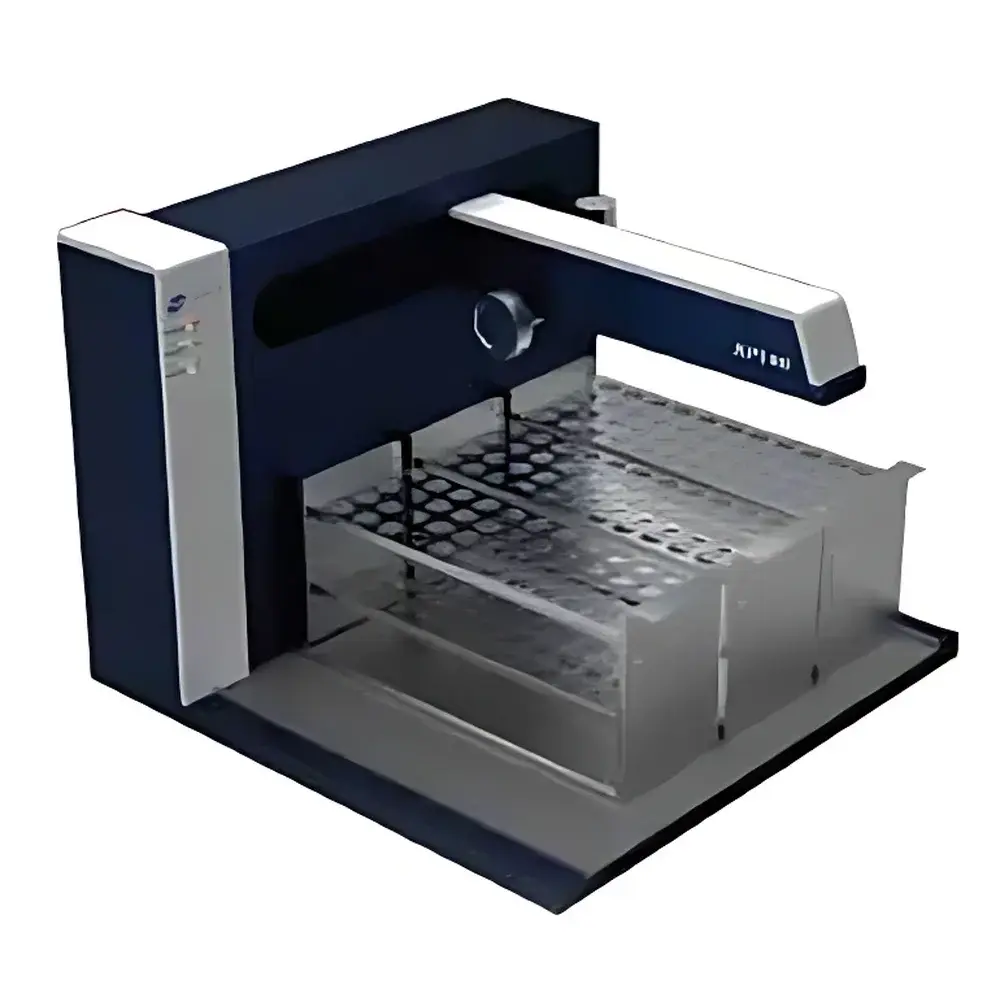
Agela FL-C100 XY-Coordinate Fraction Collector
| Brand | Agela |
|---|---|
| Model | FL-C100 |
| Type | Mixed-Mode Fraction Collector |
| Collection Axes | X-Y Dual-Axis |
| Positioning Accuracy | ≤ ±0.5 mm |
| Compatible Vessel Types | Conical Flasks, Round-Bottom Flasks, Beakers, Test Tubes |
| Waste/Collection Channel Switching | Dual-Path Solenoid-Valve Controlled |
| Power Supply | 100–240 VAC, 50/60 Hz |
| Dimensions (W×D×H) | 420 × 480 × 450 mm |
| Weight | 28 kg |
| Origin | Tianjin, China |
| Regulatory Compliance | CE-marked per EN 61010-1 for Laboratory Equipment |
Overview
The Agela FL-C100 XY-Coordinate Fraction Collector is an electromechanically controlled, programmable fraction collection system engineered for integration with analytical and preparative liquid chromatography platforms—including HPLC, UHPLC, and flash chromatography systems. It operates on a precision X-Y Cartesian coordinate mechanism, enabling accurate spatial positioning of collection vessels beneath the column effluent outlet. Unlike rotary or linear tray-based collectors, the FL-C100’s dual-axis motion architecture eliminates mechanical indexing delays and minimizes cross-contamination risk by decoupling vessel movement from fluid path switching. Its core function is to direct eluent into user-defined receptacles based on time, volume, or UV-triggered events—ensuring reproducible, traceable fractionation aligned with method development and purification workflows in pharmaceutical, academic, and quality control laboratories.
Key Features
- Precision XY-positioning system with stepper motor-driven gantry and optical encoder feedback, delivering ≤ ±0.5 mm positional repeatability across the full collection area.
- Modular tray design accommodating standard laboratory glassware: adjustable height support for conical flasks (50–500 mL), round-bottom flasks (25–250 mL), beakers (10–250 mL), and test tubes (12–18 mm diameter).
- Dual-path solenoid valve manifold enabling real-time switching between active collection and waste diversion—critical for gradient elution, peak skipping, or solvent recycling protocols.
- Embedded microcontroller with non-volatile memory retains up to 99 collection methods, each configurable with independent start/stop triggers, dwell times, and coordinate sequences.
- Front-panel LCD interface with tactile keypad supports standalone operation; optional RS-232 and USB-B ports enable bidirectional communication with third-party chromatography data systems (CDS) such as Chromeleon, Empower, or OpenLab.
- Compliance with IEC 61010-1 safety standards for laboratory electrical equipment, including overcurrent protection, thermal cutoff, and insulated high-voltage isolation for pump synchronization signals.
Sample Compatibility & Compliance
The FL-C100 accepts aqueous, organic, and mixed-solvent mobile phases commonly used in reversed-phase, normal-phase, and ion-exchange chromatography. Its wetted components—including PTFE tubing, stainless-steel valve bodies, and chemically inert collection tray surfaces—are compatible with acetonitrile, methanol, THF, dichloromethane, and dilute acid/base solutions (pH 2–12). No internal seals contact high-pressure flow paths, eliminating degradation concerns under sustained 0.1–10 mL/min flow rates. The unit is CE-marked and conforms to EN 61010-1:2010+A1:2019 for electrical safety. While not certified under FDA 21 CFR Part 11, its method storage and execution logs meet GLP documentation requirements when paired with validated CDS software supporting audit trail generation.
Software & Data Management
The FL-C100 operates natively via its onboard firmware without mandatory PC dependency. However, Agela provides optional Windows-compatible configuration software (v2.3+) that enables graphical method setup—including drag-and-drop coordinate mapping, UV threshold calibration, and CSV-based batch method import/export. All collection events are timestamped and logged locally with vessel ID, trigger type (time/volume/UV), and duration. When integrated with compliant CDS platforms, fraction metadata—including vial position, collection start time, and associated chromatogram markers—is embedded directly into raw data files, facilitating automated report generation per ISO/IEC 17025 or USP analytical instrument qualification frameworks.
Applications
- Preparative purification of natural products, synthetic intermediates, and peptide libraries where discrete fraction recovery is required prior to lyophilization or further analysis.
- Method development in QC labs validating HPLC assay specificity—collecting suspected impurity zones for offline MS or NMR identification.
- Automated fractionation in multi-dimensional LC (LC×LC) workflows, where second-dimension elution must be spatially resolved across sequential containers.
- Environmental testing labs performing EPA Method 8081/8270 fractionation of organochlorine pesticides or PAHs from extract cleanup steps.
- Academic research requiring reproducible solvent-gradient fractionation for kinetic studies or reaction monitoring via online UV detection.
FAQ
What types of chromatography systems can the FL-C100 interface with?
It supports analog TTL/relay outputs from most commercial HPLC pumps and detectors, as well as digital triggers via RS-232 or USB from major CDS vendors. No proprietary hardware interface is required.
Is the collection tray autoclavable?
No—the tray is constructed from anodized aluminum and PTFE-coated stainless steel, rated for chemical resistance but not steam sterilization. Wipe-down cleaning with isopropanol or dilute NaOH is recommended.
Can the FL-C100 operate without a connected computer?
Yes. All methods, coordinates, and triggers are stored and executed independently using the built-in controller and LCD interface.
Does it support timed collection only, or also UV-triggered collection?
Both modes are supported. UV triggering requires connection to a detector’s analog output (0–1 V or 0–5 V) and user-defined threshold adjustment within the device firmware.
What is the maximum number of fractions per run?
Limited only by tray capacity and method definition—up to 99 distinct collection events per method, with no hard limit on total vials if multi-tray sequencing is implemented externally.







