
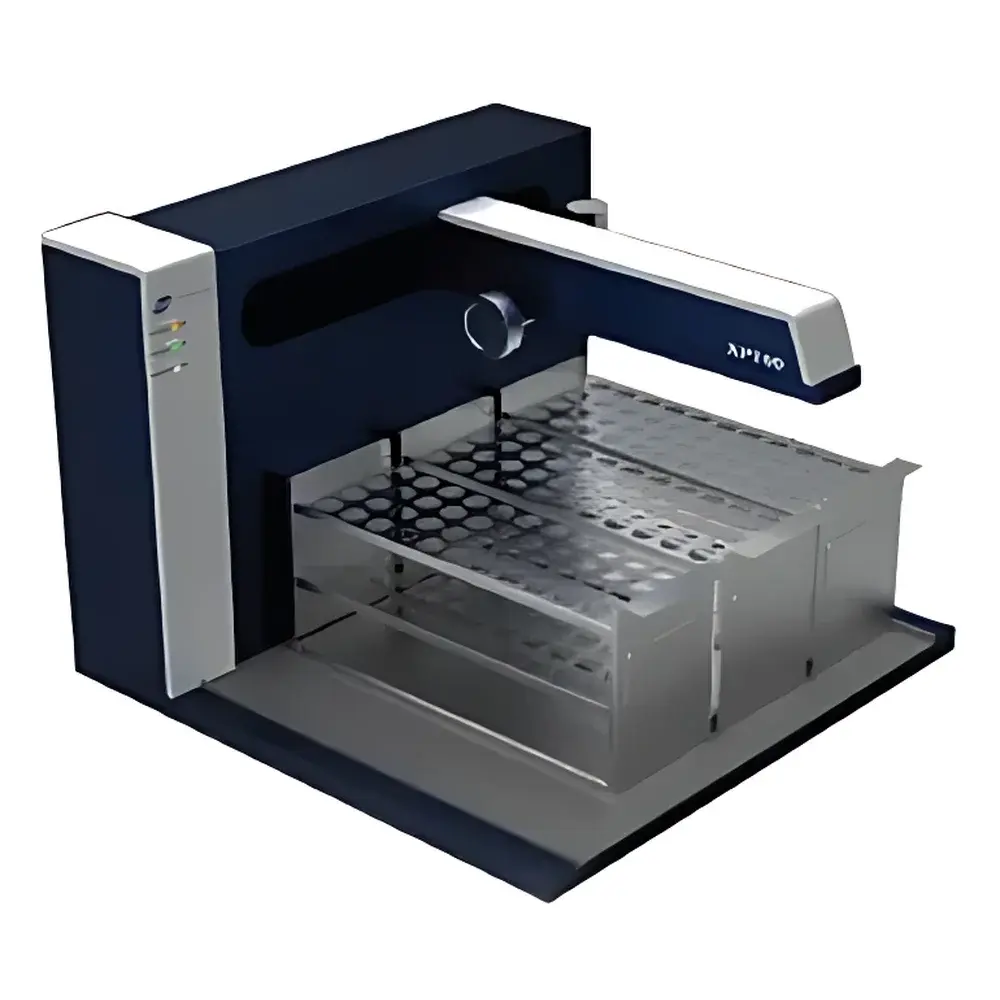
Agela FL-C500 Fraction Collector
| Brand | Agela |
|---|---|
| Origin | Tianjin, China |
| Type | Liquid-phase Fraction Collector |
| Max Flow Rate | 1 L/min |
| Collection Vessel Options | 13 mm, 15 mm, 18 mm, 25 mm test tubes & 100 mL conical flasks |
| Collection Modes | Full-collection, Manual-triggered, Threshold-triggered (peak-based), Waste/Collection Switching |
| Tube Rack Compatibility | F1–F4 standard racks (13–25 mm) + custom rack support |
| Interface | RS-232 |
| Design | Multi-channel bow-shaped collection head with adjustable software-defined coordinates |
Overview
The Agela FL-C500 Fraction Collector is an engineered liquid-phase fractionation module designed for seamless integration with analytical and preparative liquid chromatography systems—including HPLC, UHPLC, and flash chromatography platforms. It operates on a precision electromechanical actuation principle, utilizing a motorized, bow-shaped collection arm that moves along X–Y coordinates to position the effluent stream over user-defined receptacles. Unlike gravity-fed or fixed-position collectors, the FL-C500 employs closed-loop electronic control to ensure repeatable spatial accuracy—critical for reproducible fraction isolation in method development, purity assessment, and compound library generation. Its architecture supports real-time synchronization with detector signals via RS-232, enabling deterministic, event-driven fraction triggering without reliance on external timers or manual intervention.
Key Features
- Multi-channel bow-shaped collection head with independent waste and collection path selection—enabling uninterrupted operation during solvent flush or baseline stabilization.
- Software-defined coordinate mapping allows precise alignment to diverse vessel geometries: 13 mm, 15 mm, 18 mm, and 25 mm test tubes; 100 mL conical flasks; and custom-configured tube racks.
- Three operational modes: full-collection (continuous), manual-triggered (operator-initiated), and threshold-triggered (based on UV/VIS absorbance, conductivity, or other analog detector outputs).
- Maximum flow handling capacity of 1 L/min—validated for compatibility with high-flow flash systems and low-backpressure preparative columns.
- RS-232 serial interface ensures bidirectional communication with third-party chromatography data systems (CDS), supporting command scripting and status feedback for audit-ready workflows.
- Modular rack system includes four standardized holders (F1–F4) and supports OEM-style rack customization for non-standard containers—e.g., deep-well plates or glass vials with unique footprints.
Sample Compatibility & Compliance
The FL-C500 accommodates a broad range of laboratory-grade collection vessels without mechanical adaptation. Its adjustable Z-axis clearance and programmable dwell time per position accommodate both narrow-bore tubes and wide-mouth flasks while minimizing splashing and cross-contamination risk. All wetted components are constructed from chemically resistant polymers compatible with common HPLC solvents (acetonitrile, methanol, aqueous buffers, DCM, ethyl acetate). The device complies with IEC 61010-1 safety standards for laboratory electrical equipment and supports GLP/GMP-aligned documentation practices through timestamped collection logs and configurable metadata tagging (e.g., run ID, fraction number, trigger condition). While not FDA 21 CFR Part 11–certified out-of-the-box, its RS-232 logging capability enables integration into validated CDS environments where electronic signatures and audit trails are managed at the system level.
Software & Data Management
The FL-C500 operates with Agela’s Fraction Control Suite—a Windows-based application supporting real-time monitoring, coordinate calibration, and method export/import. Each collection event records the exact X/Y coordinates, elapsed time, detector threshold crossing point, and operator annotation. Export formats include CSV and XML, facilitating downstream analysis in ELN systems or statistical process control tools. The software supports multi-method storage and recall, enabling rapid reconfiguration between analytical-scale peak cutting and preparative bulk fractionation. All configuration changes and collection events are logged with ISO 8601 timestamps, providing traceability required under ISO/IEC 17025 and ASTM E2500-17 guidelines for instrument qualification.
Applications
- Peak fractionation in reversed-phase and normal-phase HPLC for natural product isolation and metabolite purification.
- Automated collection of elution windows during gradient flash chromatography—reducing manual labor and improving recovery consistency.
- Method scouting workflows where multiple fractions across retention time windows are collected for parallel MS/NMR characterization.
- QC release testing of pharmaceutical intermediates, where discrete fractions are assayed for residual solvents or degradation products per USP <467>.
- Process analytical technology (PAT) implementations requiring synchronized fraction capture with inline UV or refractive index detection.
FAQ
What types of chromatography systems can the FL-C500 interface with?
It is compatible with any LC system providing analog voltage output (0–10 V) or TTL-level trigger signals, and supports RS-232 handshake protocols used by major vendors including Waters, Shimadzu, Thermo Fisher, and Agilent.
Does the FL-C500 support timed fraction collection?
Yes—time-based collection is available as a secondary mode, but the primary design emphasizes detector-synchronized triggering for higher fidelity fraction boundaries relative to chromatographic peaks.
Can the collection coordinates be recalibrated after changing tube racks?
Yes—the software includes a guided calibration routine using reference points on the installed rack, ensuring sub-millimeter positional repeatability across hardware swaps.
Is remote control or network connectivity supported?
Native Ethernet or Wi-Fi is not integrated; however, RS-232-to-TCP/IP converters may be deployed in lab networks to enable centralized control via existing infrastructure.
What maintenance is required for long-term reliability?
Routine cleaning of the collection nozzle and waste line is recommended after each use with high-boiling solvents; no scheduled calibration is required due to the drift-free stepper motor positioning system.





