
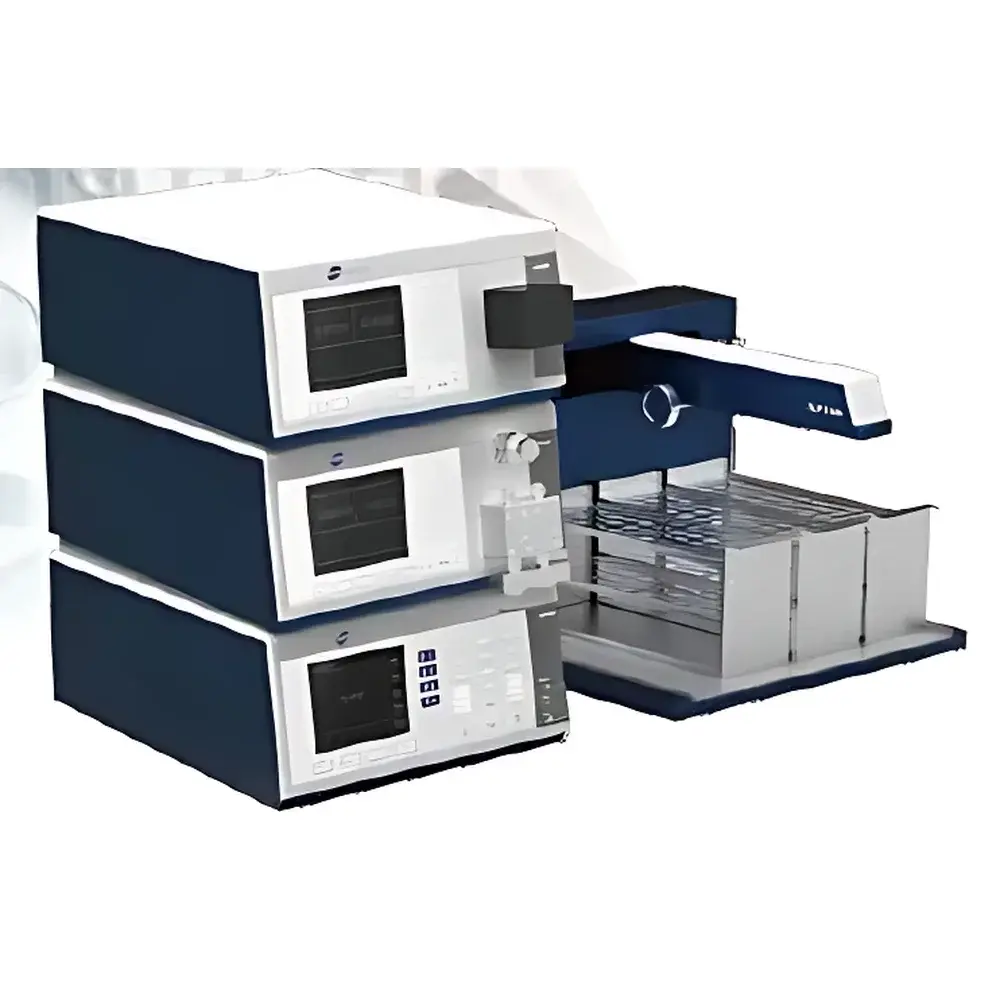
Agela FLEXA-MH Preparative Liquid Chromatography System
| Brand | Agela |
|---|---|
| Origin | Tianjin, China |
| Model | FLEXA-MH |
| Application Level | Laboratory Grade |
| Instrument Type | Medium-to-Low Pressure Preparative LC |
| Flow Rate Range | 1–200 mL/min |
| Flow Accuracy | ±2% |
| Flow Precision (RSD) | ≤2% |
| Maximum Pressure | 10 MPa |
| Wavelength Range | 200–800 nm (selectable dual-wavelength mode) |
| Wavelength Accuracy | ±1 nm |
| Wavelength Repeatability | 0.2 nm |
| Baseline Noise | ±0.75 × 10⁻⁵ AU at 254 nm, TC = 1 s |
| Data Acquisition Rate | Not specified |
| Detection Options | UV-Vis (dual-wavelength), optional ELSD or RI detector |
| Gradient Capability | Binary gradient, supporting linear, isocratic, and custom profiles |
| Column Configuration | Compatible with both reversed-phase and normal-phase chromatography |
| Collection Mode | X/Y-axis programmable fraction collector |
Overview
The Agela FLEXA-MH Preparative Liquid Chromatography System is an integrated, medium-to-low pressure preparative LC platform engineered for reproducible isolation and purification of organic compounds, natural products, pharmaceutical intermediates, and synthetic molecules in laboratory-scale research and development environments. Built upon robust industrial-grade components—including dual-piston reciprocating metering pumps and a high-stability UV-Vis detection module—the system operates on fundamental principles of liquid-phase partition chromatography. It supports both reversed-phase and normal-phase separation mechanisms, enabling method flexibility across diverse compound polarities. Designed for operational transparency and method fidelity, the FLEXA-MH delivers consistent flow delivery up to 200 mL/min at pressures up to 10 MPa, facilitating scalable purification from analytical screening through gram-level isolation.
Key Features
- Dual-wavelength UV-Vis detection with independent wavelength selection across 200–800 nm, allowing simultaneous monitoring of primary analyte (e.g., at λmax) and co-eluting impurities or secondary targets—enhancing fraction decision accuracy without hardware reconfiguration.
- High-precision dual-piston reciprocating pump architecture ensures long service life, minimal pulsation, and flow stability compliant with ISO 13842:2017 guidelines for preparative LC performance verification.
- Programmable X/Y-axis fraction collector accommodates standard test tubes, vials, microplates (96-/384-well), and custom containers, with positional repeatability < ±0.2 mm.
- Binary gradient solvent delivery enables linear, stepwise, or user-defined gradient profiles—critical for resolving complex mixtures where retention time control directly impacts purity yield.
- Modular detector compatibility: UV-Vis module is standard; evaporative light scattering (ELSD) and refractive index (RI) detectors are available as validated plug-in options per ASTM D7213 and USP recommendations for non-UV-absorbing analytes.
- Unified software interface controls all subsystems—pumps, detector(s), fraction collector, and optional column switch valves—eliminating inter-device protocol mismatches and reducing method transfer errors.
Sample Compatibility & Compliance
The FLEXA-MH accommodates samples ranging from small-molecule organics (<500 Da) to moderately sized peptides and natural product extracts (up to ~2 kDa). Its solvent compatibility spans common HPLC-grade mobile phases—including water/acetonitrile, water/methanol, hexane/ethyl acetate, and chloroform/methanol systems—with wetted parts constructed from chemically resistant stainless steel (316L), PEEK, and sapphire. The system meets essential design criteria for GLP-compliant laboratories: electronic audit trails (via optional 21 CFR Part 11–enabled software module), method versioning, user access control, and raw data integrity per ICH M7 and ISO/IEC 17025:2017 Annex A requirements. All firmware and control logic are traceable to documented design specifications and factory calibration certificates.
Software & Data Management
Control and data acquisition are managed through Agela’s proprietary ChromaMaster™ workstation software, compatible with Windows 10/11 (64-bit). The interface supports intuitive method building—including real-time gradient preview, dwell volume compensation, and auto-zero baseline correction—and provides native export to CSV, ASCII, and CDF formats for integration with third-party analysis tools (e.g., Chromeleon, OpenLab CDS). Raw chromatograms include embedded metadata: timestamp, instrument ID, method name, operator ID, and detector configuration. Optional software modules enable electronic signature workflows, automated report generation (PDF/HTML), and secure network deployment in multi-user lab networks—fully auditable under FDA 21 CFR Part 11 Subpart B when configured with time-stamped digital signatures and role-based permissions.
Applications
- Purification of synthetic reaction mixtures prior to NMR or MS characterization.
- Isolation of active constituents from plant extracts or fermentation broths.
- Preparative-scale chiral separations using polysaccharide-based columns (e.g., Chiralpak® AD-H, AS-H).
- Process development support for API purification under QbD (Quality by Design) frameworks.
- Generation of reference standards and certified calibration materials in accordance with ISO Guide 35.
- Method scouting and transfer between analytical and preparative platforms via retention time normalization algorithms.
FAQ
What pressure range is supported for preparative-scale separations?
The FLEXA-MH operates reliably up to 10 MPa (1450 psi), optimized for medium-pressure applications such as flash chromatography and low-flow high-resolution prep-LC.
Can the system perform gradient elution with more than two solvents?
While the standard configuration includes binary gradient capability, tertiary or quaternary mixing can be achieved via external low-dead-volume mixing manifolds—validated per ASTM D7213 Annex B for compositional accuracy.
Is method validation documentation available for regulatory submissions?
Yes—Agela provides IQ/OQ documentation templates, pump linearity reports, UV wavelength verification protocols, and detector linearity datasets aligned with USP , EP 2.2.46, and ICH Q2(R2) guidance.
How is baseline noise performance verified during installation qualification?
Baseline noise is measured per USP using a 1 cm pathlength cell, deuterium lamp, and 254 nm setting at 1 s time constant; results are recorded in the Factory Acceptance Test (FAT) report.
Does the software support remote monitoring or unattended overnight runs?
Yes—ChromaMaster™ includes scheduled run initiation, email/SMS alert triggers on completion or error, and encrypted remote desktop access via TLS 1.2–secured VNC tunneling.




