
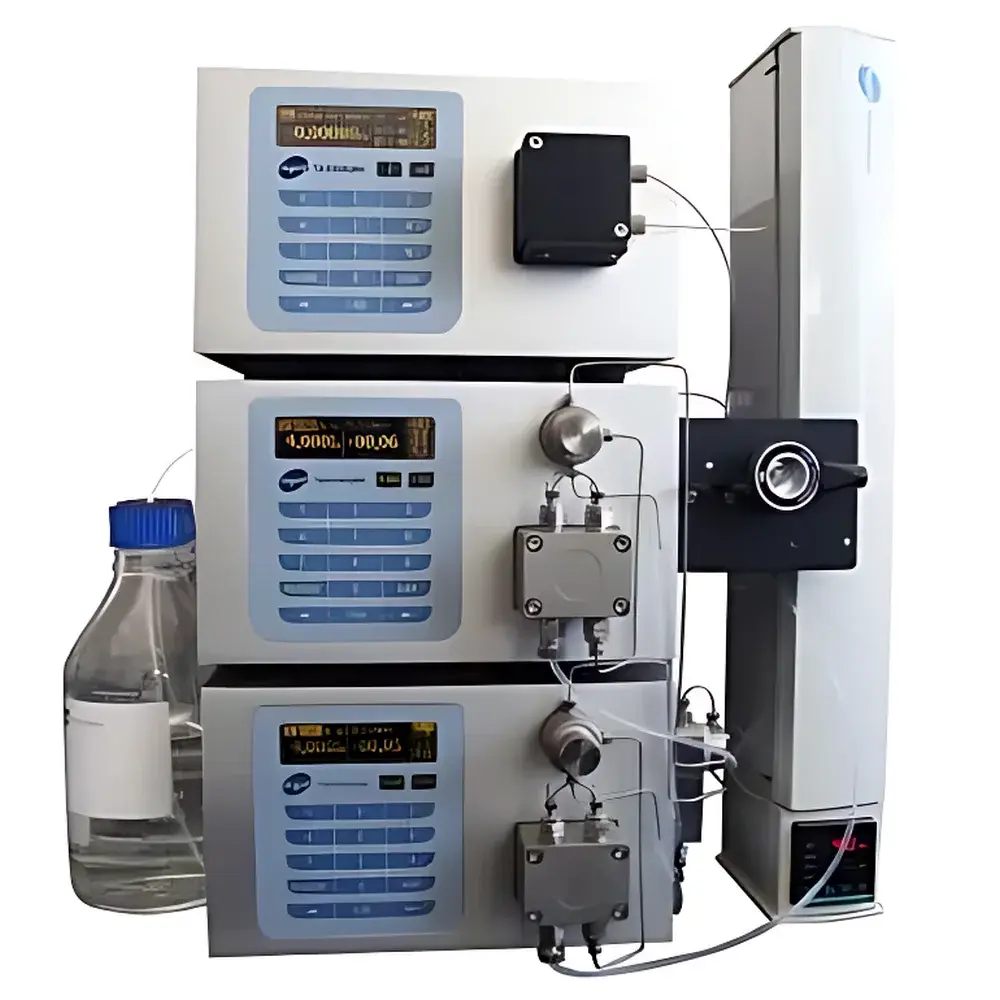
Agela LC-10F Analytical High-Performance Liquid Chromatograph
| Brand | Agela |
|---|---|
| Origin | Tianjin, China |
| Manufacturer Type | Authorized Distributor |
| Product Category | Domestic HPLC System |
| Model | LC-10F |
| Instrument Type | Conventional Analytical HPLC |
| Flow Rate Range | 1–9.999 mL/min |
| Maximum Operating Pressure | 42 MPa |
| Injection Volume Range | 1–20 µL |
| Wavelength Range | 200–800 nm |
| Data Acquisition Rate | Up to 60 Hz (programmable) |
Overview
The Agela LC-10F is a robust, entry-level analytical high-performance liquid chromatograph engineered for routine quantitative and qualitative analysis in quality control, regulatory testing, and method development laboratories. It operates on the fundamental principle of reversed-phase liquid chromatography (RPLC), where analytes are separated based on differential partitioning between a polar mobile phase and a non-polar stationary phase under high-pressure conditions. Designed with emphasis on stability, baseline integrity, and method transferability, the LC-10F delivers reproducible retention times and peak symmetry across diverse sample matrices—particularly validated for feed and food safety applications including amino acid profiling, vitamin quantification, melamine screening, and Sudan dye detection. Its architecture supports compliance-driven workflows without requiring enterprise-grade infrastructure, making it suitable for GLP-compliant environments where audit-ready documentation and system suitability verification are essential.
Key Features
- High-precision analytical pump with Electrical Damping Control (EDC) technology to suppress flow pulsation—reducing baseline noise and improving integration accuracy for low-abundance analytes.
- Multi-point flow calibration curve embedded in firmware, ensuring volumetric accuracy across the full operational range (1–9.999 mL/min) per ISO 17025 traceability requirements.
- Dual-beam UV-Vis detector featuring balanced optical path design to minimize thermal drift-induced baseline shift; optimized for stability over extended run times (≥24 h).
- Full digital signal processing (DSP) architecture eliminating analog interference sources—achieving typical baseline noise < ±0.5 × 10⁻⁵ AU at 254 nm (1 s time constant).
- Modular hardware layout supporting future expansion: compatible with optional column oven modules, autosampler retrofit kits, and fraction collector interfaces.
- Pressure monitoring with real-time display and programmable shutdown thresholds (up to 42 MPa), aligned with ISO 11471 safety guidelines for high-pressure fluid systems.
Sample Compatibility & Compliance
The LC-10F accommodates standard 3.9–4.6 mm ID analytical columns (lengths up to 250 mm) packed with C18, C8, phenyl-hexyl, or HILIC phases. It has been operationally validated for complex biological and agricultural extracts—including feed homogenates, fortified milk powder digests, and spice adulterant suspensions—without requiring extensive sample cleanup. The system meets core performance criteria outlined in USP , EP 2.2.46, and AOAC Official Method 2007.01 for melamine in animal feed. While not pre-certified for FDA 21 CFR Part 11, its software architecture supports electronic signature implementation and audit trail generation when deployed with compliant LIMS or ELN platforms.
Software & Data Management
Control and data acquisition are managed via Agela ChromoLink v3.x software—a Windows-based application supporting isocratic and gradient methods, peak integration with customizable baselines, and system suitability testing (SST) templates per ICH Q2(R2). Raw data files (.agd) adhere to open-binary format specifications, enabling third-party reprocessing in Chromeleon, OpenLab CDS, or Python-based chromatographic libraries (e.g., PyChromat). Audit trails record all method edits, injection events, and calibration actions with timestamped user IDs. Data export supports CSV, PDF reports, and XML formats compatible with laboratory information management systems (LIMS) used in contract testing labs serving EU and North American markets.
Applications
- Routine QC testing of vitamins (B1, B2, B6, B12, E, K) in premixes and finished feeds per AOAC 992.18 and ISO 11282.
- Confirmatory analysis of banned dyes (Sudan I–IV, Para Red) in chili powder and tomato paste using EPA Method 3550C-modified extraction protocols.
- Quantitation of free and protein-bound amino acids in soybean meal and fishmeal hydrolysates using o-phthalaldehyde (OPA) pre-column derivatization.
- Screening for melamine and cyanuric acid in dairy ingredients under China GB/T 22388–2008 and EU Commission Regulation (EC) No 292/2008.
- Method development support for new contaminants—such as mycotoxin metabolites or veterinary drug residues—leveraging its wide wavelength range (200–800 nm) for dual-wavelength ratio tracking.
FAQ
Does the LC-10F support gradient elution?
Yes—the integrated binary pump enables linear, step, or multi-segment gradient programming with solvent composition accuracy ≤ ±0.5% RSD.
Is an autosampler included with the base configuration?
No; the LC-10F is supplied as a manual-injection system. Agela offers the AS-10F autosampler as a field-upgradable option with 100-position capacity and 1–100 µL variable loop.
What validation documentation is provided?
Each unit ships with Factory Acceptance Test (FAT) report, IQ/OQ protocol templates, and a Certificate of Conformance referencing ASTM E2656-19 for HPLC system performance verification.
Can the detector perform spectral scanning?
No—the UV-Vis detector is fixed-wavelength or single-wavelength programmable; it does not include diode array functionality or spectral acquisition capability.
What maintenance intervals are recommended for the pump seals and detector lamp?
Pump seal replacement is advised every 6,000 operating hours or biannually under continuous use; deuterium lamp lifetime is rated at ≥1,200 hours under standard 254 nm operation.




