
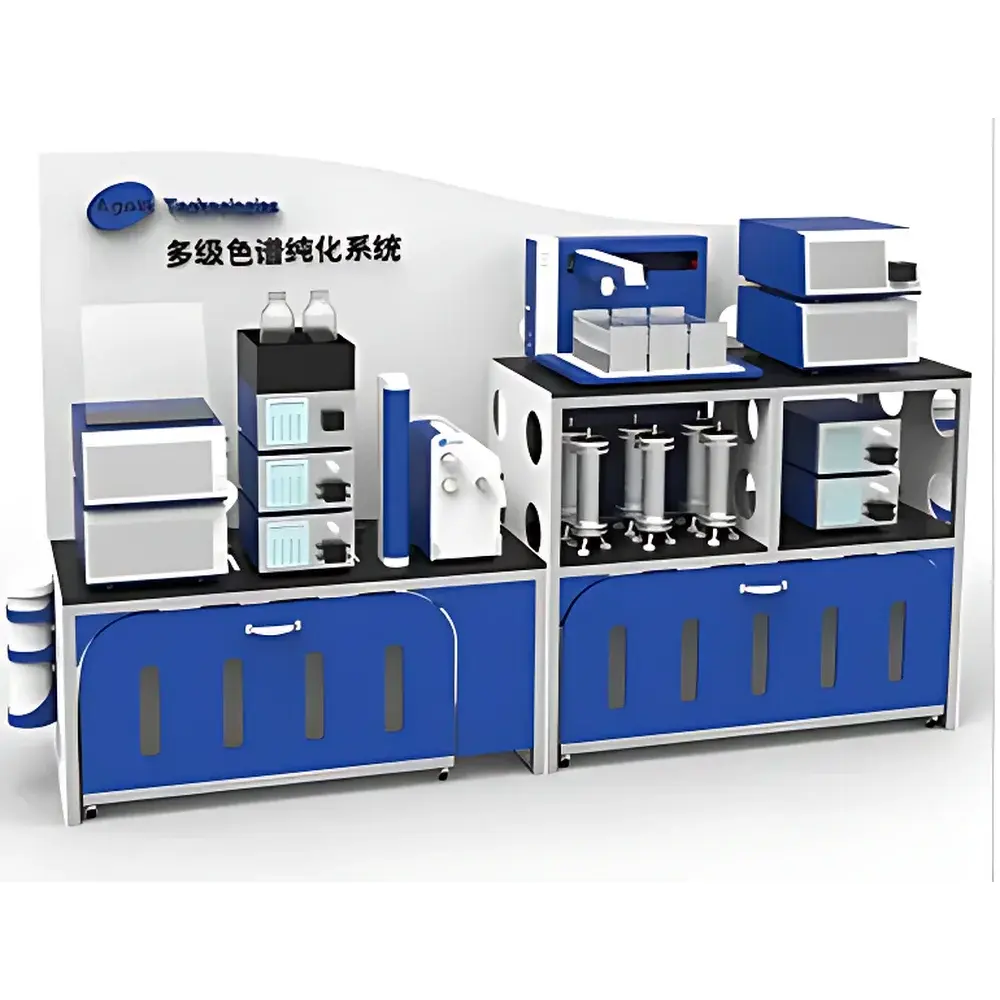
Agela Multi-Stage Chromatographic Purification System
| Brand | Agela |
|---|---|
| Origin | Tianjin, China |
| Model | Multi-Stage Chromatographic Purification System |
| Instrument Type | Conventional High-Performance Liquid Chromatography (HPLC) System |
| Configuration | Integrated Three-Stage Automated Purification Platform |
| Application Focus | Downstream Processing of Biologics, Natural Product Isolation, and Complex Matrix Sample Purification |
| Compliance Framework | Designed to support GLP-compliant workflows and scalable process development |
Overview
The Agela Multi-Stage Chromatographic Purification System is an integrated, automated preparative liquid chromatography platform engineered for high-fidelity fractionation of complex biological and natural product mixtures. Unlike conventional single-column HPLC systems, this architecture implements a sequential, decision-driven purification cascade based on real-time analytical feedback—enabling dynamic column switching, targeted fraction routing, and minimized band broadening across stages. The system operates on a three-tiered separation principle: Stage I performs coarse particulate removal and buffer exchange via inline filtration; Stage II executes primary enrichment and orthogonal separation (e.g., ion exchange or hydrophobic interaction), coupled with rapid in-line UV/Vis detection (200–400 nm) to trigger conditional flow path selection; Stage III delivers high-resolution polishing using reversed-phase or size-exclusion media under precisely controlled gradient conditions. This staged logic significantly reduces sample dilution, improves recovery of labile analytes, and enhances reproducibility in multi-step purification protocols—particularly critical for monoclonal antibody fragments, plant-derived alkaloids, fermentation broths, and cell lysate supernatants.
Key Features
- Three-stage modular architecture with fully programmable valve sequencing and pressure-monitored flow routing
- Real-time UV absorbance monitoring at Stage II outlet enabling closed-loop, detection-triggered column switching
- Integrated solvent management with dual-gradient capability for independent mobile phase control per stage
- Automated fraction collection with position-coded vial tracking and time/volume/UV-threshold triggering
- Robust stainless-steel fluidic path rated for sustained operation up to 25 MPa (3625 psi), compatible with standard preparative HPLC columns (i.d. 10–50 mm)
- Embedded system diagnostics including leak detection, pressure deviation alerts, and pump priming status reporting
Sample Compatibility & Compliance
The system accommodates aqueous, organic-aqueous, and mildly acidic/basic mobile phases (pH 2–10), supporting common stationary phases including silica-based C18, polymeric ion exchangers, and agarose-based affinity resins. It is routinely deployed in academic natural product labs, biopharmaceutical process development groups, and contract research organizations performing early-stage purification of recombinant proteins and secondary metabolites. While not pre-certified for GMP manufacturing, its architecture supports audit-ready documentation: all method parameters, run logs, fraction metadata, and operator actions are timestamped and stored with SHA-256 hash integrity verification. The system meets baseline requirements for adherence to ICH Q5A/Q5B, USP <1058>, and ISO/IEC 17025:2017 for analytical instrument qualification—particularly when validated per vendor-supplied IQ/OQ protocols.
Software & Data Management
Control and data acquisition are managed through Agela ChromoLink™ v4.x software, a Windows-based application compliant with FDA 21 CFR Part 11 requirements—including electronic signatures, role-based access control, and immutable audit trails. All chromatograms, fraction maps, and system event logs are saved in open-standard .cdf (NetCDF) format, ensuring long-term readability and third-party compatibility with tools such as OpenChrom or MATLAB. Batch processing templates allow replication of multi-stage methods across instruments, while the method editor supports conditional logic (e.g., “if A280 > 0.5 mAU, divert to Stage III”). Raw data files include embedded calibration coefficients and hardware configuration fingerprints for full traceability.
Applications
- Purification of His-tagged proteins from E. coli lysates using IMAC → SEC → RP-HPLC cascade
- Isolation of cytotoxic diterpenoids from crude plant extracts via flash → HILIC → chiral HPLC workflow
- Downstream processing of CRISPR-Cas9 ribonucleoprotein complexes with size-based capture followed by charge-based polishing
- Removal of endotoxins and host-cell proteins from monoclonal antibody harvests using multimodal resin screening across stages
- Preparative isolation of oligonucleotide impurities (n−1, n−2) for reference standard generation
FAQ
Does the system support method transfer from analytical to preparative scale?
Yes—ChromoLink™ includes built-in scalability calculators that convert analytical gradient profiles to preparative equivalents using column volume normalization and linear velocity preservation algorithms.
Can third-party columns be used without hardware modification?
All stages accept standard 1/4″-28 threaded column fittings and accommodate industry-standard column o.d. (10–50 mm); no adapter kits or firmware updates are required.
Is remote monitoring supported?
The system features Ethernet/IP connectivity with optional OPC UA server integration, enabling secure remote status viewing and alarm notification via enterprise SCADA or LIMS platforms.
What validation documentation is provided?
Agela supplies comprehensive IQ/OQ documentation packages—including test scripts, acceptance criteria, and blank execution records—aligned with ASTM E2500-13 and EU Annex 15 guidelines.
How is carryover mitigated between runs?
The system implements automated post-run column flushing with configurable solvent strength and dwell time, plus active needle wash cycles with dual-solvent aspiration during autosampler operation.




