
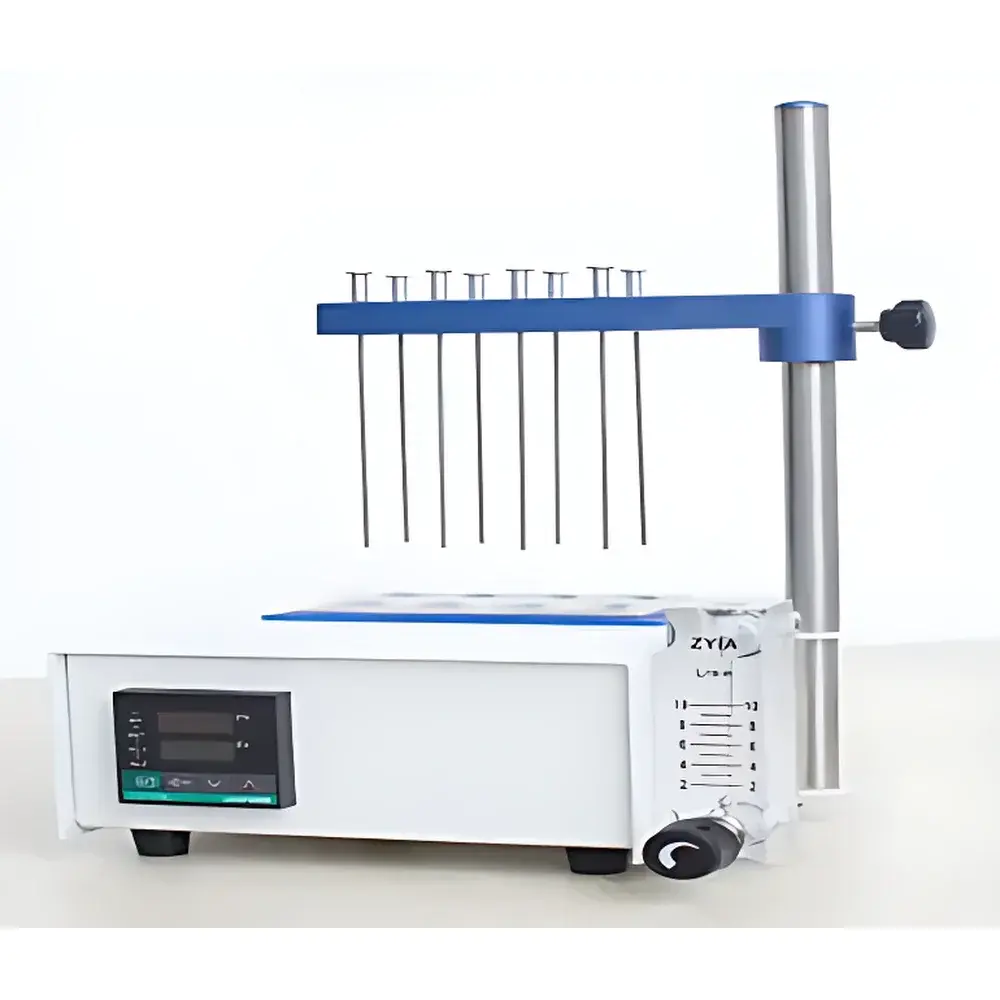
Agela NV15-G Nitrogen Evaporator
| Brand | Agela |
|---|---|
| Origin | Tianjin, China |
| Model | NV15-G |
| Heating Method | Water Bath |
| Temperature Range | >5 °C above ambient to 80 °C |
| Temperature Stability | ±1 °C |
| Sample Tube Diameter | 20 mm |
| Gas Flow Rate | 0–10 L/min |
| Sample Capacity | 8–24 positions |
| Heating Power | 240 W |
| Tube Depth | 70 mm |
| Temp Accuracy | ±0.3 °C (at setpoint) |
| Operating Ambient | 0–50 °C, ≤85% RH |
| Power Supply | 220 V/50 Hz |
| Net Weight | 3.5 kg |
Overview
The Agela NV15-G Nitrogen Evaporator is an engineered solution for gentle, reproducible solvent removal from multiple liquid samples under inert nitrogen atmosphere. Designed for laboratories performing sample preparation prior to chromatographic or mass spectrometric analysis, the system employs controlled water-bath heating combined with adjustable, per-channel nitrogen gas flow to accelerate evaporation while minimizing analyte degradation, oxidation, or thermal decomposition. Unlike dry-block or air-heated evaporators, the water bath provides uniform thermal distribution across all sample positions—critical for inter-sample comparability in quantitative workflows. The instrument operates on the principle of nitrogen sweep-assisted surface evaporation: pressurized nitrogen gas is directed tangentially over the liquid meniscus in each tube, lowering the partial pressure of volatile solvents and enhancing mass transfer without vigorous bubbling or splashing. This method is widely adopted in environmental testing, food safety, clinical toxicology, and pharmaceutical residue analysis where low-ppb recovery and high parallelism are required.
Key Features
- Modular sample capacity: configurable 8-, 12-, 16-, or 24-position configurations to match throughput requirements without compromising temperature homogeneity
- Independent gas flow control per channel with mechanical shut-off valves—enables selective termination of nitrogen delivery to individual tubes during sequential processing
- Precision water-bath temperature control (range: >5 °C above ambient to 80 °C; stability: ±1 °C; accuracy: ±0.3 °C at setpoint) via PID-regulated heating element (240 W)
- Optimized tube geometry support: accommodates standard 20 mm OD glass or plastic test tubes with 70 mm insertion depth for consistent immersion and thermal coupling
- Integrated gas manifold with calibrated rotameter and stainless-steel tubing—ensures corrosion resistance and long-term flow repeatability (0–10 L/min total range)
- Compact footprint (approx. 280 × 220 × 320 mm) and lightweight design (3.5 kg) suitable for fume hoods, clean benches, or shared lab workstations
- Compliance-ready operation: no embedded software or data storage; fully compatible with laboratory information management systems (LIMS) via external documentation protocols
Sample Compatibility & Compliance
The NV15-G supports a broad range of sample matrices including aqueous extracts, organic solvent eluates (e.g., ethyl acetate, hexane, acetonitrile), and buffered biological fluids. Its open architecture allows use with standard 20 mm OD vials, culture tubes, and GC/MS autosampler vials (with appropriate adapters). The system meets general laboratory safety standards for electrical equipment (IEC 61010-1) and is constructed using RoHS-compliant materials. While not a regulated medical device, its operational parameters align with common method validation requirements outlined in EPA Method 525.3, ISO 17025-accredited sample prep SOPs, and USP guidelines for residual solvent removal. Temperature calibration traceability follows NIST-traceable references, supporting GLP documentation when paired with external loggers.
Software & Data Management
The NV15-G is a stand-alone analog instrument with no onboard microprocessor, firmware, or digital interface. All parameter setting—including bath temperature and total gas flow—is performed manually via mechanical dials and analog indicators. This architecture eliminates cybersecurity concerns, software validation burdens, and electronic audit trail requirements. Users maintain full procedural control through written SOPs and manual logbooks, making it particularly suitable for regulated environments where simplicity, transparency, and minimal validation overhead are prioritized. For labs requiring electronic records, integration is achieved externally via calibrated temperature data loggers (e.g., HOBO UX100 series) and flow meters compliant with ISO/IEC 17025 calibration intervals.
Applications
- Concentration of pesticide residues in fruit/vegetable extracts prior to GC-MS analysis (per EN 15662)
- Pre-concentration of pharmaceutical impurities in stability-indicating HPLC methods
- Final volume adjustment of plasma or urine samples in clinical LC-MS/MS bioanalysis
- Removal of chlorinated solvents from soil leachates in environmental monitoring programs
- Parallel cleanup of fatty acid methyl esters (FAMEs) in biodiesel quality control
- Preparation of calibration standards and QC reference materials across analytical chemistry disciplines
FAQ
Is the NV15-G compatible with 15-mL conical centrifuge tubes?
Yes—when used with optional tube-height adapters, the 70-mm well depth accommodates most 15-mL conical tubes with stable vertical alignment.
Can I use compressed air instead of nitrogen?
Air may be substituted only for non-oxidation-sensitive applications; however, nitrogen is strongly recommended for analytes prone to degradation (e.g., unsaturated lipids, catecholamines, nitrosamines).
What maintenance is required?
Routine cleaning of the water bath chamber and periodic inspection of O-rings and gas line connections are sufficient; no scheduled calibration is mandated beyond annual verification against reference thermometers.
Does the unit include a nitrogen generator?
No—the NV15-G requires connection to an external nitrogen source (cylinder or lab-grade generator) via standard 6-mm OD polyurethane tubing.
How is temperature uniformity verified across positions?
Agela provides a validation protocol using multi-point RTD probes; typical inter-position variation is ≤±0.5 °C at 40 °C steady state, as confirmed by third-party lab reports available upon request.



