
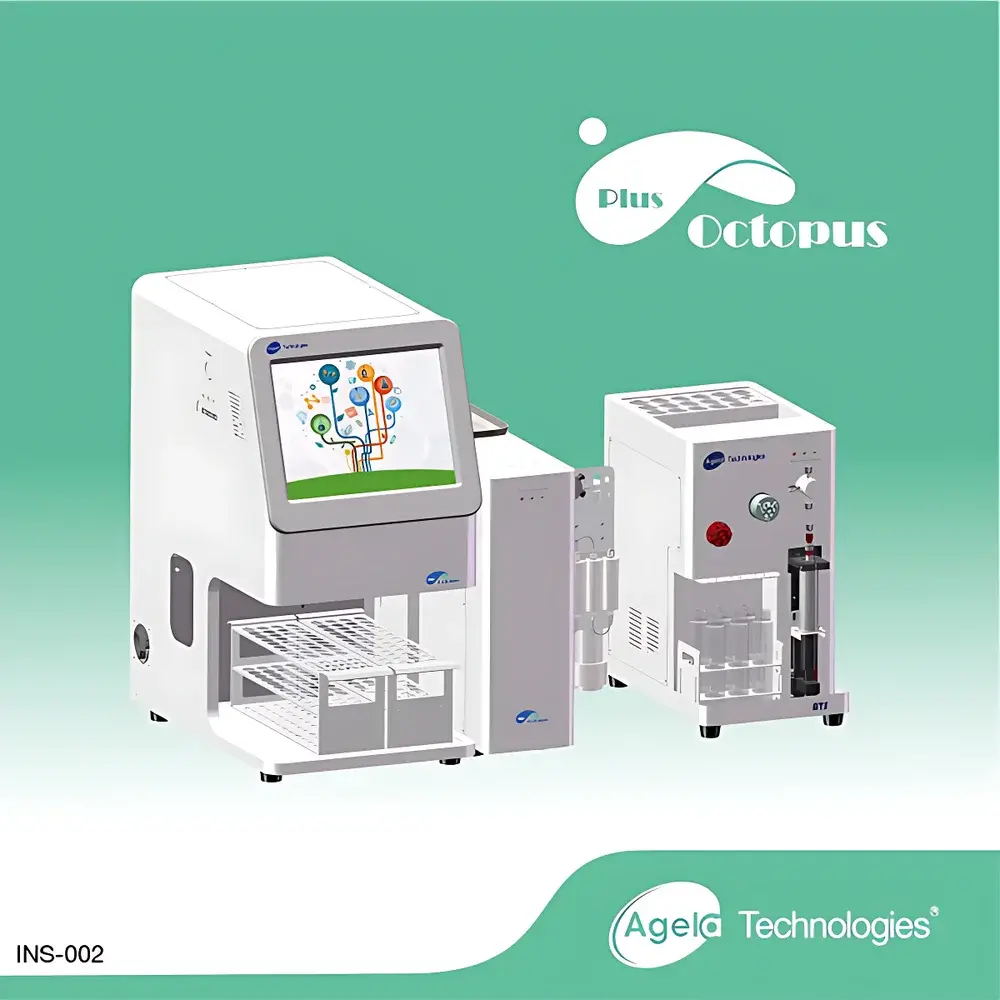
Agela OCTOPUS PLUS HS-2900P II High-Pressure Preparative Liquid Chromatography System
| Brand | Agela |
|---|---|
| Origin | Tianjin, China |
| Manufacturer Type | Authorized Distributor |
| Product Category | Domestic |
| Model | HS-2900P II |
| Application Level | Laboratory Grade |
| Instrument Type | High-Pressure Preparative LC |
| Flow Rate Range | 1–100 mL/min |
| Maximum Operating Pressure | 20 MPa |
| UV-Vis Wavelength Range | 200–800 nm |
| Touchscreen Interface | 12-inch Capacitive Display |
| Autosampler Volume Range | 1–20 mL |
| Fraction Collection Modes | Peak-based, Full-run, Manual, Time/UV Window-triggered |
| Compatible Collection Vessels | 15 mm, 18 mm, 25 mm ID tubes and custom containers |
| Pump Configuration | Dual High-Precision Plunger Pumps |
| Gradient Mixing Accuracy | ≤0.5% RSD |
| Column Compatibility | Static HPLC prep columns (10–50 mm ID) |
| Software | Dedicated preparative chromatography control suite with user permission hierarchy and 21 CFR Part 11-compliant audit trail |
Overview
The Agela OCTOPUS PLUS HS-2900P II is a fully integrated high-pressure preparative liquid chromatography (prep-LC) system engineered for reproducible, scalable compound purification in research and development laboratories. It operates on the fundamental principle of differential partitioning of analytes between a mobile phase (eluent) and a stationary phase (chromatographic column), enabling selective separation of complex mixtures under elevated pressure conditions—up to 20 MPa (2900 psi). Designed specifically for laboratory-scale purification workflows, the system supports both analytical-to-prep method transfer and direct milligram-to-gram scale isolation. Its modular architecture integrates a dual-plunger high-pressure solvent delivery unit, a 12-inch capacitive touchscreen controller, an automated sample introduction module, and an intelligent fraction collector—all coordinated via a dedicated, Windows-based preparative software platform compliant with GLP and GMP documentation requirements.
Key Features
- Dual high-precision plunger pump system delivering stable flow rates from 1 to 100 mL/min with ≤0.5% RSD across the full range, ensuring consistent retention time and peak shape during extended runs.
- Real-time gradient and flow rate adjustment without interrupting ongoing separations—enabling dynamic method optimization directly from the 12-inch touchscreen interface.
- Automated sample introduction with programmable injection volumes from 1 to 20 mL; supports large-volume loop injection and sample loop recycling for enhanced loading capacity.
- Intelligent fraction collection with four acquisition modes: UV-triggered peak collection, full-run collection, manual trigger, and time/UV window-based fractionation—optimized for recovery yield and purity control.
- Universal collection compatibility accommodating standard tube formats (15 mm, 18 mm, 25 mm ID) as well as user-defined vial geometries, facilitating seamless integration with downstream analytical or synthetic workflows.
- Comprehensive software suite featuring role-based user permissions, electronic signatures, and automated audit trail generation aligned with FDA 21 CFR Part 11 requirements for regulated environments.
Sample Compatibility & Compliance
The OCTOPUS PLUS HS-2900P II accommodates a broad spectrum of sample types—including natural product extracts, synthetic intermediates, pharmaceutical actives, peptides, and small-molecule libraries—provided they exhibit sufficient solubility in common HPLC-grade organic/aqueous mobile phases. Its pressure rating of 20 MPa allows robust operation with silica- and polymer-based preparative columns ranging from 10 mm to 50 mm internal diameter. The system meets essential laboratory safety and electromagnetic compatibility standards (IEC 61326-1, IEC 61000-6-3). While not certified as a medical device, its software architecture supports compliance with ISO/IEC 17025, ASTM E2500, and USP guidelines for analytical instrument qualification in regulated labs.
Software & Data Management
Control and data handling are managed through Agela’s proprietary PrepChrom Suite, a native Windows application developed for method development, run supervision, and post-run analysis. The software includes built-in tools for baseline correction, peak integration, retention time alignment, and fraction mapping. All user actions—including method edits, injection commands, and collection decisions—are timestamped and logged with operator ID in an immutable audit trail. Electronic signature functionality enables secure sign-off of critical operations, satisfying ALCOA+ data integrity principles. Raw chromatograms, method files, and fraction logs are stored in vendor-neutral formats (e.g., .cdf, .csv) to ensure long-term accessibility and third-party software interoperability.
Applications
This system serves core purification needs across multiple domains: isolation of bioactive compounds from botanical or microbial sources; purification of reaction mixtures in medicinal chemistry; removal of residual catalysts or by-products in asymmetric synthesis; preparative chiral separations using polysaccharide-based columns; and generation of reference standards for QC testing. Its flexibility in flow rate, pressure, and detection range (200–800 nm) makes it suitable for both UV-active and moderately chromophoric compounds. Routine use cases include parallel purification of compound libraries, desalting of oligonucleotides, and buffer exchange of protein fragments—always within the constraints of laboratory-grade throughput and resolution.
FAQ
What column dimensions are supported?
The system is validated for static preparative HPLC columns with internal diameters from 10 mm to 50 mm, including standard stainless-steel and glass-jacketed configurations.
Is method transfer from analytical HPLC possible?
Yes—scaling rules based on constant linear velocity and cross-sectional area enable reliable transfer from analytical (e.g., 4.6 mm ID) to preparative columns, with optional software-assisted parameter conversion.
Does the system support gradient delay compensation?
Yes—the dual-pump architecture incorporates digital flow synchronization and low-dead-volume mixing chambers to minimize gradient dwell volume effects, particularly critical at higher flow rates.
Can audit trails be exported for regulatory review?
All audit trail records are exportable in CSV format with full metadata (user ID, timestamp, action type, before/after values), supporting internal audits and regulatory inspections.
What maintenance intervals are recommended?
Pump seals should be inspected every 500 hours of operation; UV lamp replacement is advised every 2,000 hours; and system suitability tests should be performed prior to each high-value purification campaign.




