
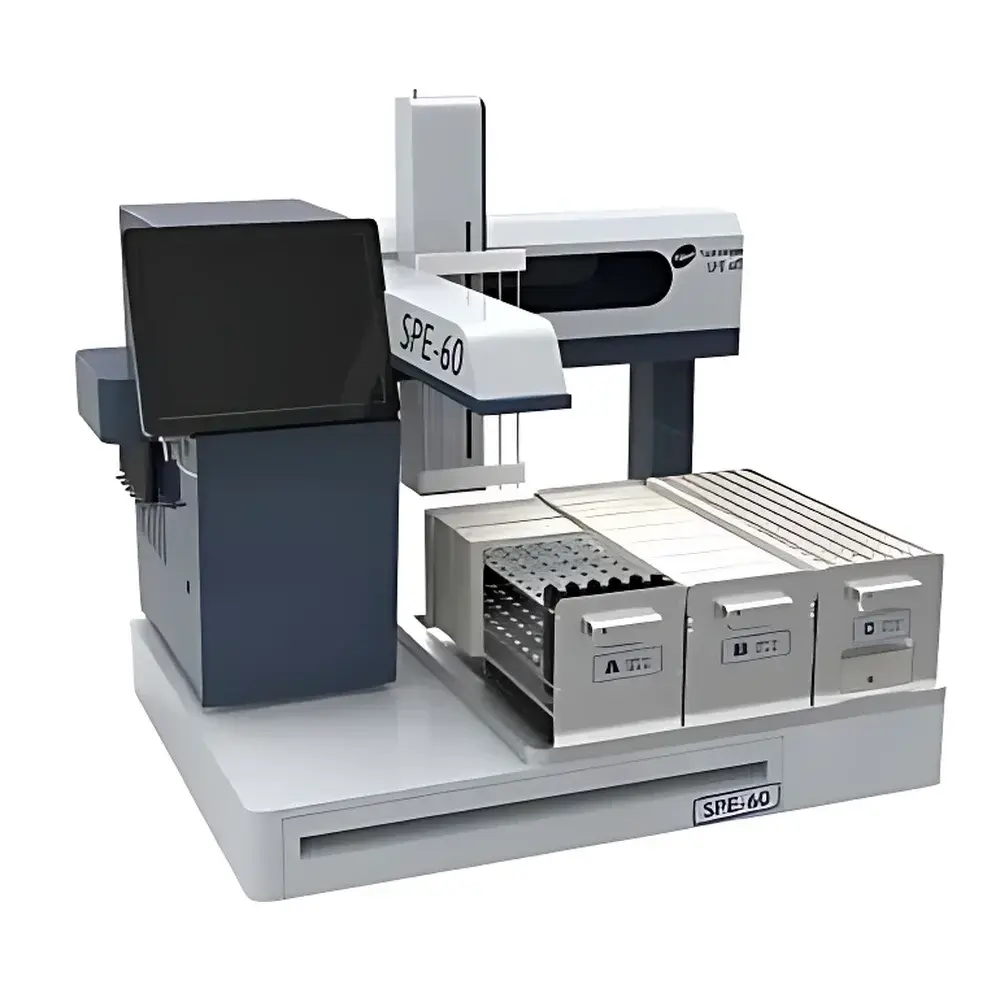
Agela SPE-60 Fully Automated Solid Phase Extraction System
| Brand | Agela |
|---|---|
| Origin | Tianjin, China |
| Model | SPE-60 |
| Automation Level | Fully Automatic |
| Number of Channels | 6 parallel extraction channels |
| Extraction Format | Cartridge-based (column) SPE |
| Flow Rate Control Range | 0.1–50.0 mL/min |
| Solvent Selection Capacity | 9 independent solvent reservoirs |
| Sample Throughput | 6 samples simultaneously |
| Sample Loading Volume | 0.1–20.0 mL (expandable to 2000 mL via optional large-volume module) |
| Wetted Materials | Stainless steel (316L), PTFE |
| Column Compatibility | Interchangeable modules for 1 mL, 3 mL, 6 mL, and 12 mL SPE cartridges |
| Integrated Online Concentration | Yes |
| Robotic Positioning | XYZ-axis precision robotic arm with auto-washable sampling needle |
Overview
The Agela SPE-60 Fully Automated Solid Phase Extraction System is an engineered solution for high-throughput, reproducible sample preparation in regulated and research-intensive laboratories. Based on positive-pressure-driven column-based solid phase extraction (SPE), the system applies controlled, programmable flow rates across multiple cartridges to ensure consistent sorbent conditioning, analyte loading, washing, and elution—critical for method robustness in trace-level analysis. Designed as a direct evolution of the Qdaura卓睿 SPE-40 platform, the SPE-60 extends operational flexibility through scalable sample volume handling (from microliter-scale biofluids to liter-equivalent environmental water extracts), modular cartridge support, and seamless integration into end-to-end analytical workflows including LC-MS/MS, GC-MS, and ICP-MS sample introduction pipelines.
Key Features
- Six independently controlled extraction channels enable true parallel processing—each with dedicated positive-pressure flow regulation (0.1–50.0 mL/min) for optimized method transfer across diverse sorbent chemistries (C18, SCX, SAX, Florisil, HLB, etc.).
- XYZ-axis robotic arm with sub-millimeter positioning repeatability ensures precise tip alignment over vials, reservoirs, and SPE cartridges; integrated needle wash station uses dual-solvent rinse cycles to minimize carryover (<0.01% typical).
- Modular cartridge holder accepts standardized 1 mL, 3 mL, 6 mL, and 12 mL SPE columns without tools—supporting method development, validation, and routine QC without hardware reconfiguration.
- Expandable sample capacity: 6 positions for simultaneous processing; 48-position carousel enables overnight unattended operation with auto-sequencing and event-triggered pauses (e.g., solvent depletion, column blockage detection).
- Onboard quantitative concentration capability via integrated nitrogen blow-down or vacuum-assisted evaporation modules—eliminating manual transfer and reducing analyte loss or degradation risks.
- All fluidic paths contacting solvents or samples are constructed from electropolished 316L stainless steel and PTFE-lined components, ensuring chemical resistance to aggressive organic modifiers (e.g., DCM, THF, conc. acids/bases) and compliance with EPA Method 500/525 series requirements.
Sample Compatibility & Compliance
The SPE-60 accommodates aqueous, semi-aqueous, and organic-diluted matrices—including drinking water, wastewater, plasma, urine, tissue homogenates, soil extracts, and plant digests. It supports both off-line and online coupling with autosamplers (e.g., Agilent 1290, Waters ACQUITY, Thermo Vanquish). The system architecture adheres to key regulatory expectations: audit-trail-enabled software (with user-level permissions and electronic signatures), full data integrity per ALCOA+ principles, and compatibility with 21 CFR Part 11-compliant configurations when deployed with validated firmware and networked server environments. Method templates align with ASTM D5905, ISO 17025-accredited SOP frameworks, and EU Directive 2002/657/EC for residue analysis.
Software & Data Management
Controlled via Agela’s SPELink™ v3.2 software, the interface provides drag-and-drop method building, real-time pressure/flow monitoring per channel, and automated error logging (e.g., air bubble detection, column clogging alerts). All method parameters, run logs, and instrument status data are stored in encrypted SQLite databases with configurable backup intervals. Raw export formats include CSV and XML for LIMS integration; PDF reports include chromatographic injection IDs, operator metadata, and timestamped execution traces—essential for GLP/GMP audits and method transfer documentation.
Applications
- Food safety labs: Multi-residue pesticide screening (QuEChERS-compatible cleanup), mycotoxin enrichment (aflatoxins, ochratoxin A), and veterinary drug residue quantification (tetracyclines, sulfonamides) in milk, honey, and cereals.
- Pharmaceutical QC: Impurity profiling in APIs, residual solvent removal from lyophilized formulations, and metabolite isolation from stability study samples.
- Environmental monitoring: PAHs, PCBs, and pharmaceuticals in surface water per EPA 1694; PFAS preconcentration from groundwater using mixed-mode cartridges.
- Clinical & life sciences: Steroid hormone extraction from serum, neurotransmitter metabolites from CSF, and phosphopeptide enrichment prior to phosphoproteomics workflows.
FAQ
Does the SPE-60 support method validation per ICH Q2(R2) guidelines?
Yes—the system enables full parameter documentation, intermediate precision testing across channels, and forced degradation studies via programmable solvent gradients and dwell times.
Can it integrate with third-party LIMS without custom middleware?
Standard HL7 and ASTM E1384-compliant data export is supported; API access requires Agela’s certified LIMS Connect Module (sold separately).
Is column priming and equilibration performed under positive pressure?
Yes—both steps use the same high-accuracy syringe pump that governs all fluid delivery, eliminating gravity-dependent variability.
What maintenance intervals are recommended for the robotic arm and fluidic seals?
Robotic rail lubrication every 6 months; PTFE-sealed check valves and pump tubing replacement every 12 months or 5000 cycles—whichever occurs first.
Are application notes available for EPA Method 537.1 (PFAS) on this platform?
Agela provides validated PFAS protocols—including WAX and C18/WAX dual-column strategies—with recovery data across 18 target analytes and IS correction factors.



