
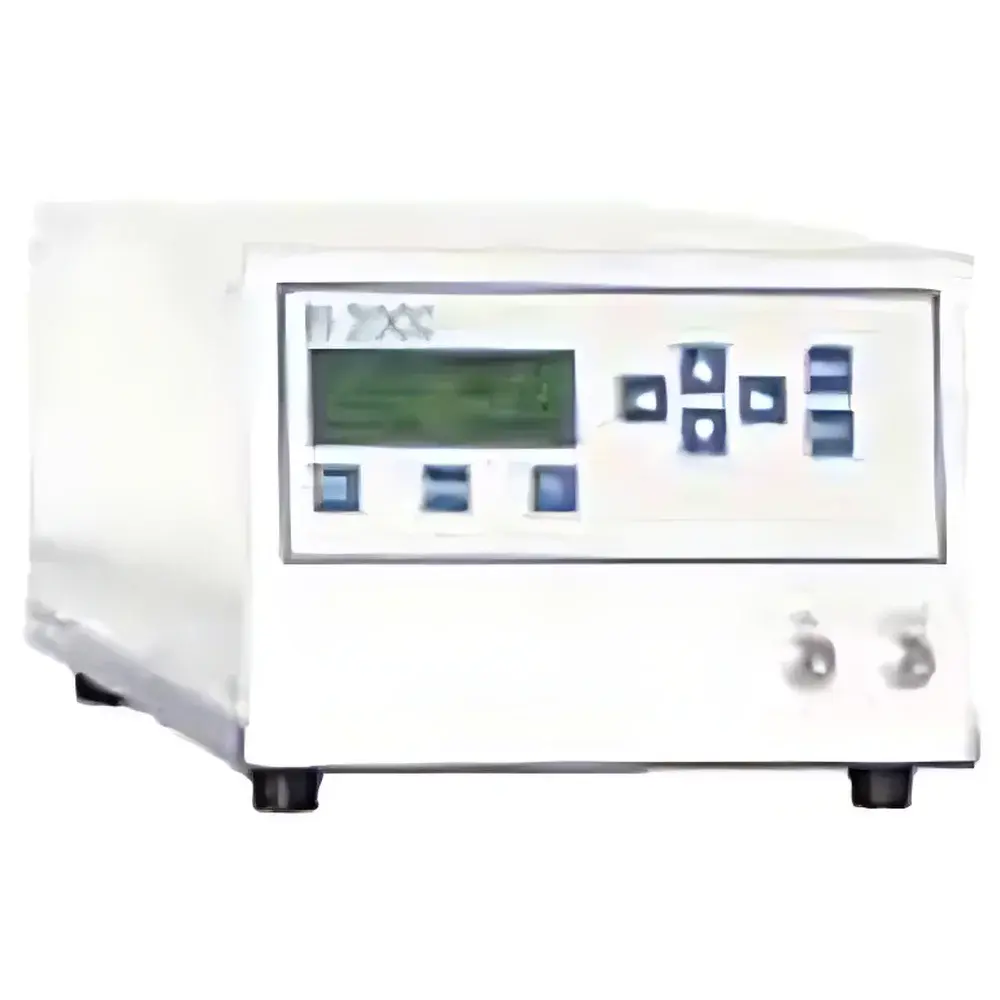
Agela ZAM4000 ELSD Evaporative Light Scattering Detector
| Brand | Agela |
|---|---|
| Model | ZAM4000 |
| Detection Principle | Evaporative Light Scattering |
| Flow Rate Range | 1–50 mL/min |
| Nebulizing Gas Pressure | 3.5–5 bar |
| Nebulizing Gas Flow Rate | 1.7 L/min |
| Auxiliary Drying Gas Flow Rate | <2 m/min |
| Evaporator Temperature Range | Ambient to 85 °C |
| Light Source | Tungsten Lamp |
| Detector | Photomultiplier Tube (PMT) |
| Output Signal | 0–5 V Analog + RS-232 Digital |
| Power-Saving Mode | Enables independent shutdown of gas, lamp, heater, and PMT |
| Fault Monitoring | Real-time diagnostics for gas flow, heater, lamp, and PMT failure |
| 雾化气流控制 | Integrated electronic pressure controller for nebulizer gas |
| Auxiliary drying gas control | Built-in controller |
Overview
The Agela ZAM4000 ELSD is a robust, benchtop evaporative light scattering detector engineered for integration with conventional high-performance liquid chromatography (HPLC) systems. Unlike UV-Vis or refractive index (RI) detectors, the ZAM4000 operates on the principle of nebulization, solvent evaporation, and light scattering—making it inherently universal for non-chromophoric analytes. It detects analytes regardless of optical absorbance or refractive index change, thereby enabling reliable quantification of compounds such as carbohydrates, lipids, polymers, and underivatized fatty acids that are otherwise invisible to UV detection or incompatible with gradient elution in RI mode.
The detector employs a dual-gas architecture: a precisely regulated nebulizing gas stream (N₂ or compressed air) atomizes the column effluent into fine droplets, while an auxiliary drying gas stream accelerates solvent removal in a temperature-controlled glass evaporator chamber. The remaining dry analyte particles pass through a collimated tungsten-lamp beam; scattered light is captured by a high-sensitivity photomultiplier tube (PMT), generating a signal proportional to analyte mass—exhibiting near-logarithmic response over three orders of magnitude. Its rotating evaporator chamber—constructed entirely of borosilicate glass—is mechanically detachable for rapid cleaning and residue inspection, minimizing carryover and enhancing long-term reproducibility.
Key Features
- Universal detection capability for non-UV-absorbing and semi-volatile compounds
- Dual independent gas control: electronic pressure regulator for nebulizing gas (3.5–5 bar), integrated controller for auxiliary drying gas (<2 m/min)
- Adjustable evaporator temperature range from ambient to 85 °C, optimized for solvent volatility and analyte thermal stability
- Modular glass evaporator chamber with rotational design—tool-free removal for visual inspection and manual cleaning
- Real-time fault diagnostics covering nebulizing gas flow, evaporator heater status, tungsten lamp operation, and PMT output integrity
- Low-noise analog output (0–5 V) plus RS-232 digital interface for seamless integration with third-party chromatography data systems (CDS)
- Power-saving mode enabling selective deactivation of lamp, heater, gas supply, and PMT during idle periods—reducing energy consumption and extending component lifetime
Sample Compatibility & Compliance
The ZAM4000 is routinely deployed in quality control laboratories validating excipients, natural product extracts, and synthetic polymers where regulatory documentation requires method robustness and analyte universality. It supports mobile phases containing volatile solvents (e.g., acetonitrile, methanol, THF, ethyl acetate) and is compatible with gradient elution protocols—eliminating baseline drift issues common in RI detection. While not intrinsically compliant with 21 CFR Part 11, its RS-232 output and deterministic analog signal support audit-trail-capable CDS configurations when paired with validated software platforms. The detector meets general laboratory safety requirements per IEC 61010-1 and carries CE marking for electromagnetic compatibility (EMC) and low-voltage directive compliance. It is suitable for use in GLP environments when operated within documented SOPs covering calibration verification, system suitability testing, and preventive maintenance.
Software & Data Management
The ZAM4000 does not include proprietary acquisition software but delivers standardized analog and serial outputs fully compatible with industry-standard chromatography data systems—including Waters Empower, Thermo Chromeleon, Agilent OpenLab CDS, and Shimadzu LabSolutions. Its 0–5 V analog signal enables real-time peak integration using standard integrator algorithms; RS-232 communication permits remote instrument status polling and basic parameter interrogation (e.g., current temperature setpoint, lamp status, gas fault flags). For full traceability, users are advised to configure their CDS to log detector-specific events—including power-saving transitions, temperature ramp profiles, and diagnostic alerts—as part of system suitability records. No firmware updates or driver installations are required for basic operation.
Applications
- Quantitative analysis of sucrose, lactose, and oligosaccharides in food and beverage matrices
- Characterization of phospholipids and triglycerides in lipidomics workflows
- Batch release testing of polyethylene glycol (PEG)-modified biopharmaceuticals
- Stability-indicating assays for underivatized fatty acids in nutraceutical formulations
- Method development support for HILIC and normal-phase LC separations where UV transparency limits detection sensitivity
- Residual solvent profiling in polymer synthesis intermediates
FAQ
Does the ZAM4000 require post-column derivatization for carbohydrate detection?
No. As an ELSD, it detects analytes based on particle light scattering after solvent evaporation—no chromophore or derivatization is needed.
Can it be used with aqueous mobile phases containing >10% water?
Yes, though optimal sensitivity is achieved with ≤50% water content; higher water fractions may reduce droplet desolvation efficiency and increase noise. Temperature and gas flow should be adjusted accordingly.
Is the glass evaporator chamber resistant to aggressive solvents like chloroform or DCM?
Borosilicate glass exhibits excellent resistance to chlorinated solvents; however, prolonged exposure to hot DCM above 60 °C is not recommended due to potential thermal stress and gradual etching.
What maintenance intervals are recommended for routine operation?
Daily: visual inspection of nebulizer tip and evaporator chamber; weekly: cleaning of glass chamber and nebulizer capillary with methanol/acetone; quarterly: PMT gain verification and lamp intensity check using reference standard.
Is the ZAM4000 compatible with UHPLC systems operating above 600 bar?
The detector itself has no pressure rating (0 bar max)—it must be installed post-column with appropriate flow splitting or low-pressure interface hardware to ensure inlet pressure remains below 10 bar at the nebulizer inlet.






