
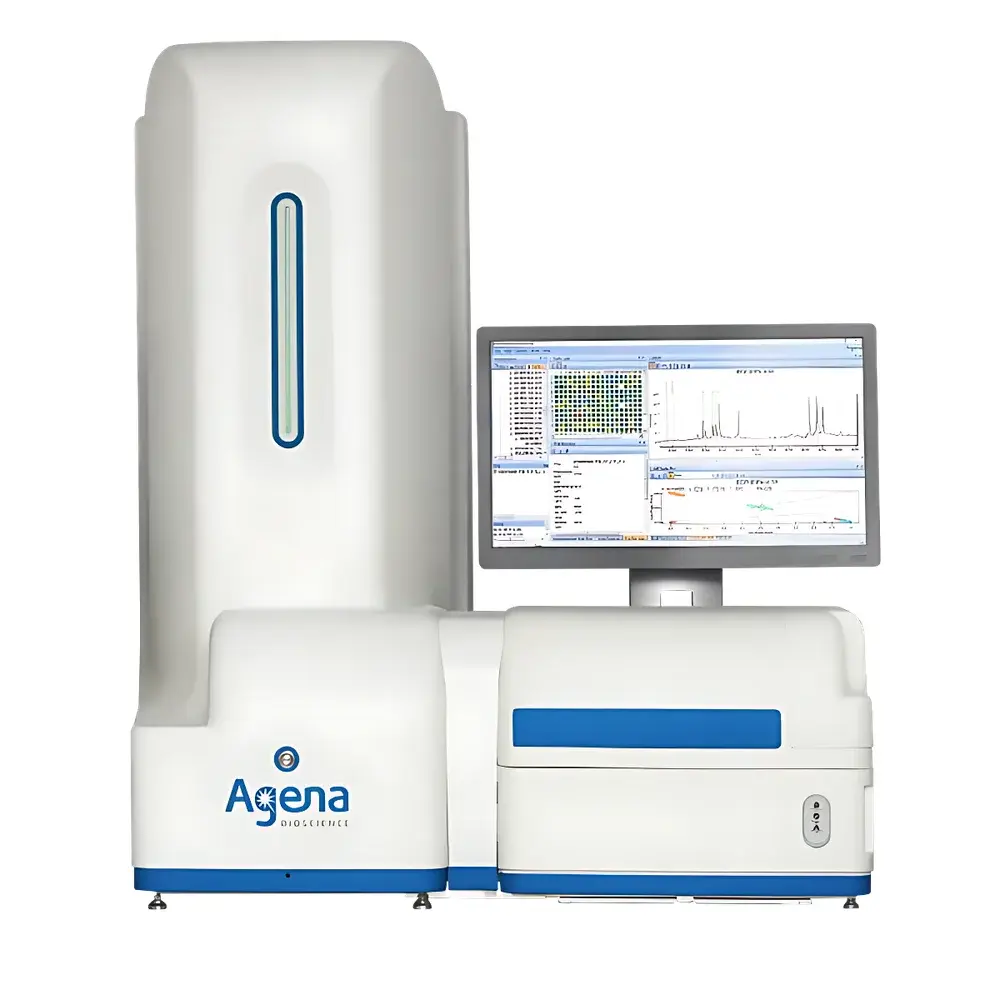
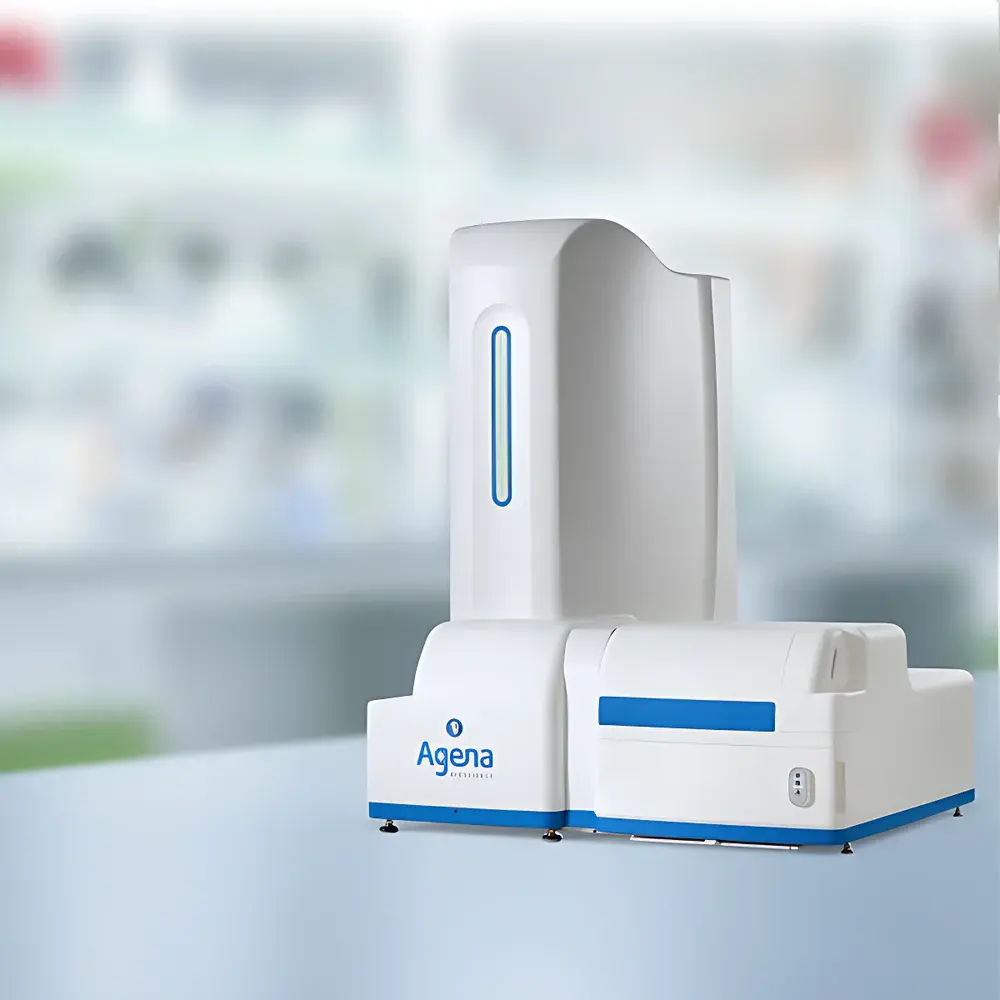
Agena Bioscience MassARRAY Nucleic Acid Mass Spectrometer
| Brand | Agena Bioscience |
|---|---|
| Origin | USA |
| Manufacturer Type | Original Equipment Manufacturer (OEM) |
| Product Category | Imported Instrument |
| Model | MassARRAY Nucleic Acid Mass Spectrometer |
| Instrument Type | Time-of-Flight (TOF) Mass Spectrometer |
| Application Scope | General-Purpose Biomolecular Analysis |
| Resolution | >750 across full detection range |
| Sensitivity | ≥5% for routine somatic mutation detection |
| Stability | Measurement deviation ≤ ±5% |
| Throughput | ≤15 minutes for 96 samples |
Overview
The Agena Bioscience MassARRAY® Nucleic Acid Mass Spectrometer is a benchtop, matrix-assisted laser desorption/ionization time-of-flight (MALDI-TOF) mass spectrometry platform engineered for high-accuracy, quantitative nucleic acid analysis. Unlike conventional sequencing or hybridization-based methods, the MassARRAY system leverages precise mass discrimination of allele-specific extension products to deliver base-resolution genotyping, methylation profiling, and somatic variant detection. Its core architecture integrates a solid-phase, single-base extension (SBE) chemistry with MALDI-TOF detection—enabling multiplexed analysis of up to 40+ loci per well without fluorescent labeling or electrophoresis. Designed for clinical and translational research laboratories, the system operates within a closed, standardized workflow that minimizes manual intervention while maintaining full traceability of sample-to-result processing.
Key Features
- MALDI-TOF Detection Engine: Optimized ion optics and delayed extraction technology ensure consistent peak shape, high mass accuracy (<±0.2 Da), and reproducible signal intensity across repeated runs.
- High-Throughput Sample Processing: Full 96-well plate analysis completed in ≤15 minutes—including matrix spotting, laser acquisition, and spectral deconvolution—supporting >300 samples per instrument day under standard operating conditions.
- Quantitative Methylation Analysis: Utilizes base-specific cleavage and mass-shift differentiation to quantify CpG site methylation levels with ≥5% dynamic range and inter-run CVs <8% (n=3 plates).
- Somatic Mutation Detection Capability: Achieves analytical sensitivity of <1% mutant allele frequency (MAF) using Agena’s OncoCarta® or UltraSEEK® chemistries, validated per CLIA and CAP guidelines for low-abundance variant calling.
- Open Platform Architecture: Supports user-developed assays via customizable primer design, flexible reaction optimization, and integration with third-party DNA extraction and PCR systems.
- Robust System Stability: Maintains calibration stability over 72-hour continuous operation; mass drift <0.15 Da and intensity variation ≤±5% across technical replicates (per Agena Bioscience System Verification Protocol).
Sample Compatibility & Compliance
The MassARRAY platform accepts purified genomic DNA, FFPE-derived DNA (with ≥20 ng input), and bisulfite-converted DNA. It is compatible with standard laboratory automation interfaces (e.g., Hamilton STAR, Tecan Freedom EVO) for liquid handling integration. Regulatory compliance includes adherence to ISO/IEC 17025:2017 for testing laboratories, alignment with FDA 21 CFR Part 11 requirements for electronic records and signatures (via SpectroCHIP® barcode tracking and audit-trail-enabled Typer® software), and support for GLP/GMP documentation workflows. Assay validation packages meet ASTM E1957-20 (Standard Guide for Validation of Molecular Diagnostic Assays) and USP (Bioanalytical Method Validation) principles where applicable.
Software & Data Management
Instrument control, spectral acquisition, and genotype/methylation calling are managed through Agena’s Typer® software suite (v4.1+). The software provides real-time spectral visualization, automated peak identification using internal mass standards (e.g., RNA oligos at m/z 2282, 3325, 4412), and batch processing with configurable QC thresholds (signal-to-noise ratio ≥10, peak width ≤1.5 Da). Raw data (.spf files) and processed reports (.csv, .pdf) are stored with immutable metadata (operator ID, timestamp, instrument serial number, calibration log). Audit trails record all user actions—including parameter edits, result overrides, and reprocessing events—in compliance with 21 CFR Part 11 Subpart B requirements. Data export supports LIMS integration via HL7 and ASTM E1384-compliant interfaces.
Applications
- Pharmacogenomics (PGx): Multiplexed genotyping of CYP2C19, CYP2D6, SLCO1B1, and other pharmacogenes to inform drug selection and dosing algorithms.
- Oncology Biomarker Profiling: Detection of hotspot mutations in EGFR, BRAF, KRAS, NRAS, and PIK3CA from tumor tissue or liquid biopsy specimens.
- Forensic Identity Testing: SNP-based human identification panels compliant with SWGDAM and ENFSI standards.
- Epigenetic Research: Quantitative methylation analysis of promoter regions in cancer progression studies and aging biomarker discovery.
- Microbial Typing & AMR Detection: Species-level identification and resistance gene screening in bacterial isolates using rRNA and plasmid-borne target panels.
FAQ
What sample types are compatible with the MassARRAY system?
Genomic DNA, FFPE-derived DNA (with ≥20 ng input and fragment size >100 bp), and bisulfite-converted DNA. RNA is not directly analyzed; cDNA must be generated prior to assay setup.
Does the system support LIMS integration?
Yes—via ASTM E1384-compliant file exchange protocols and HL7 message mapping for bidirectional sample tracking and result reporting.
Is method validation documentation available for clinical use?
Agena provides assay-specific validation reports aligned with CLIA, CAP, and ISO 15189 requirements, including precision, accuracy, LOD/LOQ, and interference studies.
Can custom assays be developed in-house?
Yes—the platform is fully open for proprietary assay design using Agena’s PrimerX® software and validated SBE chemistry protocols.
What regulatory standards does the Typer® software meet?
It satisfies FDA 21 CFR Part 11 requirements for electronic records and signatures, including role-based access control, audit trail generation, and electronic signature enforcement.
Related Products





