
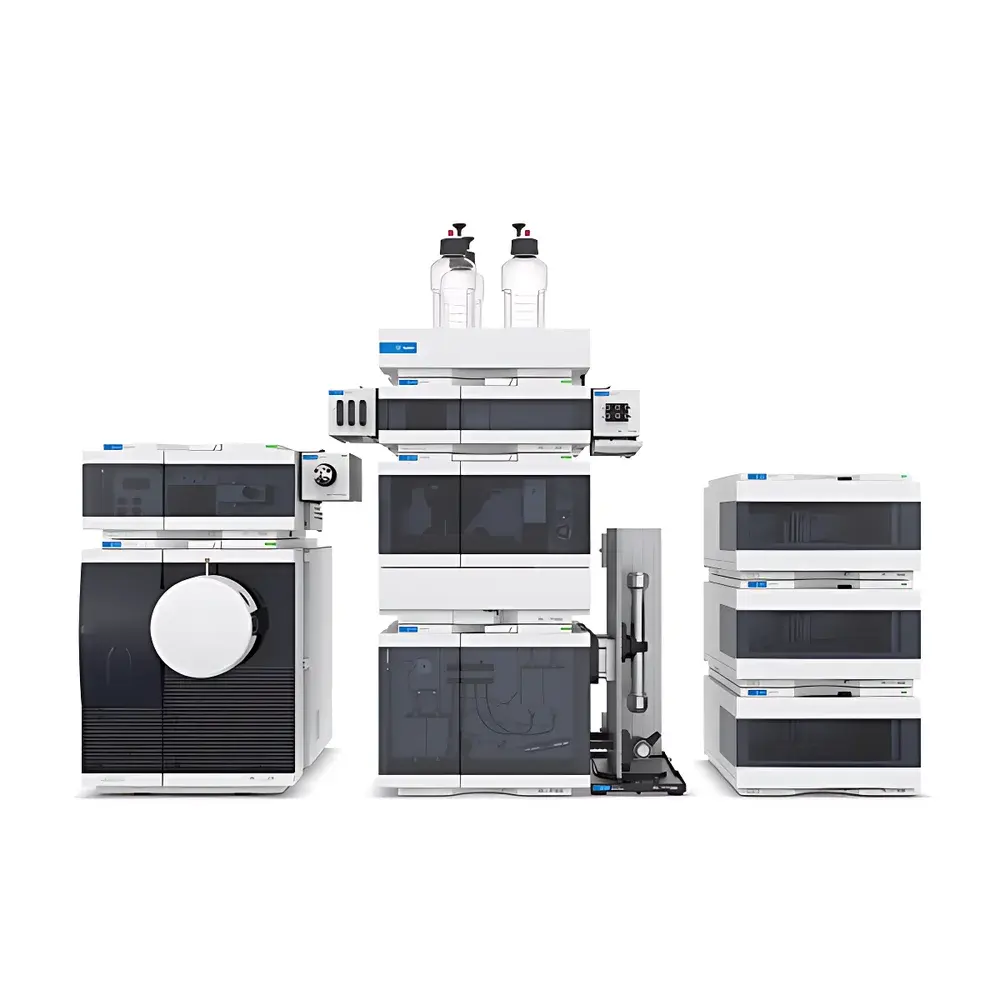
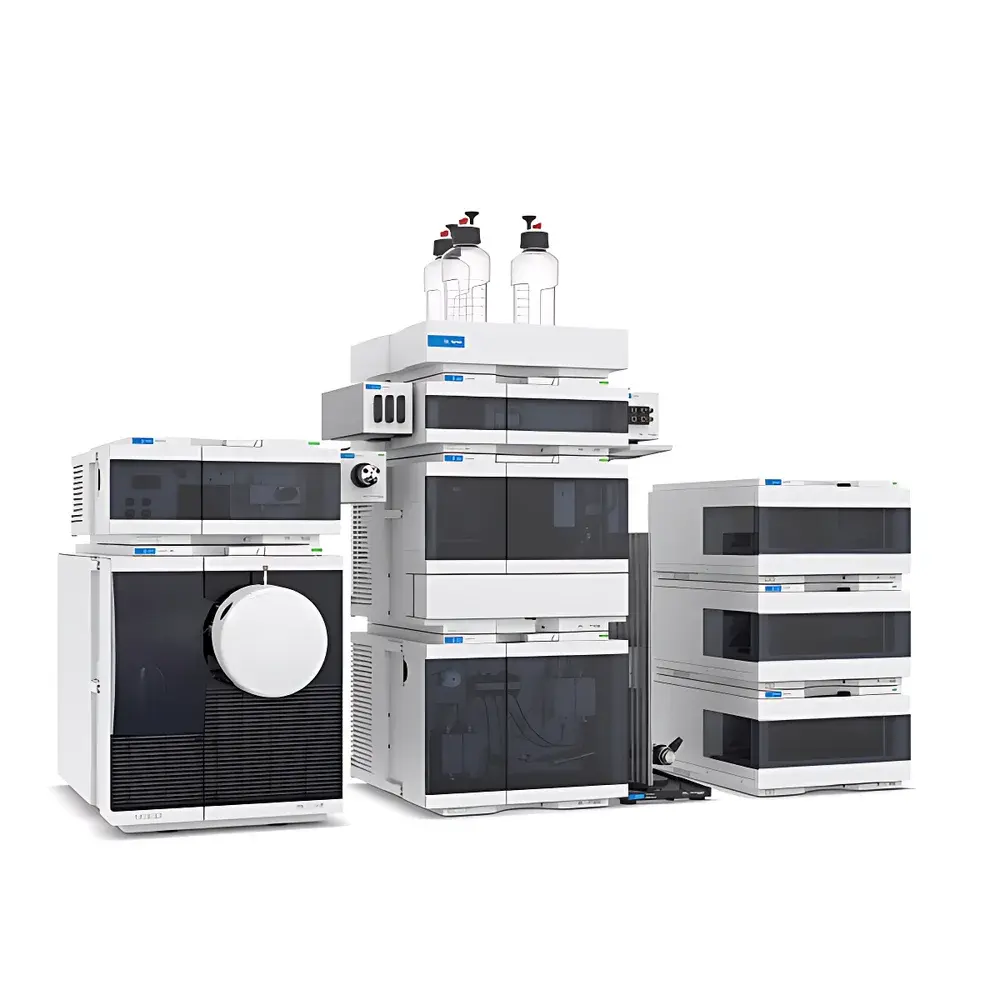
Agilent 1260 Infinity II Preparative LC/MSD System
| Brand | Agilent Technologies |
|---|---|
| Origin | Germany |
| Manufacturer Type | Original Equipment Manufacturer (OEM) |
| Origin Category | Imported |
| Model | 1260 Infinity II Preparative LC/MSD |
| Application Level | Laboratory-Grade |
| Instrument Type | High-Pressure Preparative Liquid Chromatography |
| Flow Rate Range | 1–50 mL/min |
| Maximum Operating Pressure | 20–420 bar |
Overview
The Agilent 1260 Infinity II Preparative LC/MSD System is a fully integrated, high-pressure preparative liquid chromatography platform engineered for scalable purification of small-molecule compounds under mass-directed control. Built upon Agilent’s proven Infinity II architecture, the system combines robust gradient-capable pumping, precise autosampling, real-time mass spectral detection (via optional MSD interface), and intelligent fraction collection—enabling reproducible isolation of target analytes directly from complex mixtures. Its core operational principle relies on reversed-phase or normal-phase chromatographic separation coupled with electrospray ionization (ESI) or atmospheric pressure chemical ionization (APCI) mass spectrometry for selective compound triggering. Designed for laboratories requiring trace-level purity validation, iterative purification cycles, and seamless transition from analytical to semi-preparative scale, the system operates within a validated pressure envelope up to 420 bar and supports flow rates from 1 to 50 mL/min—making it suitable for both early-stage compound library purification and late-stage intermediate refinement.
Key Features
- High-pressure preparative LC architecture rated to 420 bar, supporting C18, phenyl-hexyl, cyano, and HILIC columns with internal diameters from 10 mm to 30 mm
- Integrated mass-directed fraction collection enabled by real-time single-quadrupole MSD detection, supporting [M+H]⁺, [M−H]⁻, and user-defined m/z windows
- Automated sample introduction via 132-position refrigerated autosampler compatible with 2 mL and 6 mL vials; injection volume programmable from 0.1 μL to 3.6 mL with <1% RSD precision
- Low-dead-volume fluidic design minimizes system dwell volume (<1.2 mL) and peak dispersion, preserving chromatographic resolution and maximizing recovery of labile or low-abundance species
- Modular leak-detection system with pressure-actuated shutoff valves across all solvent, sample, and waste lines—compliant with IEC 61000-6-2/6-4 electromagnetic compatibility standards
- Scalable fraction collection: supports up to 648 discrete fractions in a single run using configurable rack-based collectors with UV-triggered or MS-triggered collection logic
Sample Compatibility & Compliance
The system accommodates diverse sample matrices including synthetic reaction mixtures, natural product extracts, peptide digests, and pharmaceutical impurity profiles. It complies with ISO/IEC 17025:2017 requirements for testing laboratories and supports audit-ready operation under GLP and GMP environments when configured with Agilent OpenLab CDS ChemStation in 21 CFR Part 11-compliant mode. All hardware modules meet UL 61010-1 and CE safety directives. Column oven temperature control (5–85 °C) ensures retention time stability across multi-day purification campaigns, while solvent compatibility covers acetonitrile, methanol, water, ammonium acetate/formate buffers, and TFA—subject to pump seal material selection (e.g., PEEK, stainless steel, or titanium).
Software & Data Management
Control and data acquisition are managed through Agilent OpenLab CDS ChemStation, a validated chromatography data system offering role-based access control, electronic signatures, and full audit trail functionality per FDA 21 CFR Part 11. The software provides synchronized method development workflows—allowing simultaneous optimization of LC gradients, MS source parameters, and fraction collection rules. Raw mass spectra are stored in .D format with embedded metadata (injection time, pressure logs, valve positions); processed data exports support .CSV, .CDF, and .mzML formats for third-party cheminformatics platforms. Batch processing tools enable automated peak integration, purity assessment (UV + MS co-detection), and report generation compliant with internal SOPs or external regulatory submissions.
Applications
- Purification of synthetic intermediates and final APIs in medicinal chemistry workflows
- Isolation of bioactive natural products from crude plant or microbial extracts
- Preparative-scale separation of diastereomers and regioisomers where UV-only detection lacks specificity
- Generation of reference standards for LC-MS method validation and calibration
- Downstream processing support for biocatalysis screening—recovering enantiopure products from racemic mixtures
- Impurity isolation and structural elucidation in forced degradation studies
FAQ
Can this system operate in both UV-only and mass-directed modes?
Yes—the system supports standalone UV detection (via optional G7111B VWD or G7121B DAD) and concurrent MS-triggered collection. Switching between modes requires no hardware reconfiguration.
Is method transfer from analytical to preparative scale supported?
Agilent provides method translation tools within OpenLab CDS that scale retention times, gradient slopes, and flow rates based on column geometry and particle size—ensuring consistent selectivity across scales.
What maintenance intervals are recommended for the MSD interface?
Under typical use (≤20 samples/day), ESI source cleaning is advised every 72 hours; quadrupole calibration and detector gain optimization should be performed weekly or after major solvent changes.
Does the system support remote monitoring and troubleshooting?
Yes—OpenLab Remote Access enables secure web-based supervision of instrument status, queue management, and real-time chromatogram viewing via TLS 1.2 encrypted connections.
Are custom fraction collection schemes programmable?
Absolutely—users define logic-based rules combining m/z triggers, UV threshold crossing, time windows, and peak width criteria to execute conditional collection across multiple detectors simultaneously.
Related Products





