
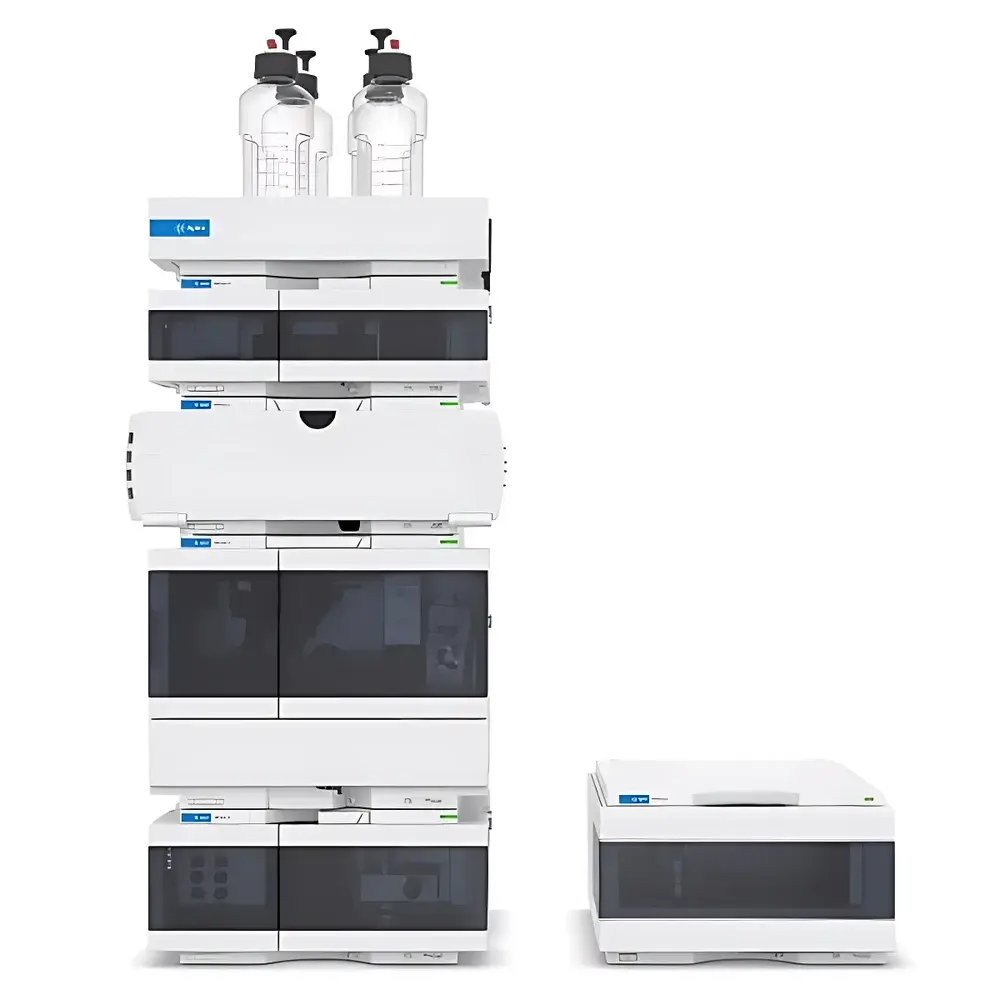
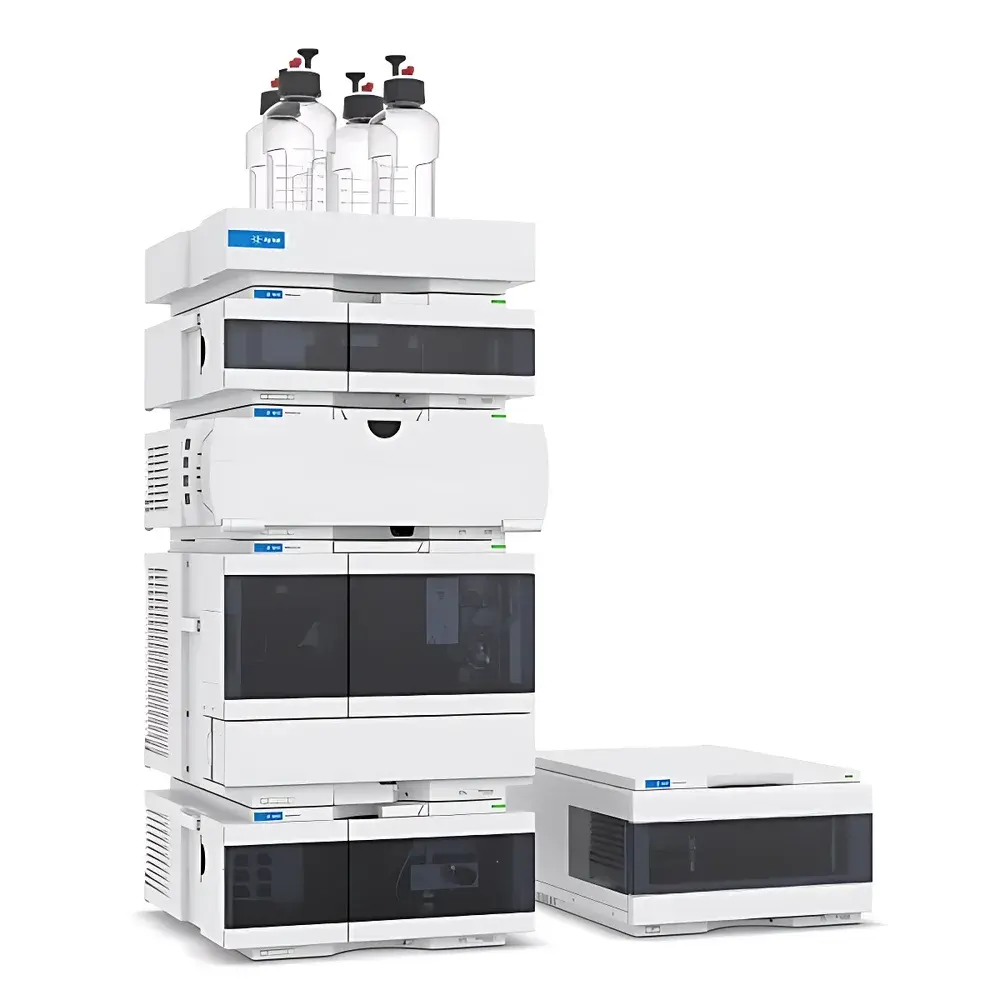
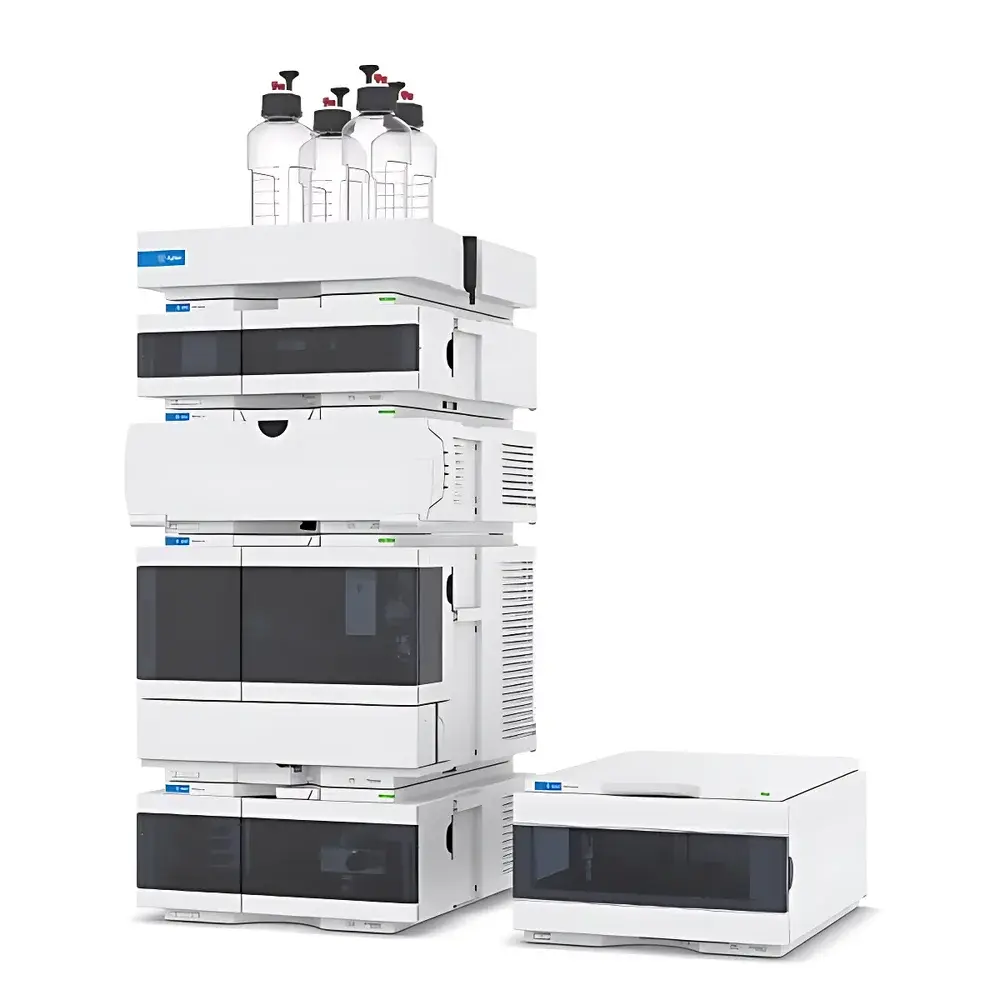
Agilent 1260 Infinity III Analytical-Scale Purification LC System
| Brand | Agilent Technologies |
|---|---|
| Origin | Germany |
| Manufacturer Type | Original Equipment Manufacturer (OEM) |
| Origin Category | Imported |
| Model | 1260 Infinity III Analytical-Scale LC |
| Application Level | Laboratory Grade |
| Instrument Type | High-Pressure Preparative Liquid Chromatography |
| Flow Rate Range | 0.05–5 mL/min (with G7112B pump), 0.2–10 mL/min (with G7110B/G7111A/G7111B pumps) |
| Maximum Operating Pressure | 600 bar |
| Column ID Reader | Optional |
| Solvent Reservoir Capacity | Up to 15 channels (with optional Solvent Selection Valve) |
| Fraction Collection Capacity | Up to 384 fractions (4 × 96-well microplates) or 216 tubes (glass, 4 tube OD sizes) |
| Injection Volume Range | 0.1–100 µL (standard), up to 1800 µL (with Multi-Draw Kit) |
| Column Temperature Zones | 2 (with G7116A/B), 1 (with Vial Sampler + Integrated Column Compartment) |
| Detector Compatibility | UV/Vis, RI, FL, ELSD, Single-Quadrupole LC/MSD |
| Software Platform | Agilent OpenLab CDS ChemStation |
| Delay Volume Sensor | Integrated, auto-calibrating |
| System Dimensions (W × D) | 980 × 468 mm |
| Power Supply | 100–240 VAC |
Overview
The Agilent 1260 Infinity III Analytical-Scale Purification LC System is a modular, high-pressure liquid chromatography platform engineered for precise compound isolation and purification at the milligram scale. Built on the InfinityLab architecture, it employs conventional reversed-phase, normal-phase, and HILIC separation mechanisms under controlled gradient elution conditions, delivering reproducible retention time stability and peak shape fidelity across extended operational cycles. Unlike preparative systems optimized for gram-scale output, this platform bridges the gap between analytical characterization and early-stage purification—enabling orthogonal fractionation of complex mixtures prior to structural elucidation, biological assay, or synthetic route validation. Its design accommodates both method development and routine purification workflows in pharmaceutical R&D, natural product chemistry, and synthetic organic laboratories where sample scarcity, compound lability, or regulatory traceability demand rigorous process control.
Key Features
- High-pressure binary pumping architecture supporting up to 600 bar operation with flow precision ≤0.1% RSD across 0.05–10 mL/min (depending on pump module configuration)
- Integrated, auto-calibrating delay volume sensor that dynamically compensates for system dwell volume variations—critical for accurate fraction triggering in gradient-based purifications
- Modular detector expansion capability: compatible with Agilent G7160A RI, G7121A FL, G7167A ELSD, and G6120B single-quadrupole mass spectrometer modules for real-time compound identification and purity assessment
- Flexible fraction collection: supports 4 × 96-well microplate formats (max. 384 fractions) or glass tube racks accommodating four distinct outer diameters (max. 216 fractions), with programmable trigger logic based on UV threshold, time window, or MS-selected ion monitoring
- Dual-zone column compartment (G7116A/B) enabling independent temperature control for column and autosampler—essential for method robustness when using thermally sensitive phases or volatile mobile phases
- Column ID reader option (G7129A) for automated method-to-hardware matching and audit-trail generation in GLP/GMP environments
Sample Compatibility & Compliance
The system handles diverse analyte classes—including small molecules, peptides, polar metabolites, and moderately hydrophobic intermediates—across column inner diameters from 2.1 mm to 10.0 mm. It complies with ISO/IEC 17025 requirements for testing laboratories and supports 21 CFR Part 11-compliant electronic records and signatures when deployed with Agilent OpenLab CDS ChemStation configured for audit trail logging, user access controls, and electronic signature enforcement. All hardware modules undergo factory calibration against NIST-traceable standards, and firmware versions are version-controlled to ensure consistent performance across instrument lifecycles.
Software & Data Management
Agilent OpenLab CDS ChemStation provides a validated, hierarchical user permission model with role-based access to acquisition, processing, reporting, and system maintenance functions. The software natively supports AIA/ANDI file formats for seamless integration with third-party data analysis tools and LIMS platforms. Method templates include embedded QC checkpoints (e.g., system suitability tests per USP , peak symmetry thresholds, resolution criteria), while fraction metadata—including retention time, UV spectrum, collected volume, and associated detector signals—is embedded directly into each fraction file for full traceability. Raw data files are stored in vendor-neutral .d format with embedded instrument configuration logs.
Applications
- Purification of reaction crude mixtures for NMR or X-ray crystallography analysis
- Isolation of natural product analogs from plant extracts or fermentation broths
- Removal of residual catalysts or protecting groups in multi-step synthesis campaigns
- Preparative chiral separations using polysaccharide-based columns (e.g., Chiralpak AD-H, IC)
- Stability-indicating purification of degradants under forced degradation conditions (acid/base/oxidative/thermal)
- Supporting ICH Q5A/Q5B assessments by isolating host-cell proteins or process-related impurities from biologics samples
FAQ
What is the minimum detectable mass for UV-triggered fraction collection?
Fraction triggering is based on integrated absorbance above user-defined thresholds; absolute mass sensitivity depends on molar absorptivity, pathlength, and injection volume—not instrument hardware limits.
Can the system be operated unattended overnight?
Yes—full sequence automation includes solvent level monitoring, pressure fault recovery protocols, and scheduled shutdown routines validated under ASTM E2500-13 guidelines.
Is method transfer possible between Agilent 1260 Infinity III and older 1200-series systems?
Method parameters (gradient slope, flow rate, column dimensions) are transferable; however, dwell volume differences require re-optimization of gradient delay times to maintain retention time alignment.
Does the system support method validation per ICH Q2(R2)?
Yes—the platform meets specificity, linearity, accuracy, precision, and robustness requirements when coupled with validated OpenLab CDS ChemStation configurations and documented system suitability procedures.
How is carryover minimized during high-sensitivity purification runs?
The autosampler features active needle wash ports with dual-solvent rinse capability and programmable post-injection purge cycles, achieving ≤0.005% carryover for typical small-molecule applications.
Related Products





