
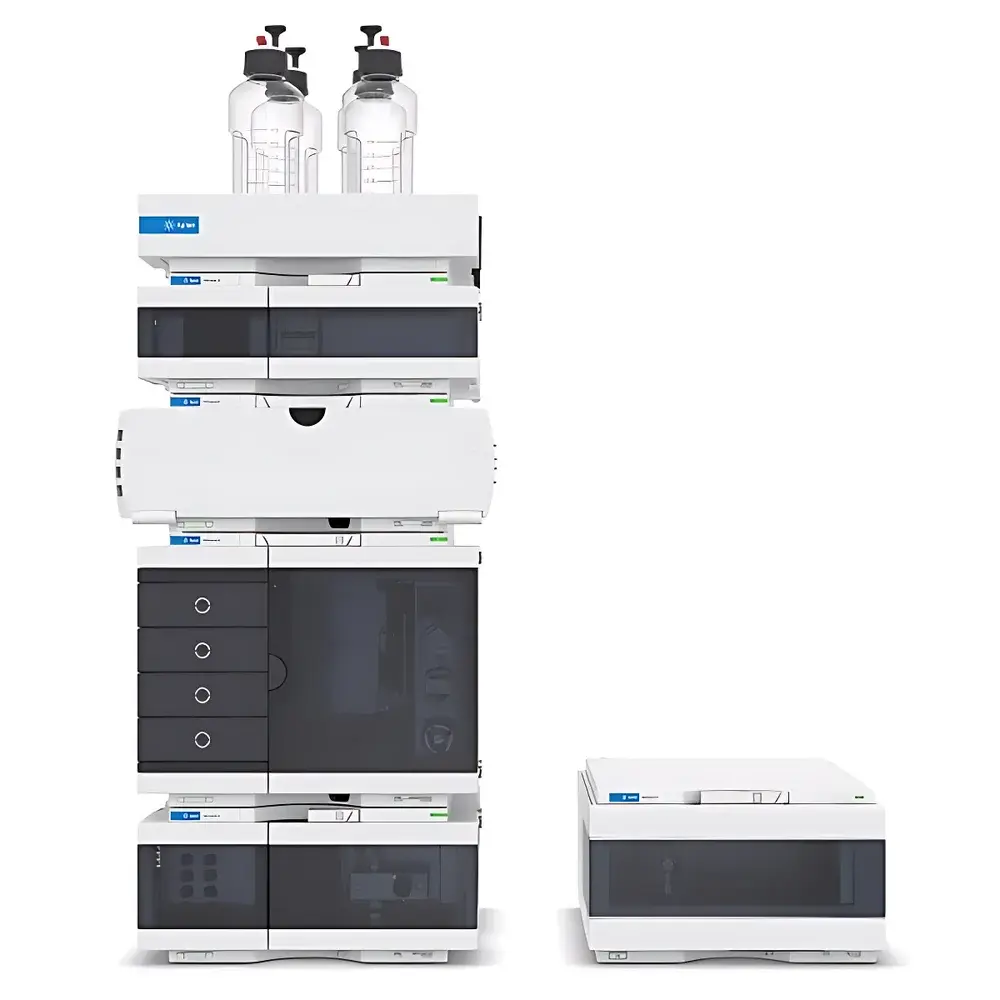
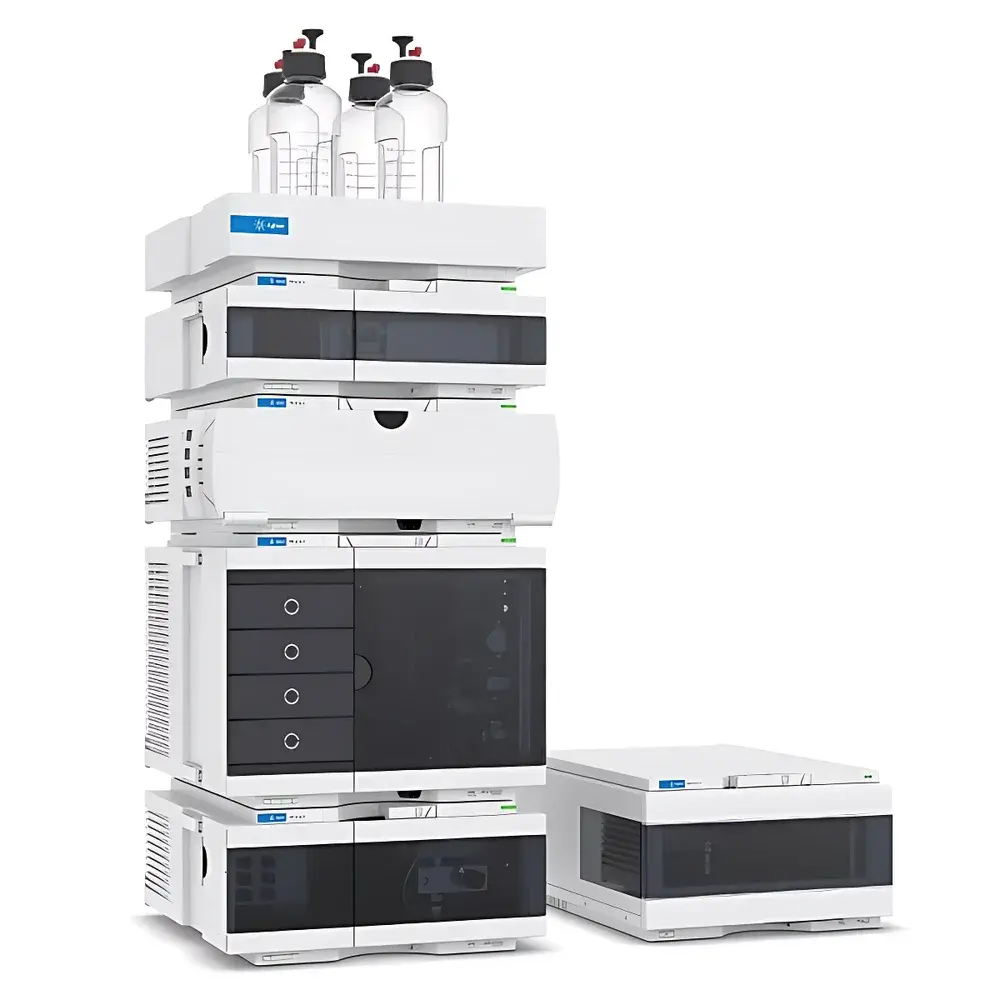
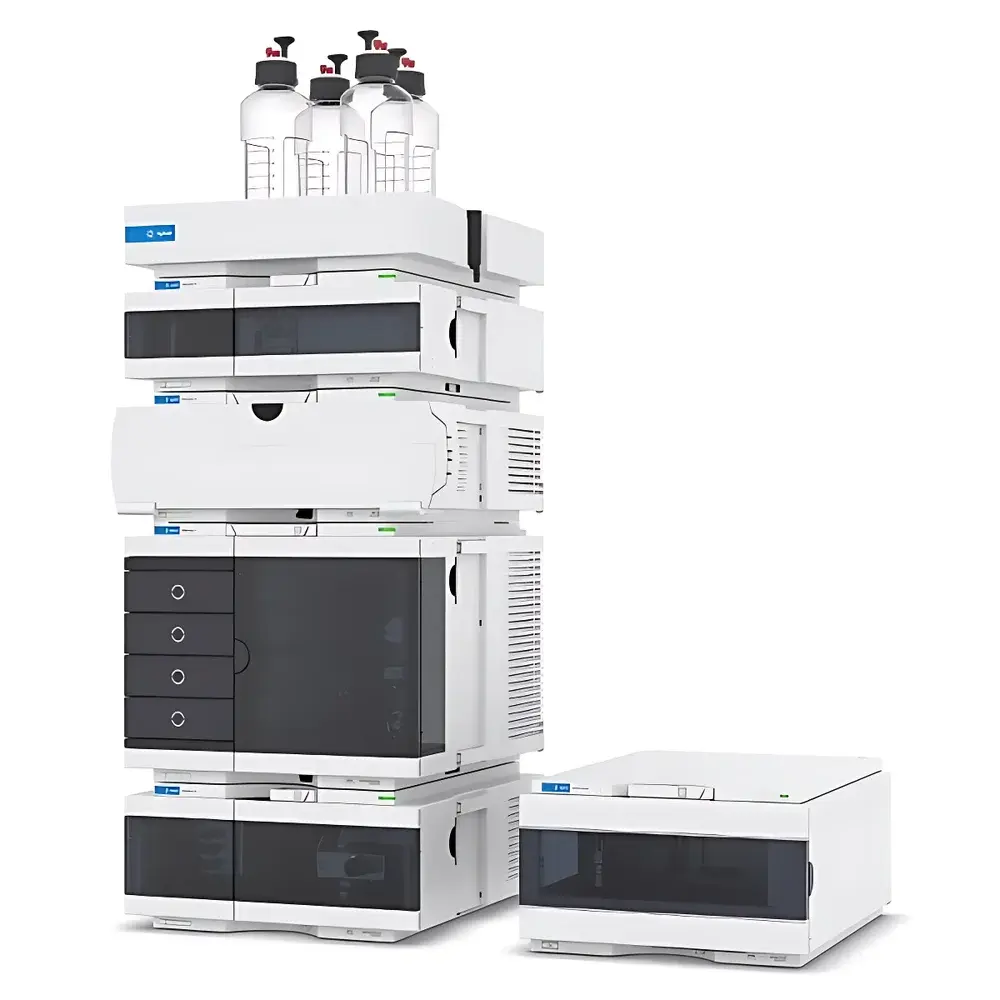
Agilent 1260 Infinity III Bio-Inert Analytical-Scale Purification System
| Brand | Agilent Technologies |
|---|---|
| Origin | Germany |
| Manufacturer | Agilent Technologies |
| Import Status | Imported |
| Model | 1260 Infinity III Bio-Inert Analytical LC System |
| Maximum Operating Pressure | up to 600 bar |
| Flow Path Material | Metal-Free (Titanium, PEEK, Sapphire, Ceramic) |
| pH Range | 1–13 (short-term exposure to pH 14) |
| Salt Tolerance | up to 2 mol/L NaCl |
| Residual Carryover | <9 ppm |
| Fraction Collection Capacity | up to 384 wells (4 × 96-well plates) or 216 tubes (4 tube diameters) |
| Detection Options | Bio-inert UV and Fluorescence Flow Cells |
| Solvent Mixing | Quaternary Gradient Mixing with Active Seal Wash |
Overview
The Agilent 1260 Infinity III Bio-Inert Analytical-Scale Purification System is an engineered solution for the high-fidelity purification and characterization of sensitive biomolecules—including monoclonal antibodies (mAbs), recombinant proteins, antibody–drug conjugates (ADCs), and viral vectors—under conditions that preserve structural integrity and functional activity. Built upon Agilent’s InfinityLab platform, this system employs a fully bio-inert fluidic path constructed from titanium, sapphire, ceramic, and high-purity PEEK components, eliminating contact with stainless steel, iron, or nickel-based alloys throughout the entire sample pathway—from autosampler to detector to fraction collector. This architecture mitigates metal-catalyzed oxidation, adsorption, aggregation, and deamidation, thereby ensuring reproducible retention times, accurate quantitation, and extended column lifetime. The system operates at pressures up to 600 bar, supporting both conventional low-pressure preparative columns (e.g., 10–25 µm particle size) and high-resolution analytical columns packed with sub-2-µm particles, enabling seamless method translation between screening, analytical QC, and small-scale purification workflows.
Key Features
- Metal-free fluidic path certified for bio-inert operation: titanium pump heads, sapphire capillaries, ceramic check valves, and PEEK-lined tubing ensure minimal surface interaction with labile biomolecules.
- 600-bar pressure capability enables use of advanced AdvanceBio columns (e.g., SEC, IEX, RP, peptide mapping) without compromising resolution or speed.
- Bio-inert Multisampler with dual-stage needle wash and active seal wash reduces carryover to <9 ppm—critical for trace-level analysis and sequential injection of precious biologics.
- Integrated refrigerated fraction collector with real-time temperature monitoring (2–10 °C) prevents thermal degradation during collection of thermolabile fractions.
- Quaternary solvent manager with integrated degasser and gradient precision ≤0.15% RSD supports complex multi-step elution gradients required for ion-exchange and mixed-mode separations.
- InfinityLab Quick Connect fittings and Quick Turn column connectors enable tool-free, leak-free connections with <0.1 µL dead volume—reducing dispersion and improving peak shape.
Sample Compatibility & Compliance
The system is validated for use with high-salt mobile phases (up to 2 mol/L NaCl or ammonium sulfate), extreme pH conditions (pH 1–13; short-term exposure to pH 14 permitted), and aggressive solvents including TFA, HFIP, and high-concentration organic modifiers. All wetted materials comply with USP Class VI and ISO 10993-5 cytotoxicity standards. The hardware and software architecture support 21 CFR Part 11 compliance when deployed with Agilent OpenLab CDS or MassHunter software—including electronic signatures, audit trails, and role-based access control. Method parameters and fraction collection metadata are recorded with timestamped, immutable entries suitable for GLP/GMP-regulated environments. Column performance metrics (e.g., backpressure trends, peak asymmetry, plate count) are automatically logged to support IQ/OQ/PQ documentation.
Software & Data Management
Agilent Buffer Advisor software streamlines buffer preparation for ion-exchange chromatography by calculating precise mixing ratios for multi-component buffers across defined pH and conductivity ranges—reducing manual errors and accelerating method development. OpenLab CDS provides full instrument control, sequence management, and integrated fraction tracking, including delay-volume compensation via built-in optical sensor feedback. Fraction data is synchronized with chromatographic peaks in real time, enabling accurate cut-point definition based on UV absorbance, fluorescence intensity, or multi-wavelength deconvolution. All raw data, processing methods, and audit logs are stored in vendor-neutral .d format, compatible with third-party data analysis platforms and LIMS integration via ASTM E1384 or HL7 interfaces.
Applications
- Purification and purity assessment of mAbs, Fc-fusion proteins, and bispecific antibodies using SEC, IEX, and hydrophobic interaction chromatography (HIC).
- Peptide mapping workflows for higher-order structure verification and post-translational modification (PTM) analysis.
- Process intermediate monitoring during upstream and downstream bioprocessing, including harvest clarification, Protein A eluate polishing, and final formulation stability testing.
- Isolation of intact viral particles or exosomes for downstream biophysical characterization (e.g., DLS, TEM, SPR).
- Orthogonal method development combining UV, fluorescence, and MS-compatible fraction collection for comprehensive attribute monitoring per ICH Q5E and Q5A(R2).
FAQ
What types of biomolecules can be purified using this system?
It is optimized for proteins, peptides, oligonucleotides, ADCs, viral vectors, and extracellular vesicles—particularly those prone to metal-induced degradation or surface adsorption.
Is the system compatible with mass spectrometry coupling?
Yes—the bio-inert flow path and low-dead-volume connections support direct LC-MS interfacing; optional nano- and micro-flow configurations are available via Agilent’s chip-based interface modules.
Can I upgrade the fraction collector capacity after installation?
Yes—modular tray carriers allow field-upgradable expansion from 96-well plates to 4 × 96-well formats or glass tube racks accommodating 4 different outer diameters (10–28 mm).
Does the system support automated method transfer from analytical to purification scale?
Yes—retention time normalization, gradient scaling algorithms, and column dimension conversion tools in OpenLab CDS facilitate robust method translation while preserving selectivity and resolution.
How is system suitability verified for GMP applications?
Built-in system suitability tests (SST) include pressure stability checks, gradient accuracy verification, UV lamp energy monitoring, and carryover assessment—all reportable with configurable pass/fail criteria aligned with USP & EP monographs.
Related Products




