
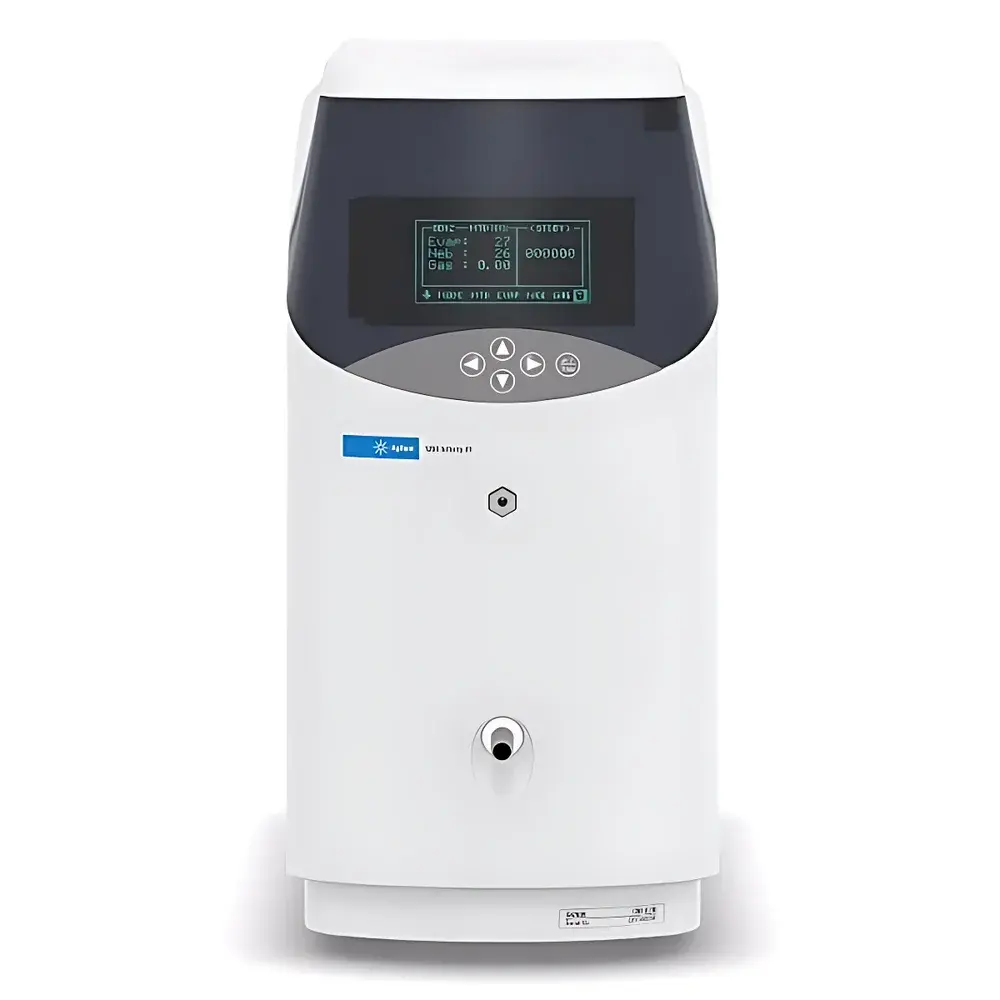
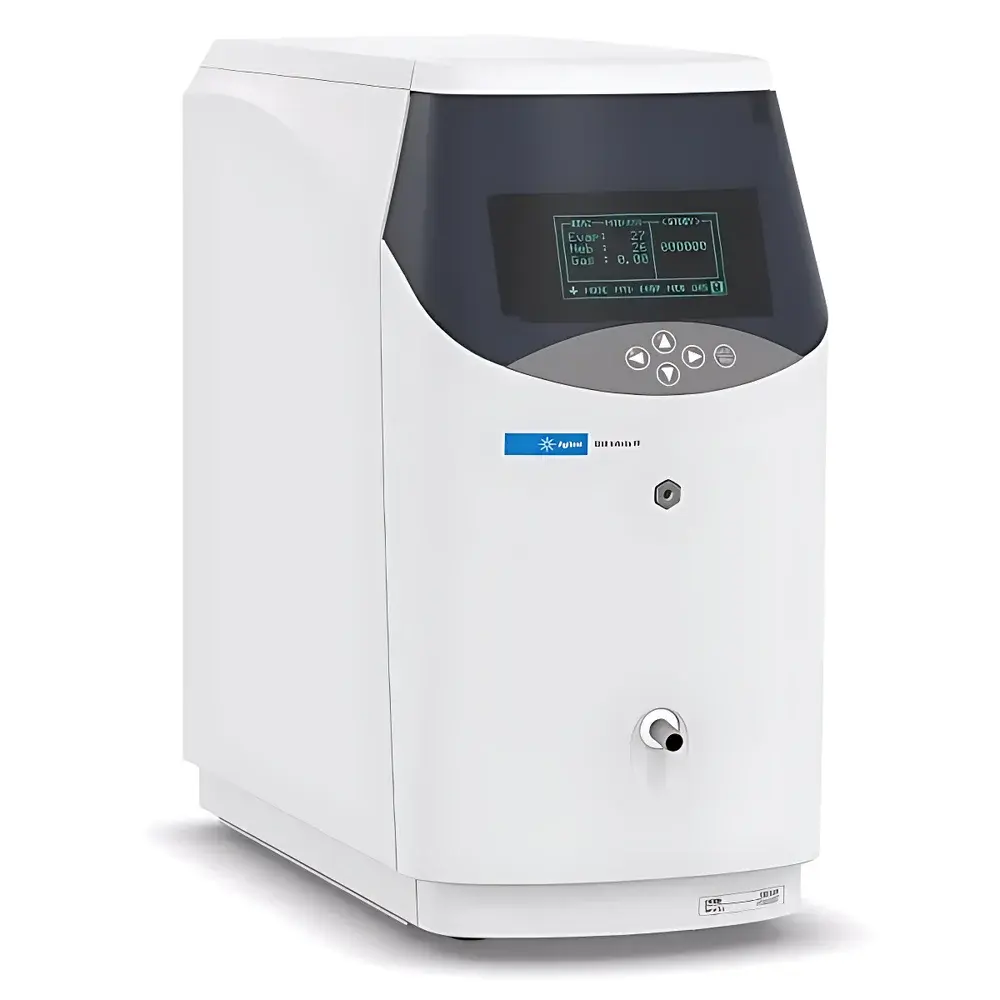
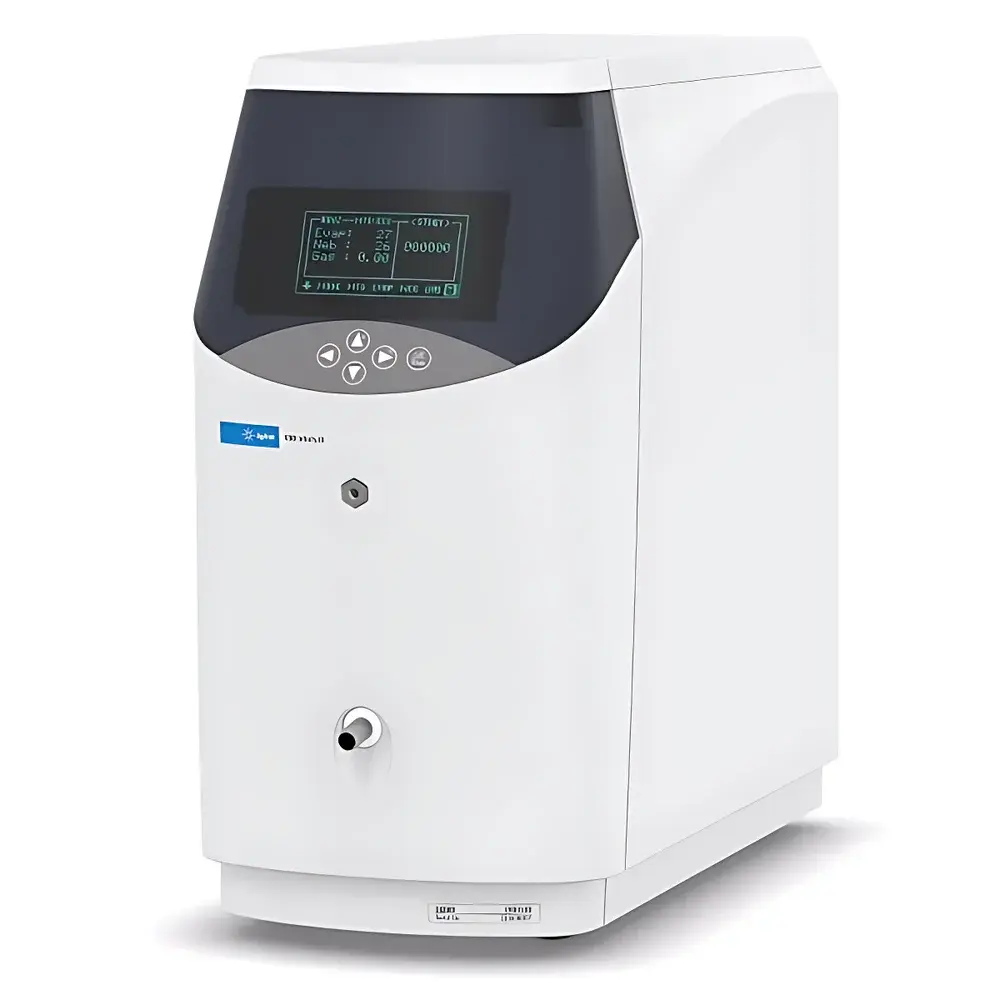
Agilent 1260 Infinity III Evaporative Light Scattering Detector (ELSD)
| Brand | Agilent Technologies |
|---|---|
| Origin | Germany |
| Manufacturer Type | Original Equipment Manufacturer (OEM) |
| Product Category | Imported Instrument |
| Model | 1260 Infinity III ELSD |
| Detection Principle | Evaporative Light Scattering Detection |
| Compatible Systems | Agilent 1260 Infinity III LC, Other HPLC/UHPLC Platforms via Analog/Digital I/O |
| Operating Temperature Range | Up to 120 °C |
| Carrier Gas | Nitrogen or Compressed Air |
| Detection Sensitivity | Sub-nanogram (ng) Level for Non-Volatile and Semi-Volatile Analytes |
| Baseline Stability | Minimal Drift (<0.5 mV/h after equilibration) |
| Data Acquisition Rate | Up to 100 Hz |
| Reproducibility | RSD < 2% (n = 6, repeated injections) |
| Solvent Compatibility | Fully compatible with DMSO, THF, DMF, chlorinated solvents, and high-boiling-point mobile phases |
| Regulatory Compliance | Designed for GLP/GMP environments |
Overview
The Agilent 1260 Infinity III Evaporative Light Scattering Detector (ELSD) is a robust, temperature- and gas-controlled universal detector engineered for high-performance liquid chromatography (HPLC) and ultra-high-performance liquid chromatography (UHPLC) systems. Unlike UV-Vis or fluorescence detectors, the ELSD operates on a physical detection principle: the mobile phase is nebulized, evaporated in a heated drift tube, and the remaining non-volatile analyte particles are illuminated by a stable light source; scattered light intensity—proportional to analyte mass—is measured by a photodiode. This mechanism ensures consistent response across compounds lacking chromophores, including lipids, carbohydrates, polymers, saponins, and synthetic organic molecules. Its design eliminates dependence on optical properties such as extinction coefficient or quantum yield, enabling direct semi-quantitative analysis without compound-specific calibration curves—critical for compound library screening, natural product profiling, and formulation development.
Key Features
- Universal detection capability for non-UV-absorbing and weakly absorbing analytes—including DMSO-solubilized compounds—with complete DMSO removal during evaporation, eliminating early-eluting peak suppression.
- Real-time, software-controlled carrier gas flow regulation maintains uniform droplet formation and particle size distribution across solvent gradients, minimizing quantitative variability in gradient elution methods.
- Drift tube temperature adjustable up to 120 °C, enabling efficient solvent evaporation for high-boiling-point mobile phases (e.g., DMF, ethylene glycol, or >30% DMSO aqueous mixtures) while preserving thermal stability of thermally labile analytes.
- Low internal volume and minimal light-path diffusion support fast data acquisition (up to 100 Hz), making it fully compatible with sub-2-minute UHPLC separations and narrow-bore column applications.
- Integrated analog and digital I/O interfaces allow seamless integration with Agilent OpenLab CDS, ChemStation, Empower, Chromeleon, and other third-party chromatography data systems—supporting remote configuration, real-time monitoring, and automated method synchronization.
- Proven analytical reproducibility: relative standard deviation (RSD) < 2% for retention time and peak area over six consecutive injections under standardized conditions, meeting routine QC and method validation requirements per ICH Q2(R2).
Sample Compatibility & Compliance
The 1260 Infinity III ELSD accommodates a broad range of sample types—including small-molecule APIs, oligosaccharides, phospholipids, PEGylated proteins, and synthetic polymers—without derivatization or post-column modification. It is routinely deployed in pharmaceutical stability-indicating assays, excipient quantification, and impurity profiling where UV-inactive species dominate. The detector meets essential regulatory expectations for analytical instrumentation used in GxP environments: its firmware architecture supports 21 CFR Part 11–compliant electronic records and signatures when paired with validated CDS platforms; audit trails, user access controls, and method change history logging are fully enabled. It complies with ISO/IEC 17025:2017 requirements for testing laboratories and aligns with ASTM E2656 and USP guidelines for universal detector qualification.
Software & Data Management
Control and data acquisition are managed through Agilent’s OpenLab CDS or legacy ChemStation software, both offering full parameter scripting (temperature ramp, gas pressure setpoint, gain adjustment) and real-time signal visualization. Raw ELSD signals are digitized at 16-bit resolution and stored in vendor-neutral formats (e.g., .CDF, .mzML-compatible metadata). Integration algorithms include baseline correction via rolling ball or adaptive polynomial fitting—optimized for low-drift ELSD baselines—and peak detection based on signal-to-noise ratio thresholds. All method parameters, calibration logs, and instrument status reports are embedded in the raw data file, ensuring traceability for regulatory submissions and internal quality audits.
Applications
- Quantification of UV-transparent excipients (e.g., lactose, mannitol, hydroxypropyl cellulose) in solid oral dosage forms.
- Analysis of lipid classes (triglycerides, phospholipids, sterols) in food and biological matrices without derivatization.
- Monitoring of polymer molecular weight distributions via SEC-GPC using refractive index–incompatible solvents (e.g., THF + 0.1% BHT).
- High-throughput screening of compound libraries dissolved in DMSO, with reliable detection of early-eluting actives unaffected by residual solvent interference.
- Stability-indicating assays for biodegradable polyesters (e.g., PLGA) and peptide conjugates in accelerated degradation studies.
FAQ
How does the ELSD differ from a mass spectrometer in terms of compound identification capability?
The ELSD is a universal, non-destructive, mass-sensitive detector—it provides no structural information or molecular weight data. Identification requires coupling with prior separation (e.g., HPLC) and orthogonal techniques such as MS or NMR.
Can the detector be used with gradient elution methods involving high water content followed by organic solvent ramps?
Yes—the real-time gas flow control and optimized nebulizer design ensure stable response across 0–100% organic gradients, including aqueous TFA or formic acid mobile phases.
Is post-run cleaning required after analyzing viscous or non-volatile samples?
Routine operation does not require manual cleaning; the heated drift tube and inert gas purge minimize residue buildup. For extended use with polymer solutions, a daily 10-minute air-purge cycle at 120 °C is recommended.
What is the minimum detectable mass for sucrose under standard operating conditions?
Typical limit of detection (LOD) is 2–5 ng on-column for sucrose using a 4.6 × 150 mm C18 column and acetonitrile/water mobile phase—dependent on injection volume, column efficiency, and signal averaging settings.
Does the system support IQ/OQ/PQ documentation packages for regulated laboratories?
Agilent provides factory-validated IQ/OQ protocols and PQ templates aligned with ASTM E2500 and EU Annex 11; site-specific execution and risk-based qualification are supported by Agilent Services.




