
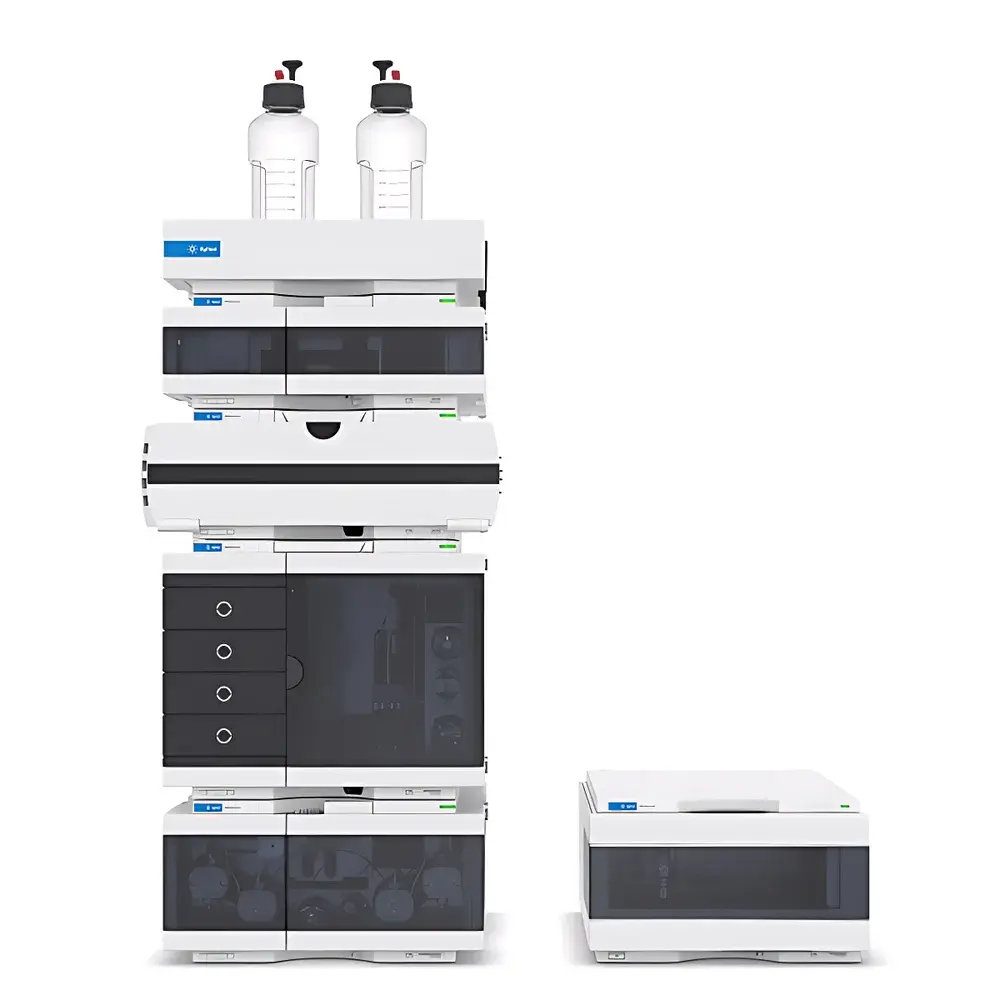
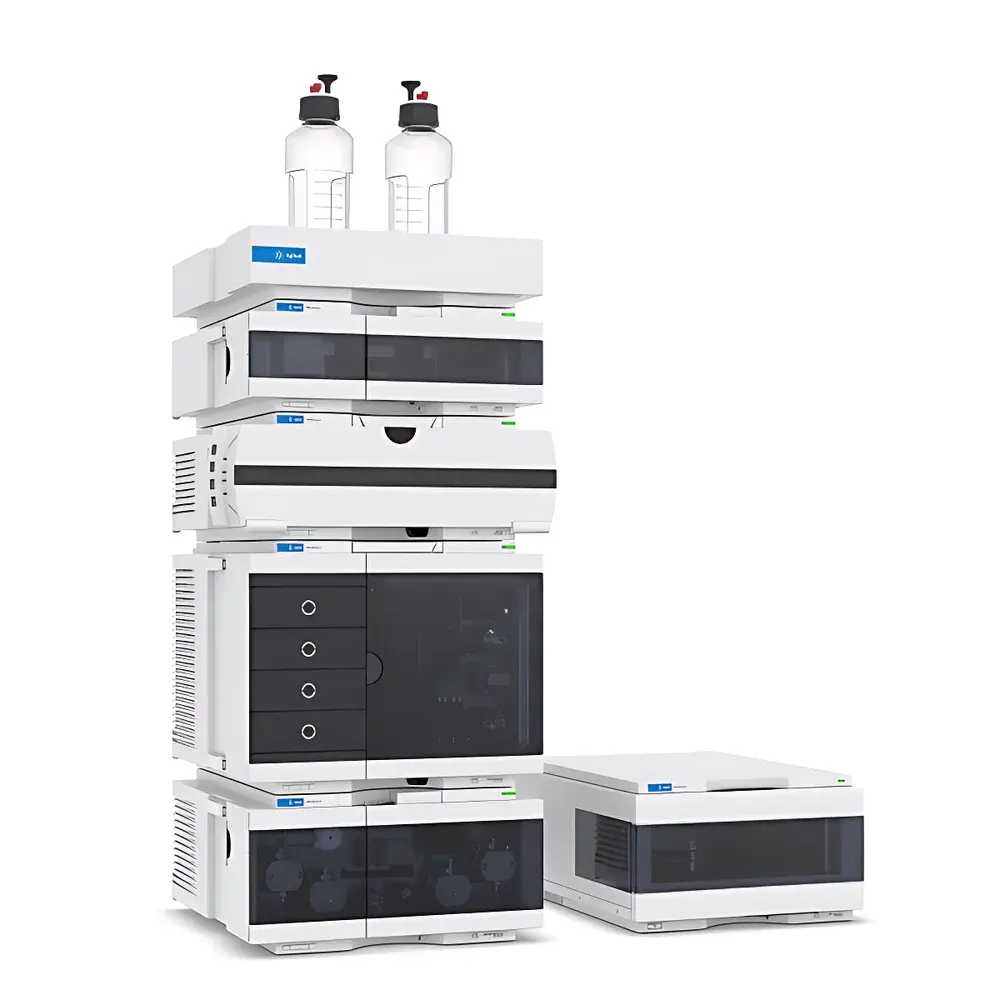
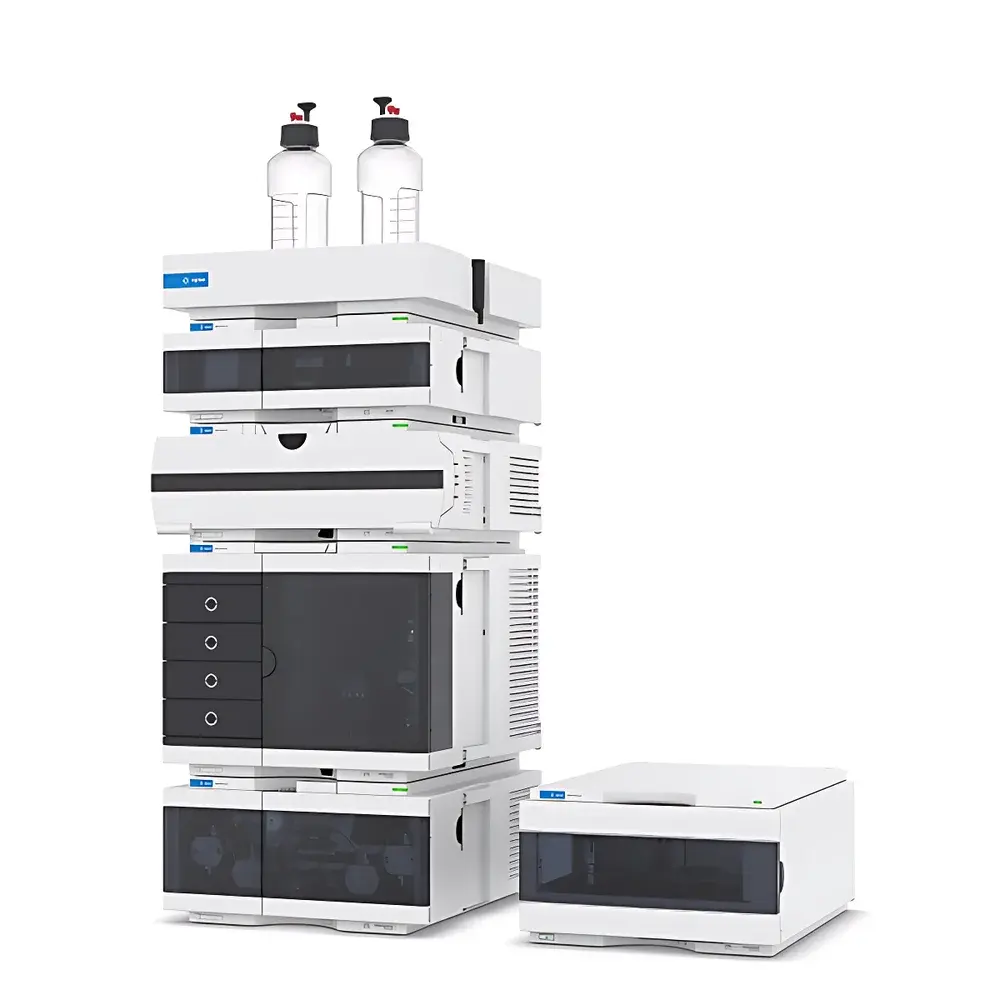
Agilent 1290 Infinity II Analytical-Scale Purification System
| Brand | Agilent Technologies |
|---|---|
| Origin | Germany |
| Manufacturer Type | Original Equipment Manufacturer (OEM) |
| Product Origin | Imported |
| Model | 1290 Infinity II Analytical-Scale Purification System |
| Application Level | Laboratory Grade |
| Instrument Type | High-Pressure Preparative Liquid Chromatography |
| Flow Rate Range | Up to 5 mL/min (with G7120A Binary Pump and G7104A Autosampler) |
| Maximum Operating Pressure | 1300 bar |
Overview
The Agilent 1290 Infinity II Analytical-Scale Purification System is a high-pressure liquid chromatography platform engineered for precise, reproducible isolation of milligram-scale compounds from complex mixtures. Built upon the InfinityLab LC ecosystem, it integrates ultra-high-performance liquid chromatography (UHPLC) architecture with analytical purification functionality—enabling separation at pressures up to 1300 bar while maintaining sub-2 µm particle column compatibility. Unlike conventional preparative systems optimized for gram-scale throughput, this system bridges the gap between analytical characterization and small-scale purification, delivering high-resolution fractionation without compromising chromatographic fidelity. Its design adheres to core principles of fluidic integrity, low dwell volume, and minimal band broadening—critical for preserving peak shape and recovery yield during collection. The system is purpose-built for laboratories engaged in natural product isolation, synthetic intermediate purification, metabolite enrichment, and early-stage compound library generation where purity, traceability, and method transferability are non-negotiable.
Key Features
- High-pressure UHPLC architecture supporting gradients up to 1300 bar, enabling use of sub-2 µm and superficially porous particle (SPP) columns for enhanced resolution and speed
- Low-diffusion fraction collection with integrated delay sensor technology—compensates for system dwell volume in real time to align UV/MS trigger signals with actual elution profiles
- Flexible fraction handling: supports collection into 4 × 96-well microplates (max. 384 fractions) or glass tubes in four standard outer diameters (up to 216 fractions per run)
- Modular detection expansion: compatible with UV/Vis (G7117A), diode array (G7118A), fluorescence (G7121A), refractive index (G7165A), evaporative light scattering (G7167A), and single-quadrupole mass spectrometry (G6120B LC/MSD) detectors
- Autosampler with dual-injection capability and needle wash station—ensures carryover < 0.005% for high-sensitivity purification workflows
- Binary pump (G7120A) with active solvent compressibility compensation and pulse-free flow delivery across 0.01–5.00 mL/min range
Sample Compatibility & Compliance
The system accommodates a wide range of sample matrices—including polar, non-polar, thermally labile, and ionizable compounds—across reversed-phase, HILIC, and normal-phase chromatographic modes. It meets essential regulatory requirements for method development and purification under GLP and GMP-aligned environments. Data acquisition and instrument control comply with FDA 21 CFR Part 11 when deployed with Agilent OpenLab CDS ChemStation configured for electronic signatures, audit trails, and role-based access control. All hardware components conform to IEC 61010-1 safety standards and CE marking for laboratory instrumentation. Column temperature control (G7116A Thermostatted Column Compartment) maintains ±0.1 °C stability—supporting ISO 17025-compliant calibration protocols.
Software & Data Management
Agilent OpenLab CDS ChemStation provides a validated, scalable software environment for method building, sequence definition, real-time monitoring, and fraction triggering logic. Its modular architecture supports both standalone operation and integration into enterprise-level LIMS or ELN platforms via ASTM E1384-compliant data export. Fraction metadata—including retention time, UV spectra, MS base peaks, and collection timestamps—is embedded directly into .d data folders and can be exported as CSV or XML for downstream analysis. Audit trail functionality logs all user actions, parameter changes, and system events with immutable timestamps—meeting ALCOA+ data integrity criteria. Method templates and SOP-driven workflows reduce operator dependency and support consistent execution across multiple users and shifts.
Applications
- Purification of synthetic intermediates and final APIs in medicinal chemistry campaigns
- Isolation of bioactive natural products from crude extracts with orthogonal detection confirmation
- Enrichment of low-abundance metabolites for NMR or high-resolution MS structural elucidation
- Preparative chiral separations using polysaccharide-based columns under UHPLC conditions
- Generation of reference standards and certified calibrants for QC laboratories
- Multi-dimensional purification workflows combining 2D-LC fractionation with offline MS-guided collection
FAQ
What is the difference between analytical-scale purification and preparative HPLC?
Analytical-scale purification operates at flow rates ≤5 mL/min and injects µg–mg quantities, prioritizing resolution and purity over throughput. Preparative HPLC typically uses >10 mm ID columns and flow rates ≥10 mL/min for gram-scale output.
Can this system be used for method development prior to scale-up?
Yes—the identical column chemistries, gradient profiles, and mobile phase compositions used on the 1290 Infinity II translate directly to larger-bore preparative systems, minimizing re-optimization effort.
Is mass-directed fraction collection supported?
Yes—when coupled with the G6120B LC/MSD and OpenLab CDS ChemStation, the system enables real-time m/z-triggered collection based on extracted ion chromatograms.
Does the system support automated method optimization?
While not fully autonomous, it integrates with Agilent’s Method Scouting Software for systematic evaluation of column, mobile phase, and gradient variables—generating ranked method recommendations.
How is system suitability verified for purification runs?
Built-in diagnostics include pressure profiling, baseline noise assessment, UV lamp energy monitoring, and autosampler precision testing—reportable via customizable PDF certificates compliant with internal SOPs.




