
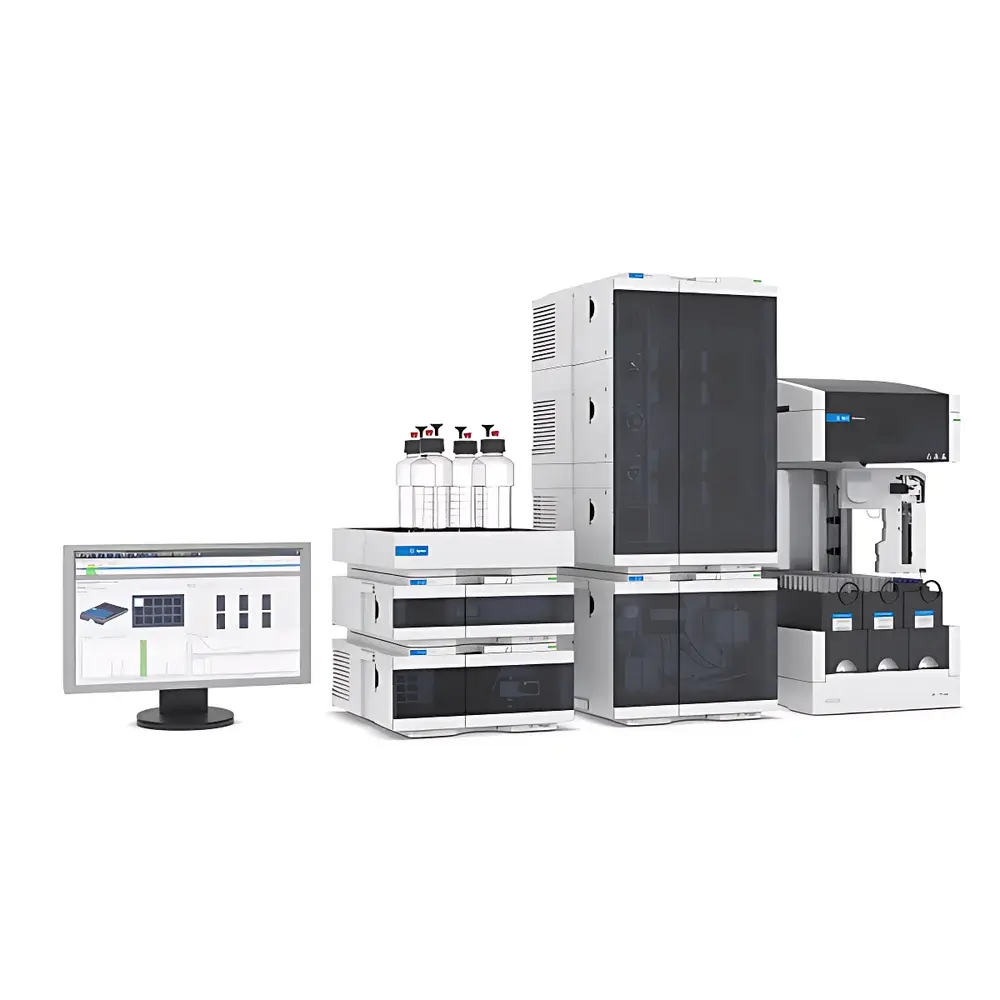
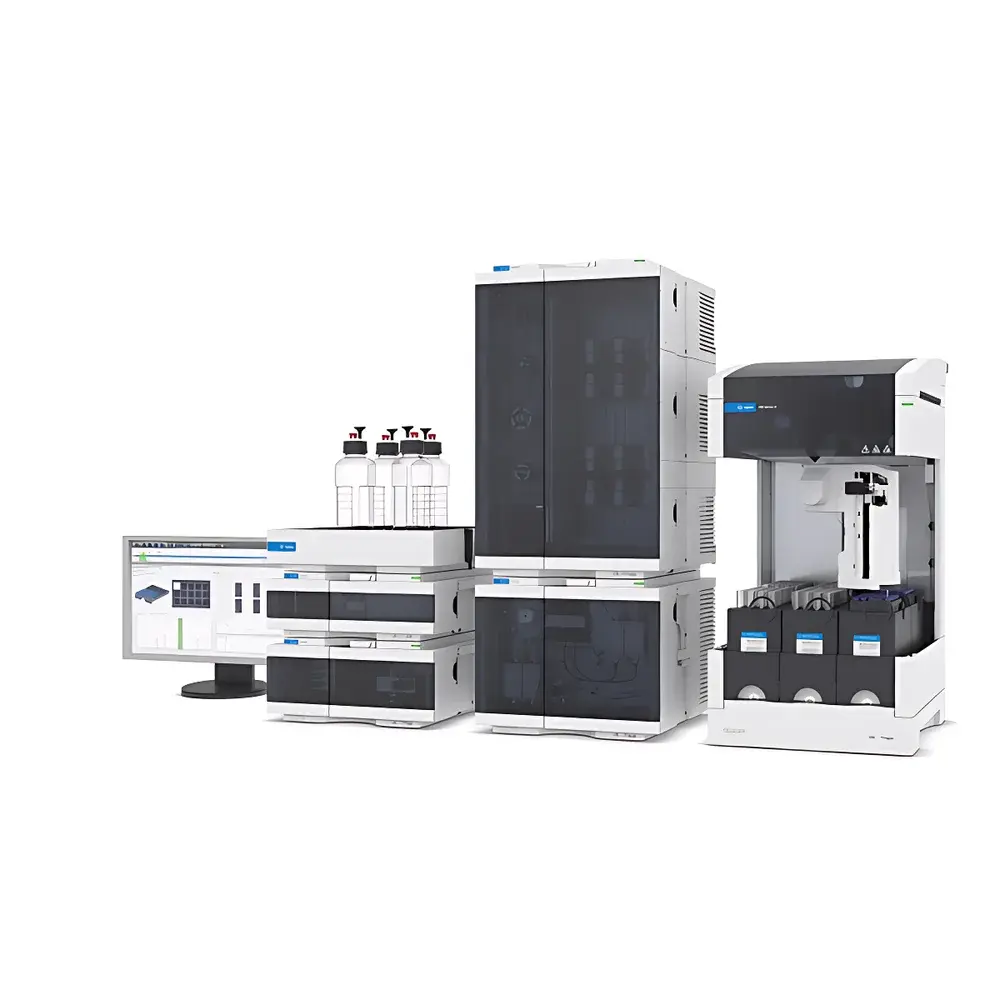
Agilent 1290 Infinity II Automated Preparative Liquid Chromatography System
| Brand | Agilent Technologies |
|---|---|
| Origin | Germany |
| Manufacturer Type | Original Equipment Manufacturer (OEM) |
| Origin Category | Imported |
| Model | 1290 Infinity II Automated Preparative |
| Application Level | Laboratory-Grade |
| Instrument Type | High-Pressure Preparative Liquid Chromatograph |
| Flow Rate Range | 1–200 mL/min |
| Maximum Operating Pressure | 20–600 bar |
Overview
The Agilent 1290 Infinity II Automated Preparative Liquid Chromatography System is a high-performance, workflow-driven platform engineered for seamless method translation from analytical-scale screening to preparative-scale purification. Built upon robust ultra-high-pressure liquid chromatography (UHPLC) architecture, it employs dual-gradient solvent delivery, low-dispersion fluidics, and real-time fraction triggering to support scalable purification of small molecules, natural products, synthetic intermediates, and early-stage pharmaceutical candidates. Its core design integrates precision pumping, intelligent valve routing, and minimized system dwell volume—enabling reproducible retention time alignment between analytical and preparative runs. This ensures method fidelity during scale-up while maintaining compliance with ICH Q5A, Q5B, and regulatory expectations for purity profiling in drug substance development.
Key Features
- Automated analytical-to-preparative method transfer via Agilent AutoPurify software, leveraging retention time normalization, peak capacity mapping, and dynamic gradient focusing algorithms to preserve selectivity and resolution across scales.
- Modular high-pressure quaternary pump with field-replaceable pump heads, delivering stable flow rates from 1 to 200 mL/min at pressures up to 600 bar—compatible with both conventional 10–30 µm prep columns and sub-2 µm high-efficiency media.
- Five configurable valve slots supporting simultaneous integration of fraction delay coils, mass spectrometry flow diverters (e.g., Agilent 1290 Infinity II MS Flow Modulator), and multi-collector switching—enabling parallel collection strategies and orthogonal detection triggers.
- Ultra-low system dispersion (<50 µL total dwell volume) achieved through minimized tubing length, integrated mixing chambers, and direct-injection loop design—reducing band broadening and cross-contamination to maximize recovery and purity of target fractions.
- Full compatibility with Agilent OpenLab CDS ChemStation software, providing validated, audit-trail-enabled operation aligned with FDA 21 CFR Part 11 requirements for electronic records and signatures in regulated environments.
Sample Compatibility & Compliance
The system accommodates a wide range of sample types—including polar/non-polar organic compounds, peptides, oligonucleotides, and thermally labile metabolites—across mobile phase pH ranges of 1–12 and temperatures from 5 °C to 80 °C. Column compatibility spans internal diameters from 10 mm to 50 mm and lengths up to 250 mm, supporting reversed-phase, HILIC, ion-exchange, and chiral separations. All hardware components comply with CE marking directives, RoHS 2011/65/EU, and ISO 9001:2015 manufacturing standards. For GxP laboratories, the system supports GLP/GMP-compliant workflows when deployed with OpenLab CDS ChemStation’s role-based access control, electronic signature validation, and full audit trail logging.
Software & Data Management
Agilent AutoPurify software serves as the central intelligence layer for method scaling. It imports analytical UHPLC methods—including gradient profiles, column dimensions, and detector parameters—and applies empirically derived scaling rules (e.g., linear velocity matching, constant mass load per unit column volume) to generate optimized preparative conditions. Real-time UV/Vis spectral deconvolution enables compound-specific fraction triggering, while optional integration with Agilent MassHunter enables mass-triggered collection. All acquisition, processing, and reporting data are stored within the OpenLab CDS database, supporting automated report generation (PDF/CSV), metadata tagging, and secure export for LIMS or ELN integration.
Applications
- Purification of synthetic reaction mixtures in medicinal chemistry, including removal of catalysts, protecting groups, and diastereomeric impurities.
- Isolation of natural product fractions from crude extracts for structure elucidation and bioactivity screening.
- Preparative separation of enantiomers using chiral stationary phases under SFC or LC conditions.
- Generation of reference standards and certified reference materials (CRMs) meeting ISO/IEC 17025 traceability requirements.
- Supporting quality-by-design (QbD) initiatives by enabling systematic investigation of critical process parameters (CPPs) such as flow rate, gradient slope, and column temperature during method development.
FAQ
Can analytical methods developed on Agilent 1290 Infinity II Analytical systems be directly transferred to this preparative configuration?
Yes—AutoPurify software performs retention time correction, peak width adjustment, and gradient compression to maintain elution order and relative resolution during scale-up.
What is the minimum detectable mass for UV-triggered fraction collection?
Detection sensitivity depends on analyte molar absorptivity and pathlength; typical LOD for standard 10-mm flow cells is ~0.1 ng on-column for compounds with ε > 10,000 L·mol⁻¹·cm⁻¹.
Is the system compatible with third-party fraction collectors or mass spectrometers?
Yes—via TTL/RS-232/USB interfaces and open API protocols, enabling synchronization with external collectors (e.g., Gilson FC204, Teledyne ISCO Combiflash) and LC-MS platforms.
How is system suitability verified prior to a purification run?
Built-in system suitability tests include pressure stability checks, gradient accuracy verification (using acetone step gradients), and retention time reproducibility assessment across consecutive injections.
Does the system support unattended overnight operation?
Yes—full sequence automation, leak detection, pressure fault handling, and automatic shutdown/restart protocols ensure reliable 24/7 operation without manual intervention.






