
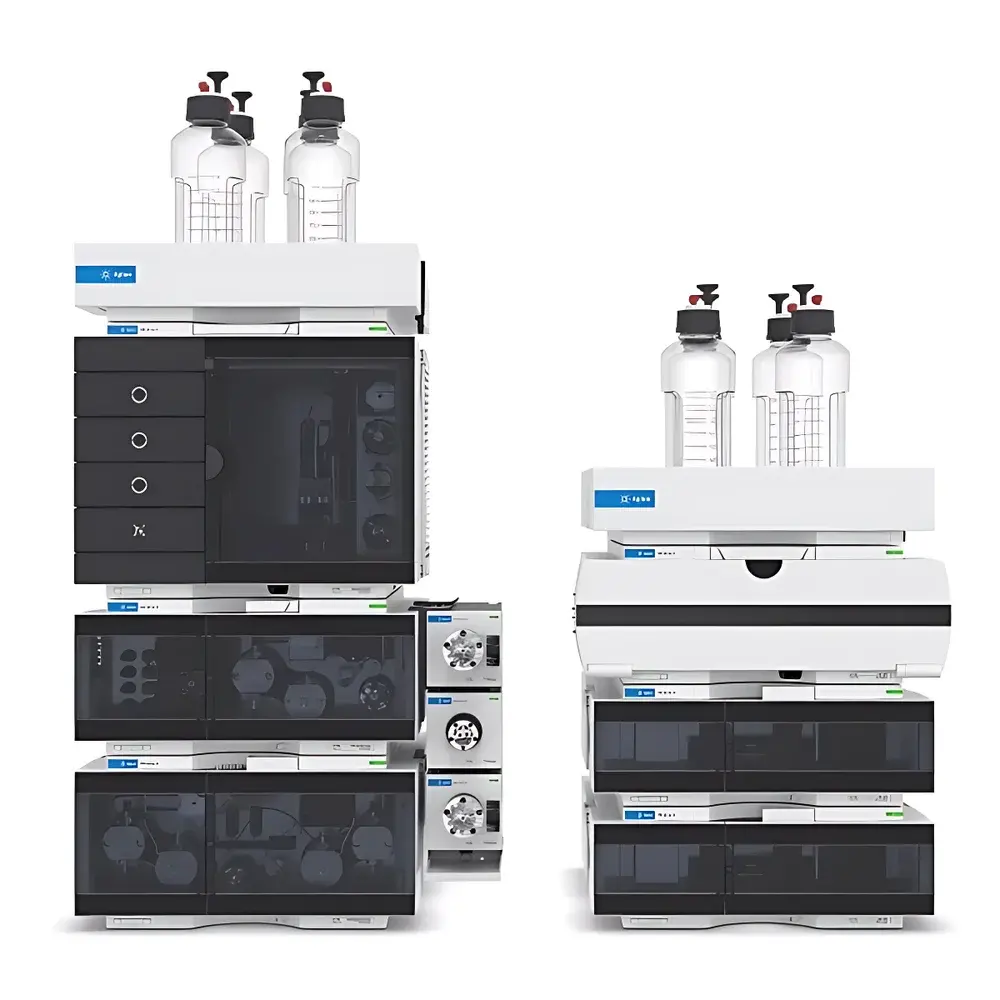
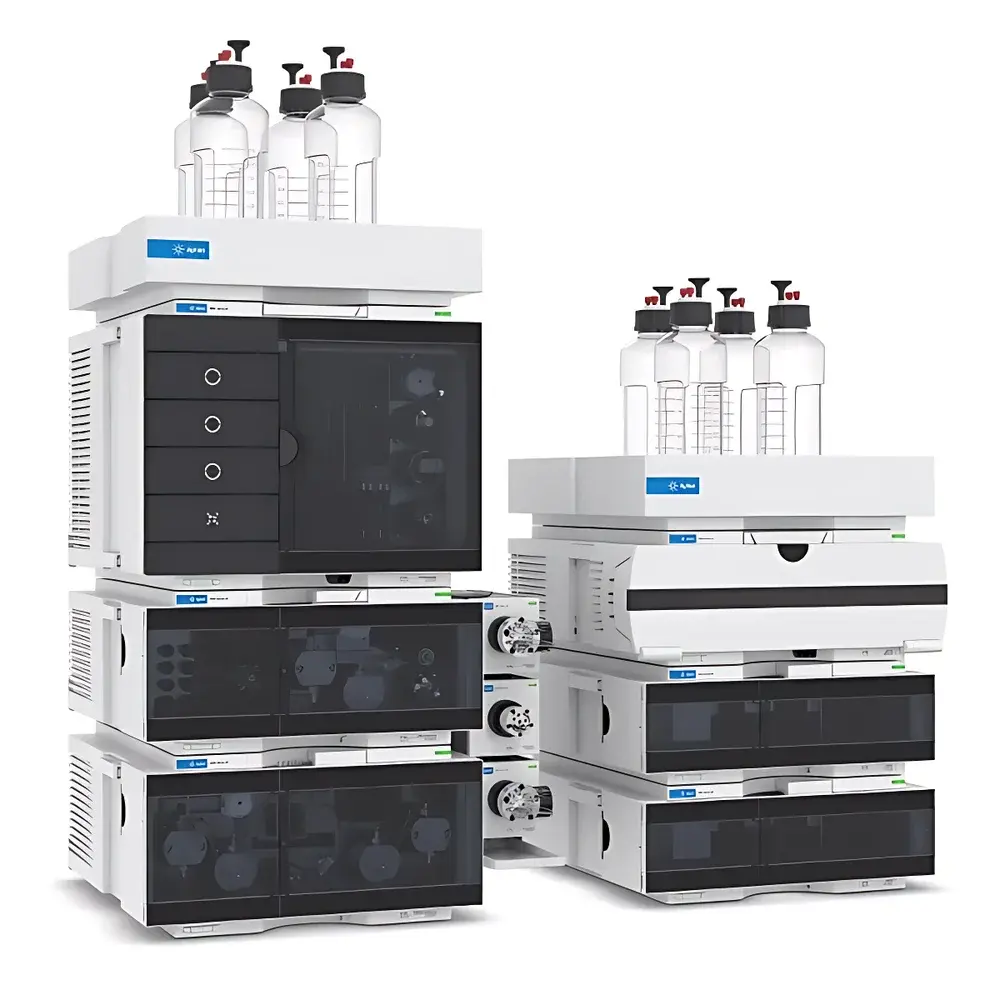
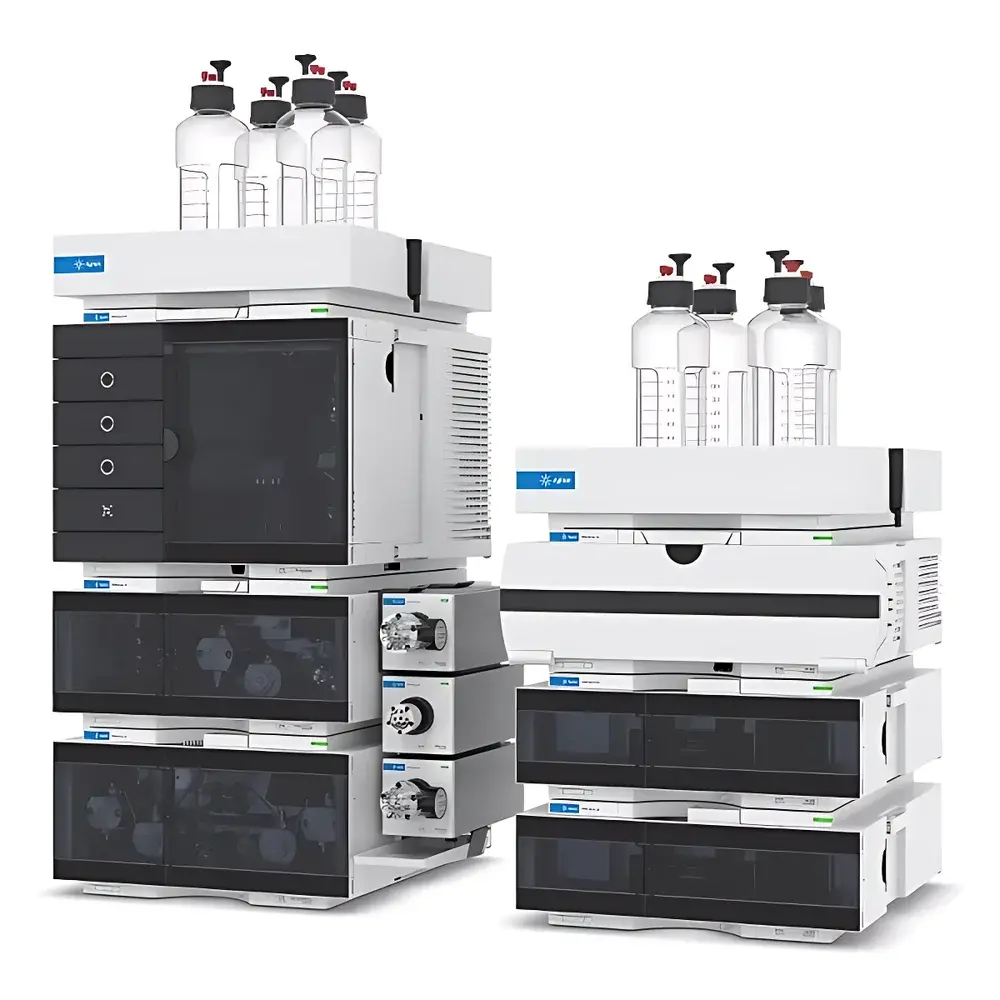
Agilent 1290 Infinity III 2D-LC Two-Dimensional Liquid Chromatography System
| Brand | Agilent Technologies |
|---|---|
| Origin | Germany |
| Manufacturer Type | Original Equipment Manufacturer (OEM) |
| Product Origin | Imported |
| Model | 1290 Infinity III 2D-LC |
| Instrument Type | Multidimensional Liquid Chromatograph |
| Application Scope | General-Purpose Analytical Platform |
| Flow Rate Range | 0.001–5 mL/min |
| Maximum Operating Pressure | up to 1300 bar |
| Injection Volume Range | 1–360 µL |
Overview
The Agilent 1290 Infinity III 2D-LC Two-Dimensional Liquid Chromatography System is an engineered platform for multidimensional separation of complex chemical and biological matrices. It implements orthogonal chromatographic mechanisms—typically reversed-phase in the first dimension (¹D) and a complementary mode (e.g., hydrophilic interaction, ion exchange, or size exclusion) in the second dimension (²D)—to dramatically increase peak capacity beyond the limits of conventional one-dimensional HPLC. By decoupling retention mechanisms and enabling comprehensive sampling of the ¹D effluent into the ²D column, the system achieves effective resolution of co-eluting species without requiring prior fraction collection or manual intervention. Designed around UHPLC-grade hardware—including low-dispersion flow paths, sub-2-µL dwell volume, and active solvent modulation—the platform delivers high reproducibility, minimal carryover, and compatibility with mass spectrometry detection across a wide pH and salt concentration range. Its architecture supports both comprehensive 2D-LC (LC×LC) and multiple heart-cutting (MHC-2D-LC) configurations, making it suitable for method development, stability-indicating assays, impurity profiling, and biomolecule characterization under regulated environments.
Key Features
- Modular 2D-LC configuration: seamless integration of dedicated 2D valve modules, biocompatible fluidic paths (MP35N, ceramic, PEEK, gold), and pressure-rated components rated to 1300 bar
- Active Solvent Modulation (ASM): dynamically adjusts ²D mobile phase composition to mitigate mismatch-induced band broadening during transfer from ¹D to ²D
- Ultra-low dispersion flow path: <2 µL total system dwell volume ensures precise gradient fidelity and retention time stability across repeated runs
- Wide injection flexibility: programmable loop-based autosampler supports 1–360 µL injections with <0.3% RSD precision at full loop fill
- Biocompatible fluidic design: inert surfaces minimize adsorption of sensitive biomolecules (mAbs, ADCs, peptides) and enable operation from pH 1–12 and up to 1 M salt concentrations
- Scalable modularity: existing Agilent 1290 Infinity III LC systems can be upgraded to 2D-LC via certified field installation kits and firmware updates
Sample Compatibility & Compliance
The 1290 Infinity III 2D-LC system is validated for use with diverse sample types including small-molecule pharmaceuticals, oligonucleotides, monoclonal antibodies, glycoproteins, polymers, petrochemical fractions, and food-derived metabolites. Its bio-inert flow path meets USP , ISO 10993-1 (cytotoxicity screening), and ASTM F2477 (biomaterial compatibility) requirements. When operated with OpenLab CDS software configured for audit trail and electronic signature, the system complies with FDA 21 CFR Part 11, EU Annex 11, and ICH Q5/Q6 guidelines for GxP-compliant analytical workflows. All 2D-LC method parameters—including valve switching events, gradient timing, and fraction collection logic—are fully traceable and version-controlled within the instrument method file.
Software & Data Management
Agilent’s 2D-LC software suite—integrated into OpenLab CDS, MassHunter, and ChemStation—provides intuitive graphical tools for method development, including interactive ¹D/²D contour plot visualization, automated peak tracking across dimensions, and retention time alignment algorithms. The software supports GLP/GMP data integrity requirements through built-in audit trails, user access controls, and electronic signatures. Raw data files (.d format) retain full dimensional metadata (valve state timestamps, gradient vectors per dimension, detector synchronization markers), enabling retrospective reprocessing and cross-platform interoperability. For LC×LC applications, the software exports standardized .cdf files compatible with third-party chemometric packages (e.g., MATLAB, Python scikit-learn) for multivariate analysis and pattern recognition.
Applications
- Pharmaceutical impurity profiling: resolving structurally similar degradants and process-related impurities in forced degradation studies
- Biopharmaceutical characterization: intact mass analysis of antibody-drug conjugates (ADCs) and charge variant mapping of mAbs
- Fuel and lubricant analysis: separating aromatic isomers and sulfur-containing compounds in complex hydrocarbon matrices
- Food authenticity testing: detecting adulteration in olive oil, honey, and wine using fingerprint chromatographic patterns
- Environmental contaminant screening: quantifying persistent organic pollutants (POPs) in soil and water extracts with matrix interference reduction
- Metabolomics and lipidomics: comprehensive profiling of polar and non-polar metabolite classes in single injections
FAQ
What distinguishes comprehensive 2D-LC (LC×LC) from heart-cutting 2D-LC?
Comprehensive 2D-LC samples the entire ¹D effluent in discrete fractions transferred to the ²D column, generating a two-dimensional retention surface. Heart-cutting isolates specific ¹D regions of interest for further ²D separation—ideal when only targeted peaks require enhanced resolution.
Can the 1290 Infinity III 2D-LC interface directly with mass spectrometers?
Yes—its low-flow ²D eluent stream (typically 0.2–0.4 mL/min) is compatible with electrospray ionization (ESI) sources on triple quadrupole, Q-TOF, and Orbitrap platforms without flow splitting or post-column dilution.
Is method transfer between different 2D-LC configurations supported?
Agilent provides method translation tools within OpenLab CDS that preserve relative peak spacing and gradient timing relationships when migrating from LC×LC to MHC or vice versa.
How does the system handle carryover in high-sensitivity bioanalysis?
The biocompatible valve and flow path design—combined with customizable needle wash protocols and active solvent modulation—achieves <0.01% carryover for peptides and oligonucleotides at sub-ng levels.
Does the system support regulatory submission-ready reporting?
All reports generated via OpenLab CDS include embedded raw data links, processing parameters, system suitability results, and electronic signatures compliant with FDA eCTD Module 5.4.1 requirements.
Related Products




