
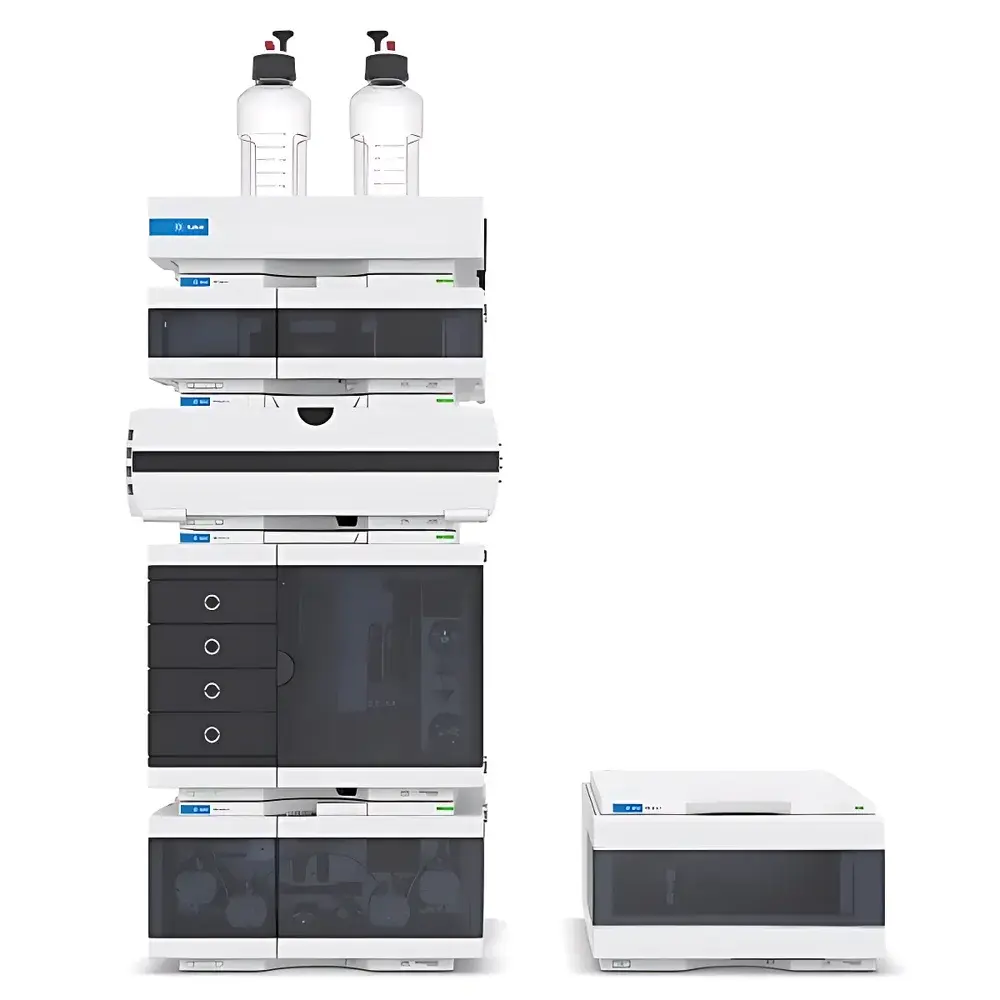
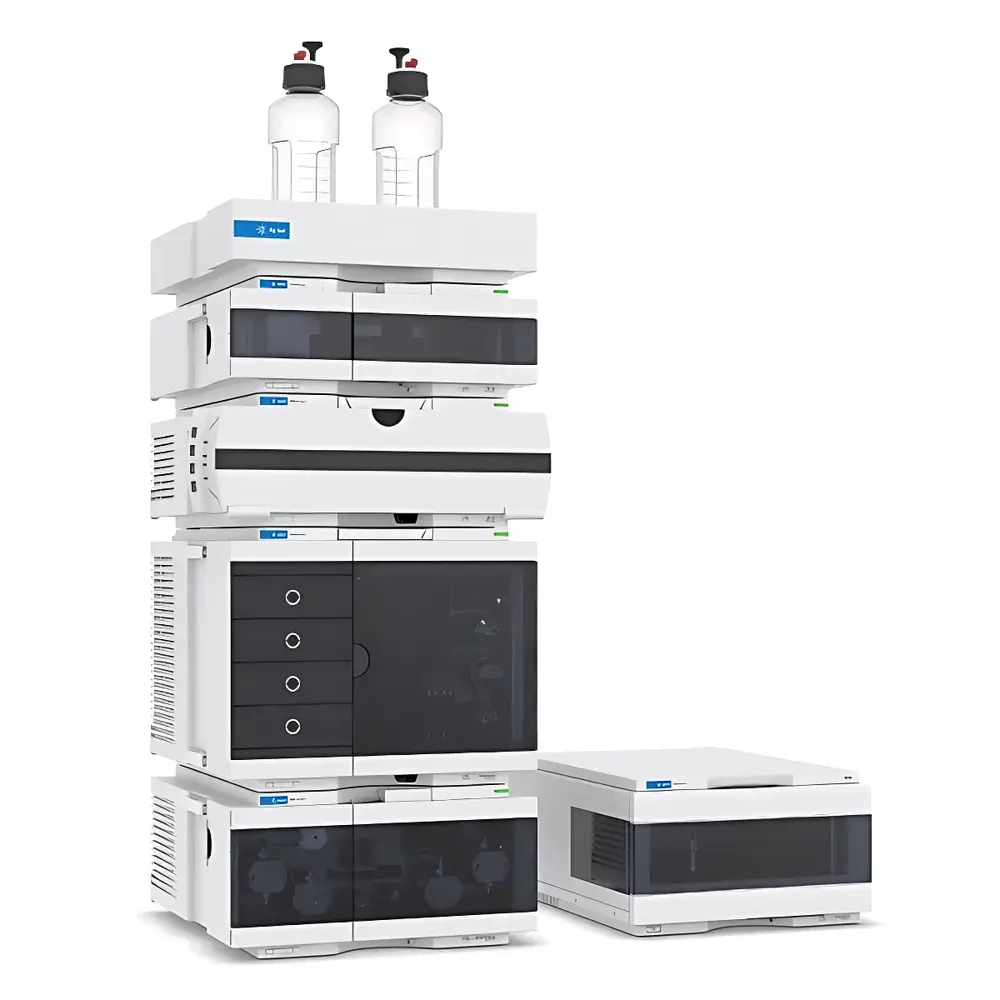
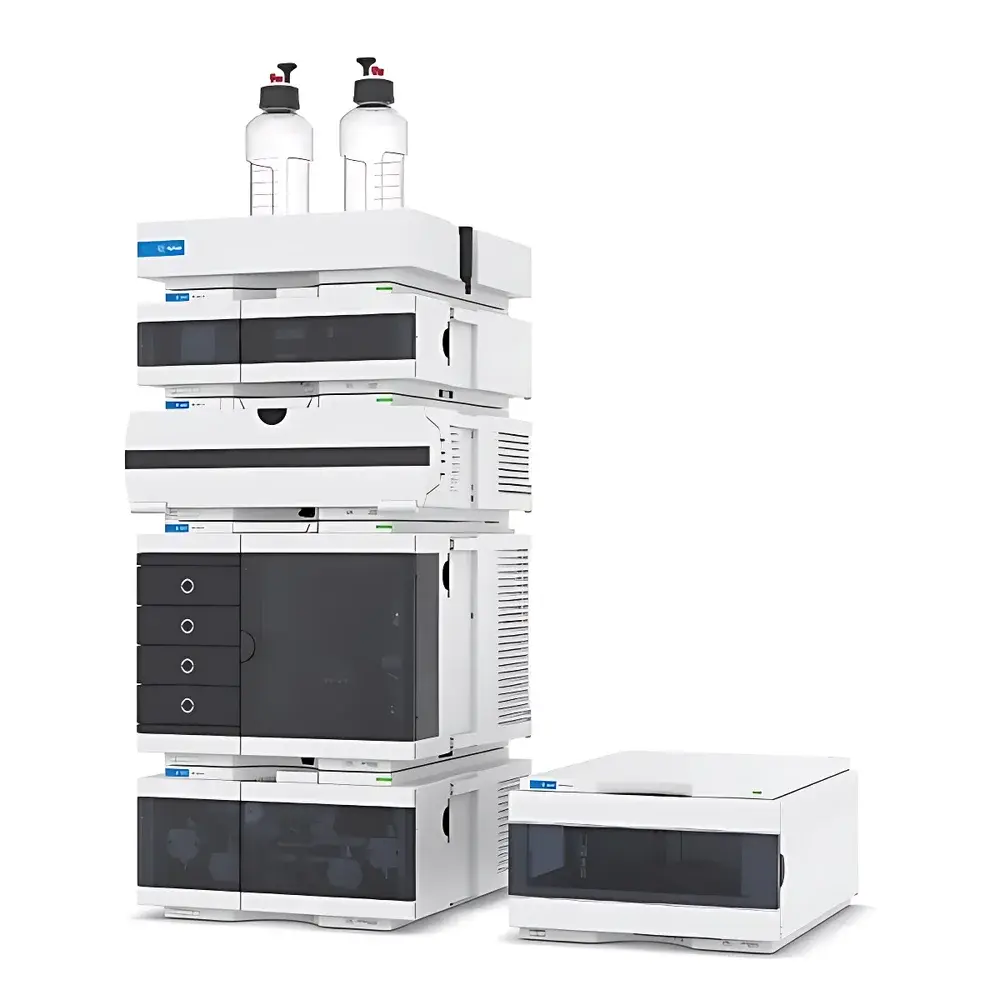
Agilent 1290 Infinity III Analytical-Scale Purification LC System
| Brand | Agilent Technologies |
|---|---|
| Origin | Germany |
| Manufacturer Type | Original Equipment Manufacturer (OEM) |
| Product Origin | Imported |
| Model | 1290 Infinity III Analytical LC System |
| Application Level | Laboratory Grade |
| Instrument Type | High-Pressure Preparative Liquid Chromatography |
| Flow Rate Range | up to 5 mL/min (with G7120A and G7104A pumps) |
| Maximum Operating Pressure | 1300 bar |
| Column ID Reader | Optional |
| Solvent Reservoir Capacity | 4 standard, up to 15 with optional Solvent Selection Valve |
| Injection Volume Range | 0.1–100 µL (standard), 0.1–1500 µL (with Multi-Draw Kit) |
| Fraction Capacity | up to 384 fractions (4 × 96-well plates or 216 glass tubes) |
| Delay Volume Sensor | Integrated, auto-calibrating |
| Temperature Zones | 2 (with G7116B column compartment), 1 (with vial sampler-integrated column oven) |
| Pump Type | Binary Gradient Pump |
| System Dimensions (W × D) | 980 × 468 mm |
| Power Supply | 100–240 VAC |
| Software Platform | Agilent OpenLab CDS ChemStation |
Overview
The Agilent 1290 Infinity III Analytical-Scale Purification LC System is a high-pressure liquid chromatography platform engineered for reproducible, scalable compound isolation at the milligram level. Built upon the InfinityLab architecture, it integrates UHPLC performance—characterized by low system dispersion, rapid gradient formation, and precise dwell volume control—with analytical purification workflow logic. Unlike conventional preparative systems optimized solely for mass throughput, this instrument bridges the gap between analytical characterization and targeted purification by maintaining chromatographic fidelity across method transfer. Its 1300 bar pressure rating enables use of sub-2 µm particles and narrow-bore columns (down to 2.1 mm ID), delivering superior resolution and peak capacity without sacrificing robustness. The system operates under ISO/IEC 17025-aligned design principles and supports GLP-compliant operation when configured with audit-trail-enabled software and hardware interlocks.
Key Features
- Binary high-pressure pump (G7120A/G7104A) delivering flow rates from 0.001 to 5 mL/min with ≤0.1% RSD and pulseless delivery—critical for gradient reproducibility in multi-step purification sequences.
- Integrated delay volume sensor with automatic calibration ensures accurate fraction triggering across variable flow rates and column configurations, minimizing carryover and cross-contamination.
- Modular detection support: native compatibility with UV/Vis (DAD), ELSD, RID, fluorescence, and single-quadrupole LC/MSD detectors—enabling orthogonal compound identification during collection.
- Flexible fraction collection: accommodates 4 × 96-well microplates (384 positions) or up to 216 glass tubes (4 tube diameters supported); all trays feature positive-position encoding and collision avoidance logic.
- Dual-zone thermal management: independent column oven (G7116B, ambient to 80 °C) and autosampler cooling (4–40 °C) ensure retention time stability and analyte integrity across extended runs.
- Column ID reader option (G7152A) automates method validation by reading embedded RFID tags or QR codes on Agilent-certified columns—reducing manual entry errors and supporting 21 CFR Part 11 compliance.
Sample Compatibility & Compliance
The system handles diverse sample matrices—including natural product extracts, synthetic reaction mixtures, biopolymer digests, and chiral intermediates—without requiring extensive method redevelopment. Its low-diffusion fluidic path (<15 µL total system volume) preserves peak shape for early-eluting compounds, while backpressure tolerance up to 1300 bar allows direct scaling from analytical (e.g., 2.1 × 50 mm, 1.8 µm) to semi-preparative (e.g., 4.6 × 100 mm, 2.7 µm) columns. Regulatory readiness includes full traceability via OpenLab CDS ChemStation’s electronic lab notebook (ELN) integration, user access controls, electronic signatures, and configurable audit trails meeting FDA 21 CFR Part 11, EU Annex 11, and ISO 13485 requirements. All modules comply with IEC 61010-1 safety standards and CE/UKCA marking.
Software & Data Management
Agilent OpenLab CDS ChemStation provides a validated, modular software environment designed for chromatographic data acquisition, processing, and reporting in regulated laboratories. It supports method templating for purification workflows—including trigger-based fraction collection using UV threshold, peak apex, or MS-selected ion monitoring—and exports structured metadata (e.g., retention time, fraction number, detector response) to LIMS via ASTM E1384-compliant XML. Batch processing tools enable retrospective reintegration of collected fractions against updated reference standards. Raw data files (.D format) are stored with embedded instrument configuration logs, ensuring full method traceability for internal audits or regulatory inspections.
Applications
- Purification of synthetic intermediates prior to NMR or X-ray crystallography analysis
- Isolation of bioactive natural products from complex plant or microbial extracts
- Chiral separation and collection of enantiomerically pure pharmaceutical candidates
- Preparative-scale cleanup of peptide synthesis crude mixtures
- Targeted metabolite isolation for quantitative structure–activity relationship (QSAR) studies
- Method development for downstream scale-up to industrial preparative HPLC systems
FAQ
Can the system operate under GLP conditions?
Yes—when deployed with OpenLab CDS ChemStation in validated mode, including enabled audit trail, electronic signatures, and role-based access control.
What is the minimum injection volume for reliable quantitation?
0.1 µL is achievable with the standard autosampler; precision improves to ≤0.5% RSD at ≥1 µL using the Multi-Draw Kit for viscous or low-concentration samples.
Is method transfer from Agilent 1260/1290 II systems supported?
Yes—the Infinity III maintains backward compatibility with legacy methods through firmware-mapped dwell volume compensation and identical binary pump timing logic.
How is column lifetime monitored?
System pressure trends, peak asymmetry metrics, and retention time drift are logged automatically; optional Column Health Monitor reports generate predictive maintenance alerts based on historical baseline shifts.
Does the system support automated method scouting?
Not natively—but third-party method development software (e.g., DryLab, ACD/Labs) can interface via OpenLab’s API to execute gradient and temperature screening protocols.





