
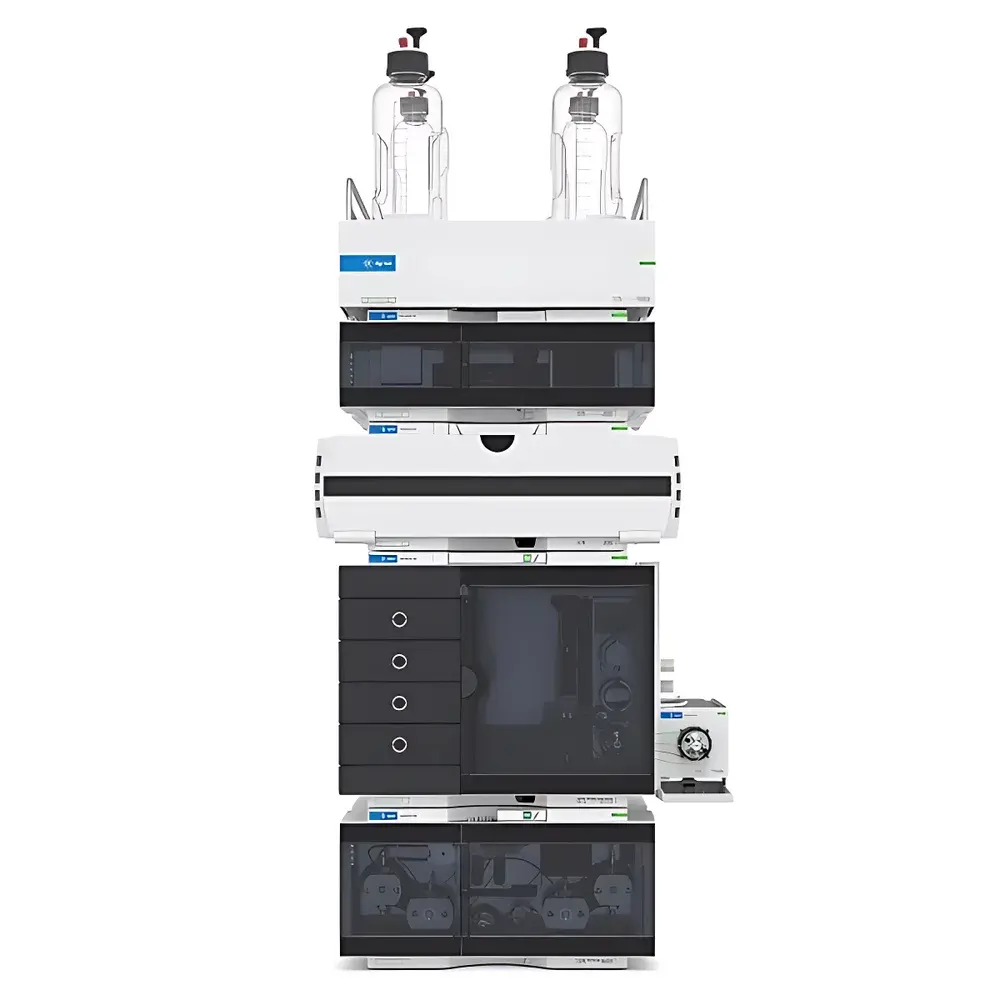
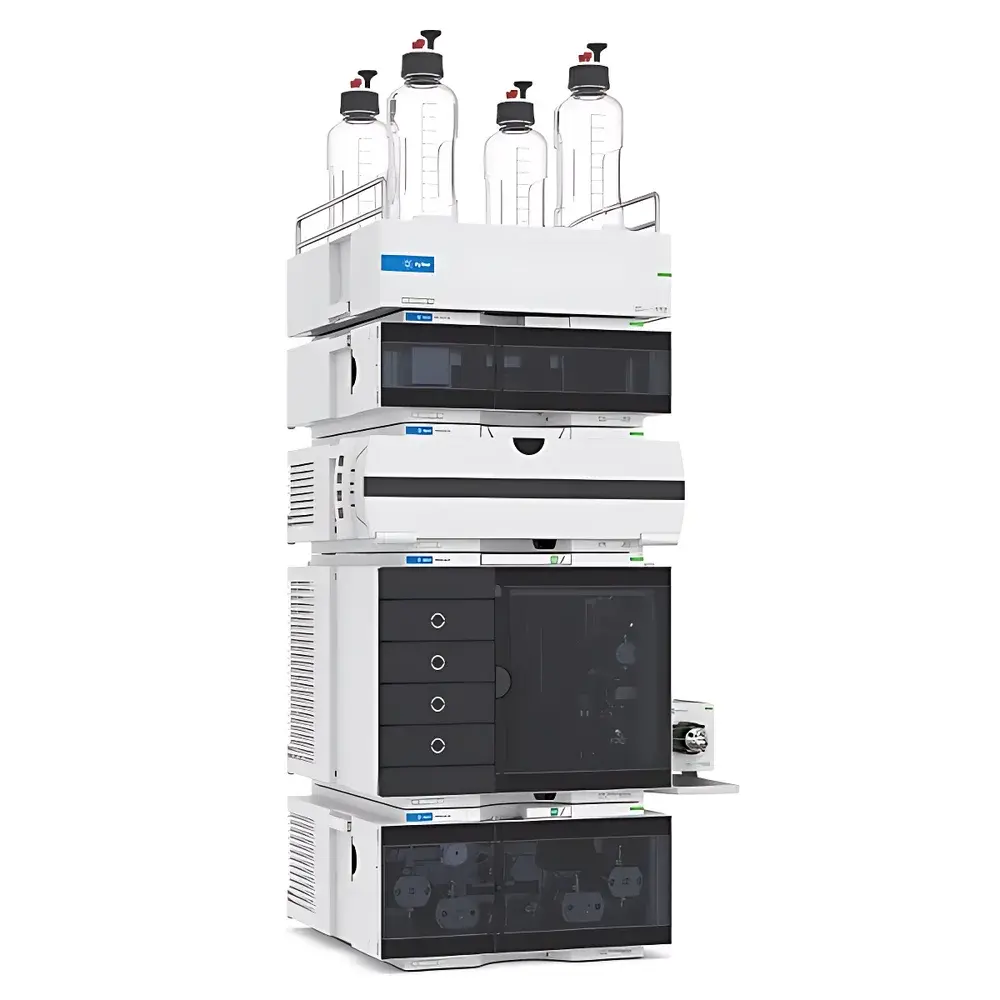
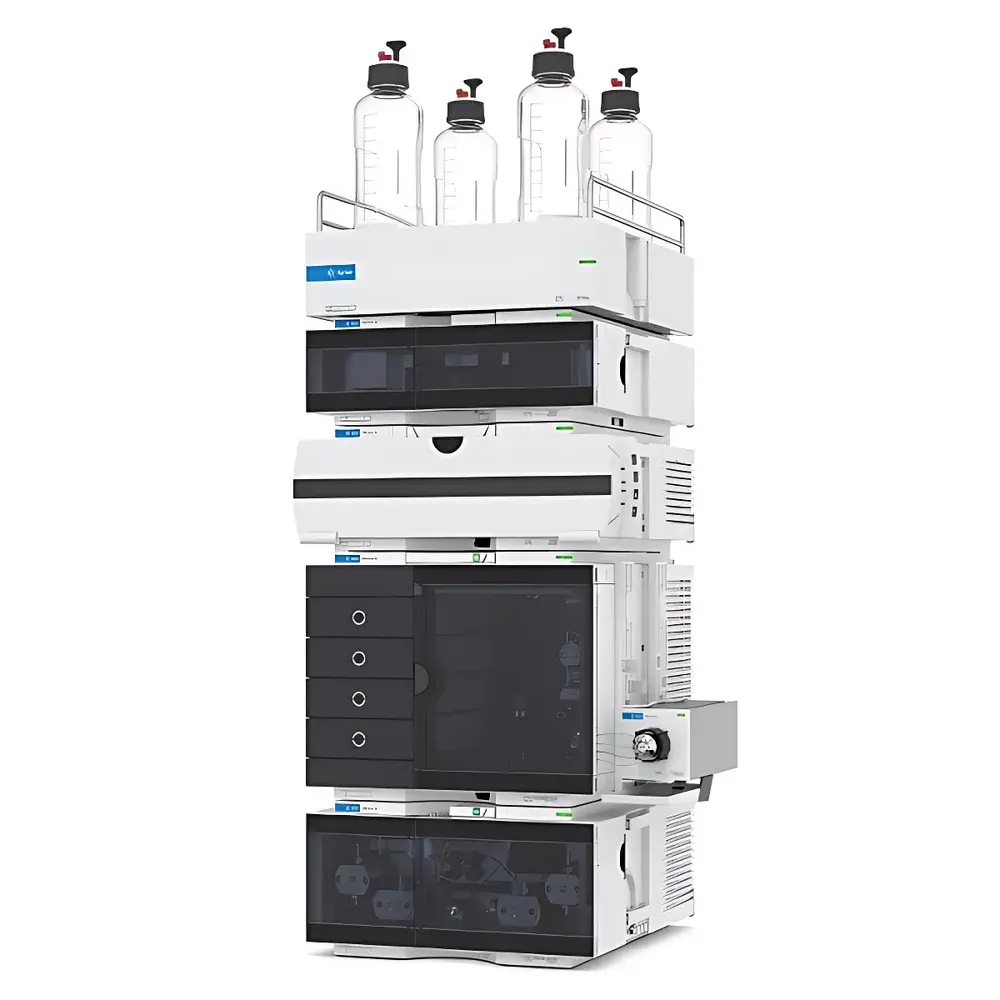
Agilent 1290 Infinity III Bio-Online UHPLC System
| Brand | Agilent Technologies |
|---|---|
| Origin | Germany |
| Manufacturer Type | Original Equipment Manufacturer (OEM) |
| Import Status | Imported |
| Model | 1290 Infinity III Bio-Online |
| Instrument Type | Ultra-High Performance Liquid Chromatograph (UHPLC) |
| Application Scope | General-purpose with PAT-focused bioprocess monitoring |
| Flow Rate Range | 0.001–5 mL/min |
| Maximum Operating Pressure | 1300 bar |
| Injection Volume Range | 0.001–500 µL |
Overview
The Agilent 1290 Infinity III Bio-Online UHPLC System is an integrated, process-analytical technology (PAT)-enabled ultra-high performance liquid chromatography platform engineered for real-time, in-line analysis of biopharmaceutical manufacturing processes. It combines the high-resolution separation capability and bio-inert fluidic architecture of the 1290 Infinity III Bio LC system with the automated sampling, scheduling, and data integration functionality of the 1260 Infinity III Prime Online LC system. Designed explicitly for continuous bioprocess monitoring—including upstream cell culture, downstream purification (e.g., protein A elution pools, viral clearance steps), and final formulation—this system operates under physiologically relevant conditions while maintaining analytical rigor. Its core measurement principle relies on gradient-elution reversed-phase, size-exclusion, or ion-exchange chromatography, coupled with UV-Vis, fluorescence, or mass spectrometric detection, enabling quantitative tracking of critical quality attributes (CQAs) such as monoclonal antibody monomer content, aggregate formation, charge variants, host cell proteins (HCPs), and residual DNA.
Key Features
- Bio-inert fluidic path constructed from titanium, PEEK, and sapphire components to minimize adsorption, denaturation, or degradation of sensitive biomolecules—including mAbs, ADCs, bispecifics, and viral vectors.
- 1300 bar maximum pressure rating supports sub-2 µm particle-packed columns and narrow-bore capillary formats, delivering high peak capacity and resolution without compromising robustness.
- True online injection via direct-loop or FEED (Flow-Enabled Extended Dilution) technology enables programmable sample dilution, reaction quenching, and matrix-matched calibration—all without manual intervention.
- Integrated autosampler with 0.001–500 µL injection range and <0.2% RSD precision ensures reproducible quantitation across low-abundance analytes and high-concentration process streams.
- Modular detector compatibility including bio-inert MDS (Multi-Detector System), VWD (Variable Wavelength Detector), DAD (Diode Array Detector), FLD (Fluorescence Detector), and LC/MS interfaces—each optimized for low carryover and high signal-to-noise ratio in complex biological matrices.
- Temperature-controlled column compartment (5–80 °C) and sample tray (4–40 °C) maintain stability of thermolabile species during extended unattended operation.
Sample Compatibility & Compliance
The system accommodates a broad spectrum of bioprocess samples—including clarified harvests, protein A eluates, polishing pool fractions, buffer exchange intermediates, and final drug substance—without requiring offline dilution or filtration. Its high salt tolerance (up to 1 M NaCl) and wide pH operating range (pH 1.5–12.0) support method development across diverse separation chemistries. All wetted materials comply with USP Class VI and ISO 10993-5 biocompatibility standards. The hardware and software architecture are designed to meet FDA 21 CFR Part 11 requirements for electronic records and signatures, supporting audit trails, user access controls, and electronic signature workflows when deployed with OpenLab CDS 2. System validation documentation aligns with ICH Q5, Q6, and Q7 guidelines, and routine operation supports GLP/GMP environments through configurable IQ/OQ/PQ protocols.
Software & Data Management
The Bio-Online LC Control Software provides intuitive, workflow-driven configuration of sampling schedules, event-triggered injections, and real-time chromatogram visualization. Trend plots, overlay comparisons, and automated CQA threshold alerts are generated directly within the interface. Data export conforms to ASTM E1985 (Chromatographic Data Exchange Standard) and is natively compatible with Agilent OpenLab CDS 2, enabling seamless integration into enterprise LIMS and MES systems. All raw data files (.d format), processing methods, and audit logs are stored with time-stamped, immutable metadata. The software supports multi-user role-based permissions and includes built-in tools for system suitability testing (SST), peak purity assessment, and forced degradation study alignment—essential for regulatory submissions.
Applications
- Real-time monitoring of monoclonal antibody titer, glycosylation profile, and fragmentation during fed-batch and perfusion bioreactors.
- In-line QC of Protein A eluate pools for monomer content, aggregates, and leached ligand quantification.
- Continuous assessment of viral clearance steps using SEC-MALS or IEX-HPLC.
- Automated release testing of drug product batches for potency, purity, and stability-indicating impurity profiles.
- Support for Quality by Design (QbD) initiatives through design-of-experiments (DoE) integration and multivariate statistical process control (MSPC).
FAQ
Can the 1290 Infinity III Bio-Online system operate unattended for extended periods during bioreactor campaigns?
Yes—the system supports fully automated 7-day+ runs with scheduled sampling, self-diagnostic routines, and predictive maintenance alerts based on pump seal wear, detector lamp life, and column backpressure trends.
Is method transfer from offline HPLC/UHPLC to this online platform feasible?
Yes—FEED injection and identical column oven/detector configurations enable direct method portability; retention time shifts are minimized through dynamic flow compensation and temperature stabilization.
Does the system support compliance with EU Annex 1 requirements for aseptic process monitoring?
While not a sterile device, its bio-inert flow path, SIP-compatible design (with optional steam-in-place validation kits), and validated cleaning procedures support integration into classified environments under strict engineering controls.
How is data integrity ensured during long-term PAT deployments?
All acquisitions are timestamped, digitally signed, and stored in tamper-evident archives with full audit trail visibility—including operator actions, parameter changes, and instrument status events.
What detector options are certified for GMP-compliant biologics release testing?
The bio-inert MDS and DAD modules are pre-validated for use in regulated environments when configured with OpenLab CDS 2 and operated under approved SOPs and change control procedures.
Related Products





