
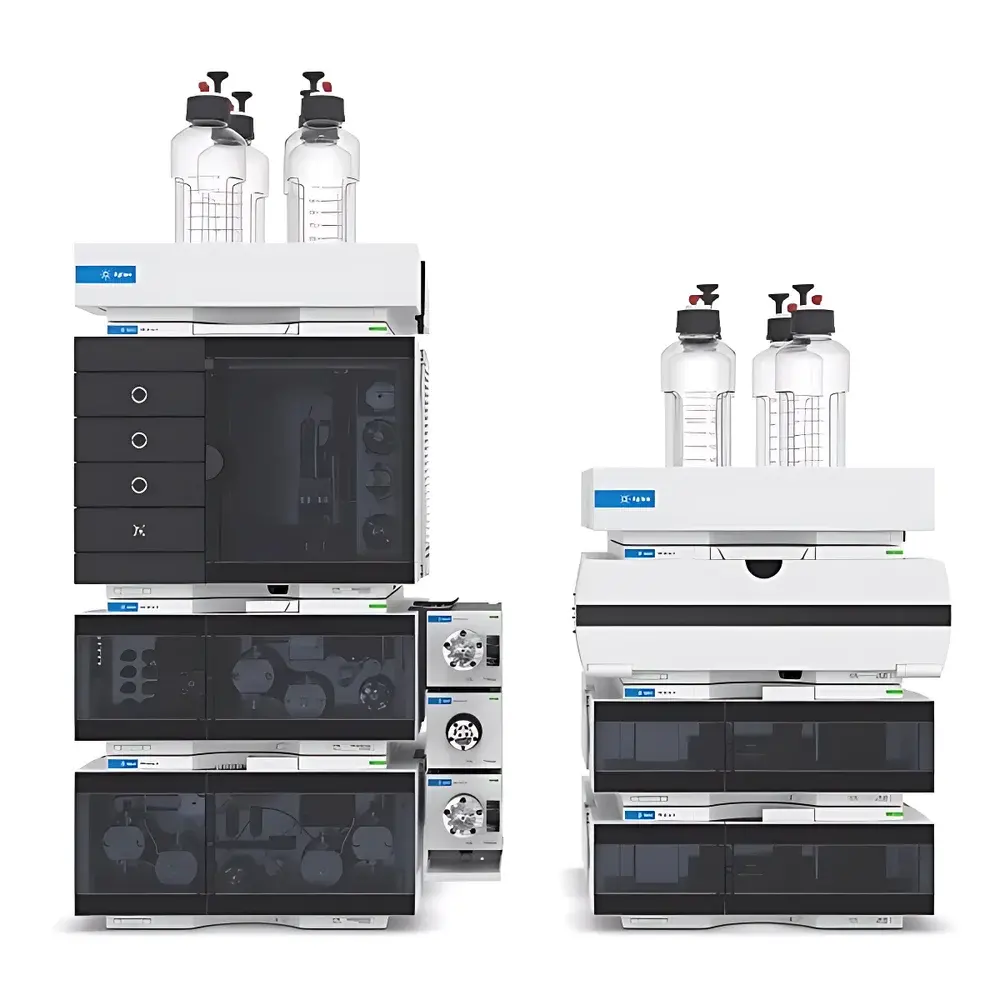
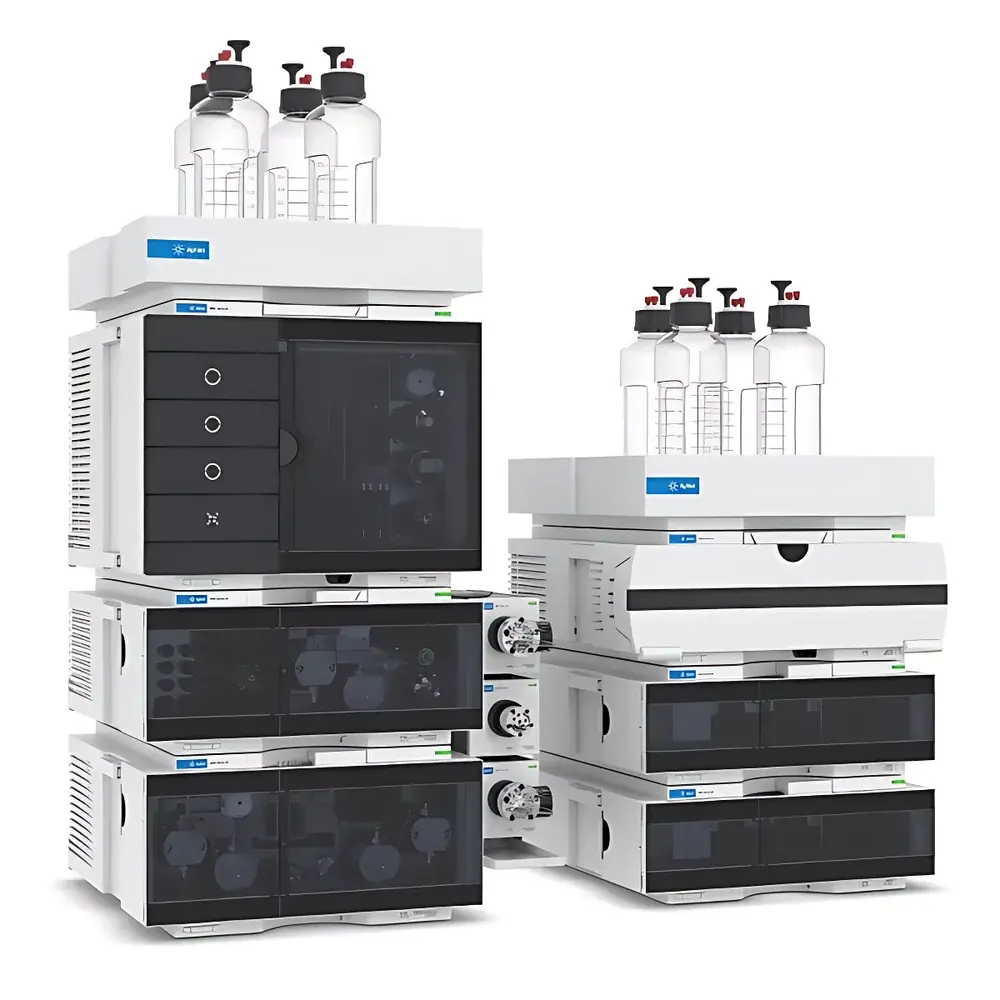
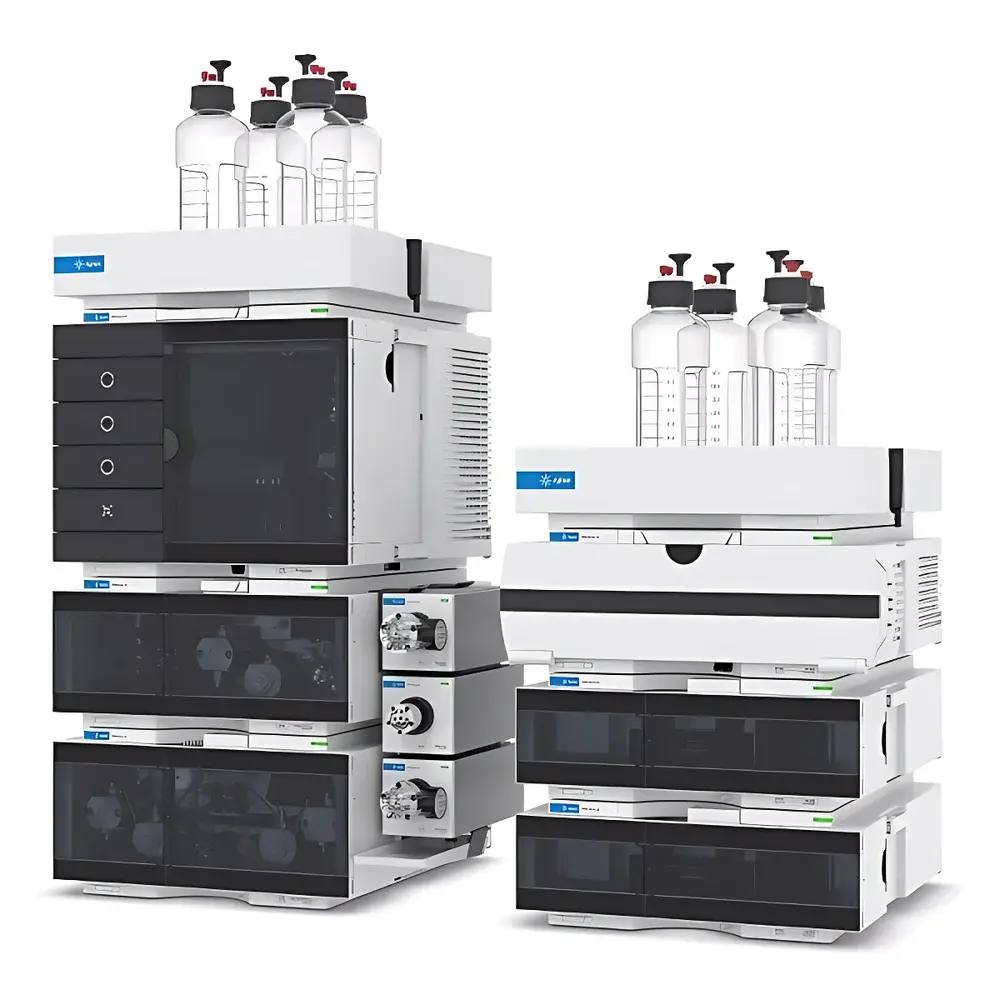
Agilent 1290 Infinity III Two-Dimensional Liquid Chromatography System
| Brand | Agilent Technologies |
|---|---|
| Origin | Germany |
| Manufacturer Type | Original Equipment Manufacturer (OEM) |
| Origin Category | Imported |
| Model | 1290 Infinity III 2D-LC |
| Instrument Type | Multidimensional Liquid Chromatograph |
| Maximum Operating Pressure | 1300 bar |
| Application Scope | General-Purpose Analytical Platform |
| Regulatory Compliance | Designed for GLP/GMP environments |
Overview
The Agilent 1290 Infinity III Two-Dimensional Liquid Chromatography (2D-LC) System is an engineered platform for high-resolution, orthogonal separation of complex mixtures—leveraging comprehensive two-dimensional liquid chromatography (LC×LC), multiple heart-cutting (mHC), and high-fidelity sampling architectures. Built upon the proven UHPLC foundation of the 1290 Infinity III architecture, it delivers sub-2 µm particle compatibility, ultra-low dispersion flow paths, and pressure stability up to 1300 bar. The system operates on the principle of coupling two independent chromatographic dimensions—typically differing in selectivity (e.g., reversed-phase × hydrophilic interaction, or size exclusion × ion exchange)—to significantly expand peak capacity beyond one-dimensional HPLC limits. This enables resolution of co-eluting species in pharmaceutical impurity profiling, intact protein analysis, natural product fractionation, and polymer characterization—where conventional LC fails due to undersampling or insufficient orthogonality.
Key Features
- Modular 2D-LC configuration supporting both comprehensive (LC×LC) and multiple heart-cutting (mHC) modes via dedicated high-pressure, low-dead-volume 6-port/2-position and 10-port/2-position switching valves
- Active Solvent Modulation (ASM) technology enabling real-time, dynamic adjustment of 2D mobile phase composition to maintain solvent strength compatibility between dimensions—critical for MS-coupled workflows
- Bio-inert fluidic path constructed from MP35N alloy, ceramic, PEEK, and gold-plated components—validated for use across pH 0–14, high-salt buffers (e.g., >500 mM ammonium acetate), and aggressive solvents (e.g., TFA, HFIP)
- Integrated high-speed gradient delay management and dwell volume compensation—ensuring reproducible retention time alignment across repeated 2D runs
- UHPLC-grade performance: <10 nL system dispersion, <0.05% RSD gradient precision, and <0.25% RSD retention time repeatability over 100 injections
- Seamless upgrade path from existing 1290 Infinity III 1D systems via hardware add-ons and software license activation—no instrument replacement required
Sample Compatibility & Compliance
The system accommodates diverse sample matrices—including monoclonal antibodies, antibody-drug conjugates (ADCs), oligonucleotides, small-molecule APIs, petrochemical fractions, and food extracts—without compromising column lifetime or signal fidelity. Its bio-inert flow path minimizes metal-induced degradation and surface adsorption, satisfying ICH Q5E and USP requirements for biopharmaceutical characterization. Hardware and software configurations support audit-trail-enabled operation per FDA 21 CFR Part 11 and EU Annex 11 when deployed with Agilent OpenLab CDS 2.x or MassHunter Quant/Qual. All modules undergo ISO 9001-certified manufacturing and are validated against ASTM E2656 (Standard Guide for LC Method Transfer) and ISO 17025 traceability protocols.
Software & Data Management
Agilent’s 2D-LC software—available as plug-ins for OpenLab CDS, MassHunter, and ChemStation—provides method templating, automated peak tracking across retention time grids, contour plot generation, and spectral overlay for UV/Vis and MS data fusion. It supports batch processing of LC×LC datasets with retention time normalization, peak volume integration, and export to CSV, CDF, or mzML formats. Raw data integrity is preserved through immutable acquisition logs, electronic signatures, and configurable review workflows compliant with ALCOA+ principles. Optional GC Image LC×LC Edition extends visualization capabilities with interactive heatmaps, slice extraction, and cross-dimension correlation statistics.
Applications
- Pharmaceutical QC/QA: Resolution of genotoxic impurities, stereoisomers, and degradants in forced degradation studies (ICH Q1–Q5)
- Biopharma characterization: Intact mass analysis of mAbs under native conditions, charge variant mapping, and glycoform profiling
- Fuel and lubricant analysis: Polycyclic aromatic hydrocarbon (PAH) speciation and sulfur compound classification in distillates
- Food safety: Mycotoxin screening in cereals using immunoaffinity cleanup coupled to 2D-LC–MS/MS
- Environmental monitoring: Simultaneous quantification of PFAS isomers in wastewater using mixed-mode × reversed-phase LC×LC
FAQ
What distinguishes comprehensive 2D-LC from multiple heart-cutting (mHC) on this platform?
Comprehensive mode collects sequential fractions from the 1D column onto the 2D column for full modulation, maximizing peak capacity. mHC selectively transfers only target regions—ideal for targeted quantitation of known co-eluters with minimal runtime overhead.
Is method transfer from 1D to 2D-LC supported?
Yes—Agilent provides retention prediction tools and gradient translation algorithms within OpenLab CDS that preserve selectivity while adapting to orthogonal column chemistries and flow rates.
Can the system be operated under GxP-regulated environments?
Fully—when configured with OpenLab CDS 2.4 or later, it supports role-based access control, electronic signatures, audit trails, and 21 CFR Part 11-compliant reporting.
What maintenance intervals are recommended for the 2D valve modules?
Valve seals require replacement every 6 months under continuous operation; full valve calibration is advised quarterly per Agilent Technical Note 5991-6457EN.
Does the system support hyphenated detection beyond UV/Vis?
Yes—it interfaces natively with Agilent 6470/6495 triple quadrupole and 6550 iFunnel Q-TOF mass spectrometers via standard LC-MS trigger signals and synchronized data acquisition clocks.




