
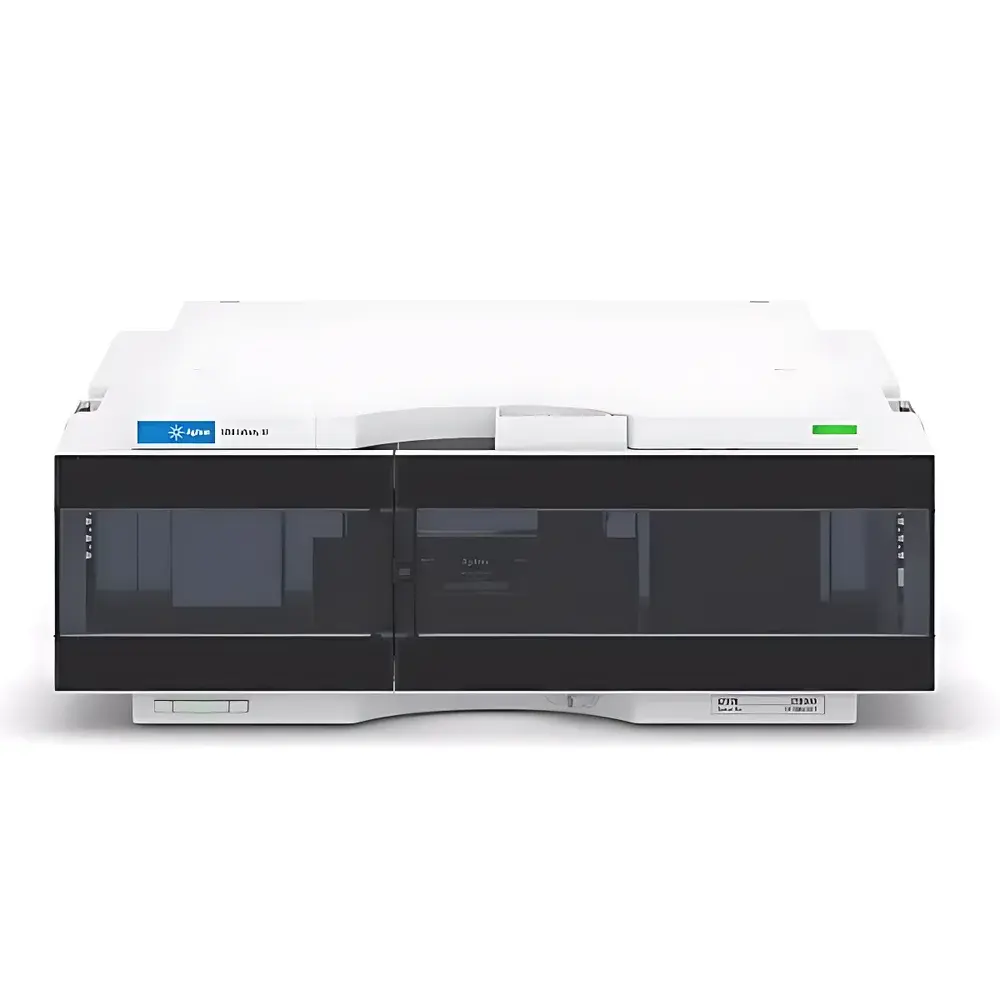
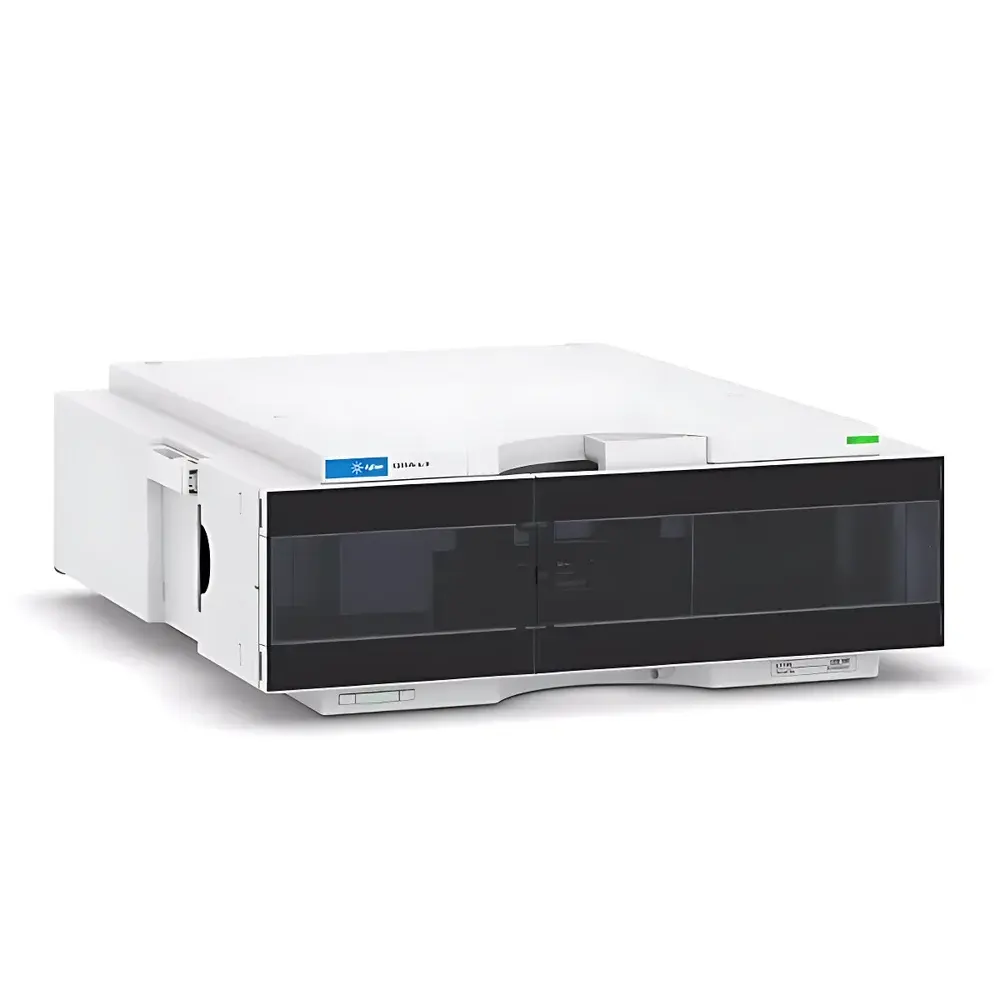
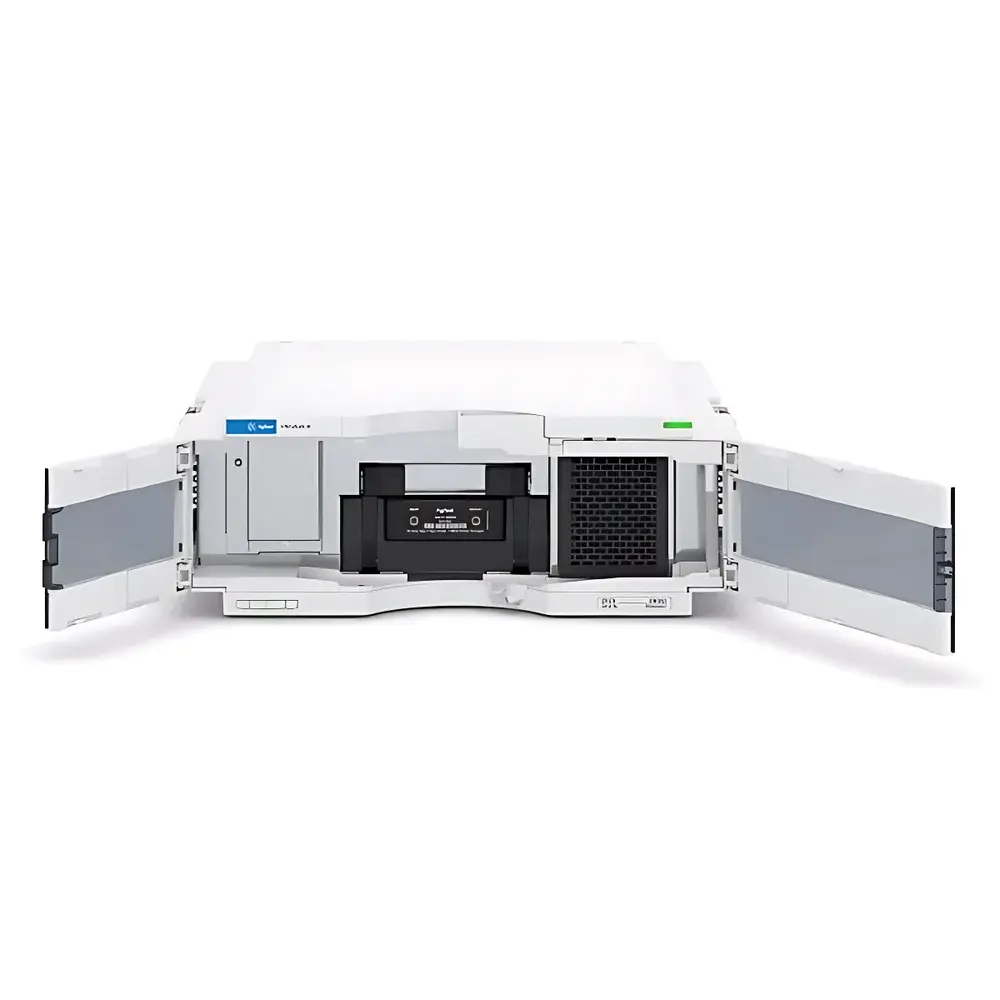
Agilent 1290 Infinity III Diode Array Detector (DAD)
| Brand | Agilent Technologies |
|---|---|
| Origin | Germany |
| Manufacturer Type | Original Equipment Manufacturer (OEM) |
| Product Origin | Imported |
| Model | 1290 Infinity III Diode Array Detector |
| Instrument Type | Diode Array Detector (DAD) |
| Noise Level | < ±3 µAU (10 mm flow cell, 1 s response time) |
| Signal Channels | Up to 8 simultaneous wavelength channels |
| Spectral Acquisition Rate | Up to 240 Hz |
| Optical Path Length Options | 10 mm (standard), 60 mm (high-sensitivity flow cell) |
| Baseline Drift | < ±0.6 µAU/cm (60 mm flow cell) |
| Linear Dynamic Range | Up to 2.5 AU (standard) |
| Slit Width Programmability | 1–8 nm |
| Temperature Control | Electronic Temperature Control (ETC) with RFID-tracked flow cell and lamp modules |
Overview
The Agilent 1290 Infinity III Diode Array Detector (DAD) is a high-performance, modular optical detection system engineered for ultra-high-performance liquid chromatography (UHPLC) and HPLC applications requiring full-spectrum acquisition, quantitative accuracy, and robust baseline stability. Operating on the principle of simultaneous multi-wavelength absorbance measurement across the UV-Vis range (190–800 nm), the detector captures complete spectral data at each data point—enabling real-time peak purity assessment, spectral library matching, and multi-component quantitation without post-run reprocessing. Its core architecture integrates advanced optical waveguide technology within a maximum-intensity slip-in flow cell, achieving near-100% photon transmission efficiency while minimizing dispersion-induced band broadening—a critical advantage in sub-2-µm particle separations where resolution preservation is paramount.
Key Features
- High-speed spectral acquisition up to 240 Hz, fully synchronized with UHPLC gradient elution and column switching events.
- Two interchangeable flow cell options: 10 mm pathlength (optimized for sensitivity and low dispersion with 2.1–4.6 mm ID columns) and 60 mm pathlength (delivering ~10× higher sensitivity with baseline noise as low as ±0.6 µAU/cm).
- Programmable slit width (1–8 nm) allows precise trade-off adjustment between photometric linearity, spectral resolution, and signal-to-noise ratio—tailored per method requirements.
- Electronic Temperature Control (ETC) actively stabilizes optical components against ambient fluctuations, reducing thermal drift and refractive index artifacts that compromise baseline fidelity.
- RFID-enabled flow cells and deuterium/tungsten lamps automatically log calibration history, usage hours, and maintenance events—supporting audit-ready traceability under GLP/GMP and FDA 21 CFR Part 11 compliance frameworks.
- High-dynamic-range (HDR) upgrade option extends linear response from 2.5 AU to >75 AU (30× expansion), enabling accurate co-quantitation of major analytes, process-related impurities, and degradation products in a single injection.
Sample Compatibility & Compliance
The 1290 Infinity III DAD supports standard and microbore UHPLC/HPLC configurations, including low-volume capillary systems (down to 50 µm ID) when paired with appropriate flow cell adapters. It complies with ISO/IEC 17025 analytical instrument qualification requirements and meets key performance criteria outlined in USP , ICH Q2(R2), and ASTM E260 standards for photometric accuracy, wavelength precision, and noise specification. All firmware and control logic adhere to cybersecurity best practices defined in IEC 62443-3-3, ensuring secure data handling in regulated laboratory environments.
Software & Data Management
Controlled via OpenLab CDS or MassHunter software, the detector provides native integration with Agilent’s chromatographic data system—including automated spectral library search (NIST, Wiley, custom libraries), peak purity algorithms (e.g., peak shape comparison, spectral angle mapping), and multi-wavelength overlay visualization. Raw spectral datasets are stored in vendor-neutral .cdf format (netCDF-based), supporting third-party chemometric analysis tools. Audit trails, electronic signatures, and role-based access control are fully enabled for 21 CFR Part 11 compliance; all detector parameter changes, calibration logs, and RFID-read events are timestamped and immutable.
Applications
- Pharmaceutical QC/QA: Simultaneous assay, related substances, and residual solvent analysis in API and finished dosage forms.
- Biopharmaceutical characterization: Monitoring oxidation, deamidation, and aggregation via UV spectral shifts during stability studies.
- Food and environmental testing: Multi-residue pesticide screening using spectral deconvolution and library-matching workflows.
- Academic and method development labs: Rapid optimization of selectivity through real-time spectral profiling and wavelength-specific chromatogram extraction.
- Regulated bioanalysis: PK/PD sample quantitation with dual-wavelength correction and peak purity verification per FDA Bioanalytical Method Validation Guidance.
FAQ
What is the minimum detectable absorbance change (MDAC) under typical operating conditions?
Under standard 10 mm flow cell configuration with 2 nm slit and 1 s response time, MDAC is ≤0.5 µAU (RMS) at 254 nm.
Can the detector be used with non-Agilent LC systems?
Yes—it accepts analog voltage input (0–1 V DC) and digital TTL triggers, enabling synchronization with third-party pumps and autosamplers via external timing signals.
Is the 60 mm flow cell compatible with standard 4.6 mm ID analytical columns?
It is mechanically compatible but requires flow rate adjustment (typically ≤0.5 mL/min) and pressure monitoring to avoid excessive backpressure; optimal use is with narrow-bore or microfluidic columns.
How does RFID tracking enhance data integrity?
Each RFID-tagged component stores unique identifiers, firmware version, calibration date, and cumulative operational metrics—automatically ingested into the CDS audit trail without manual entry.
Does the HDR option require hardware modification?
Yes—the HDR configuration includes a dedicated optical attenuator module and recalibrated photodiode array electronics, installed as a factory-certified field upgrade.



