
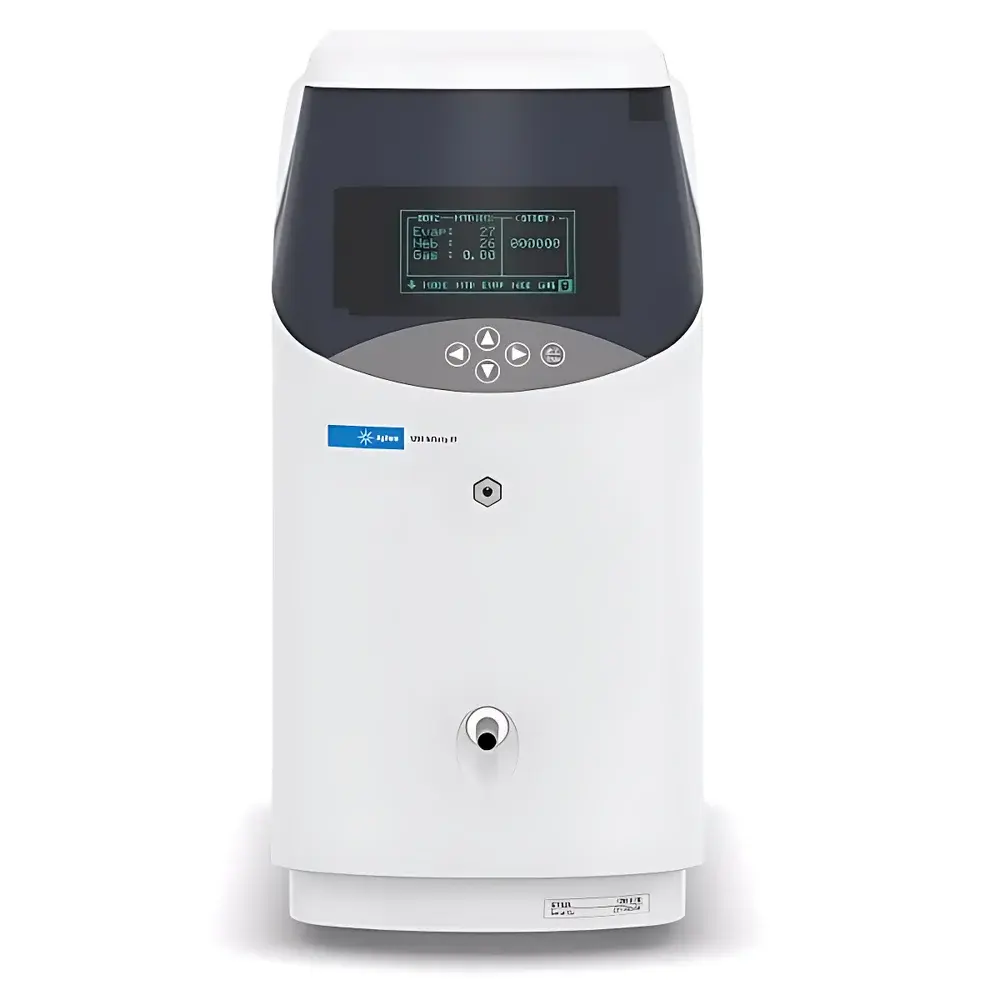
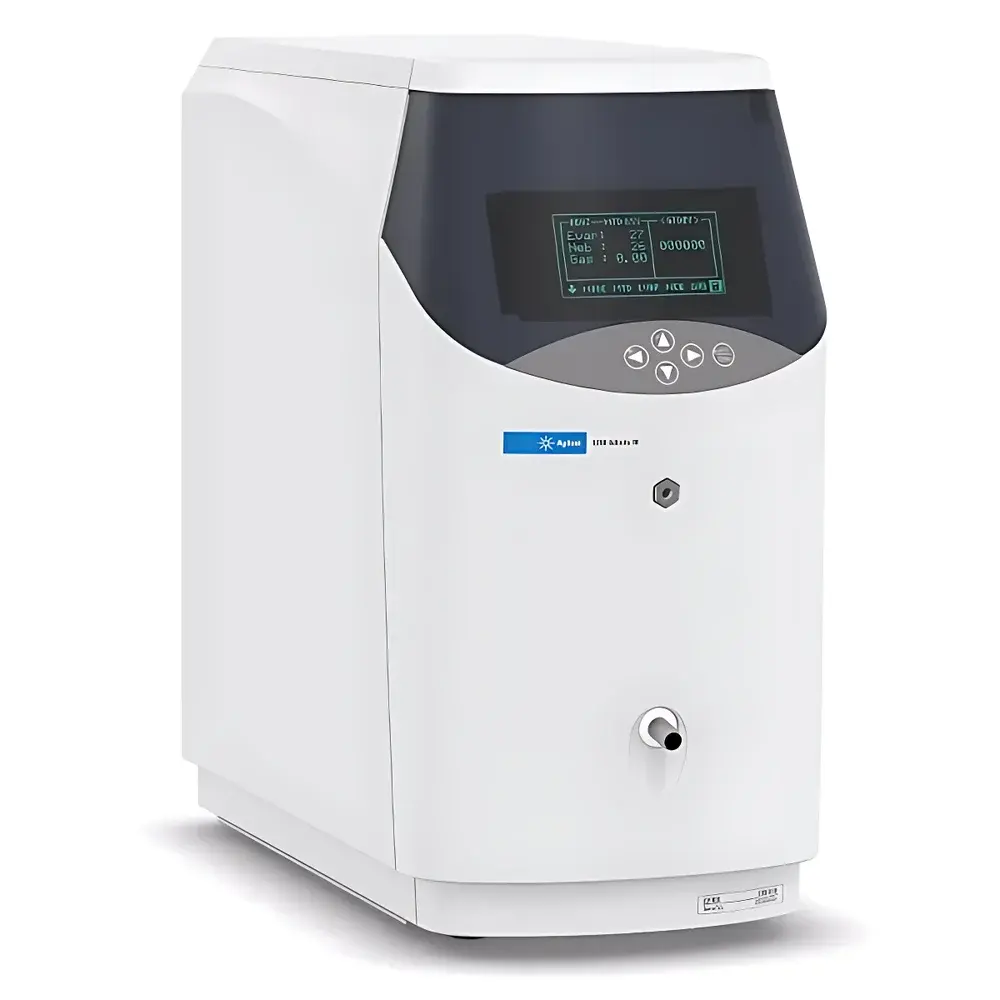
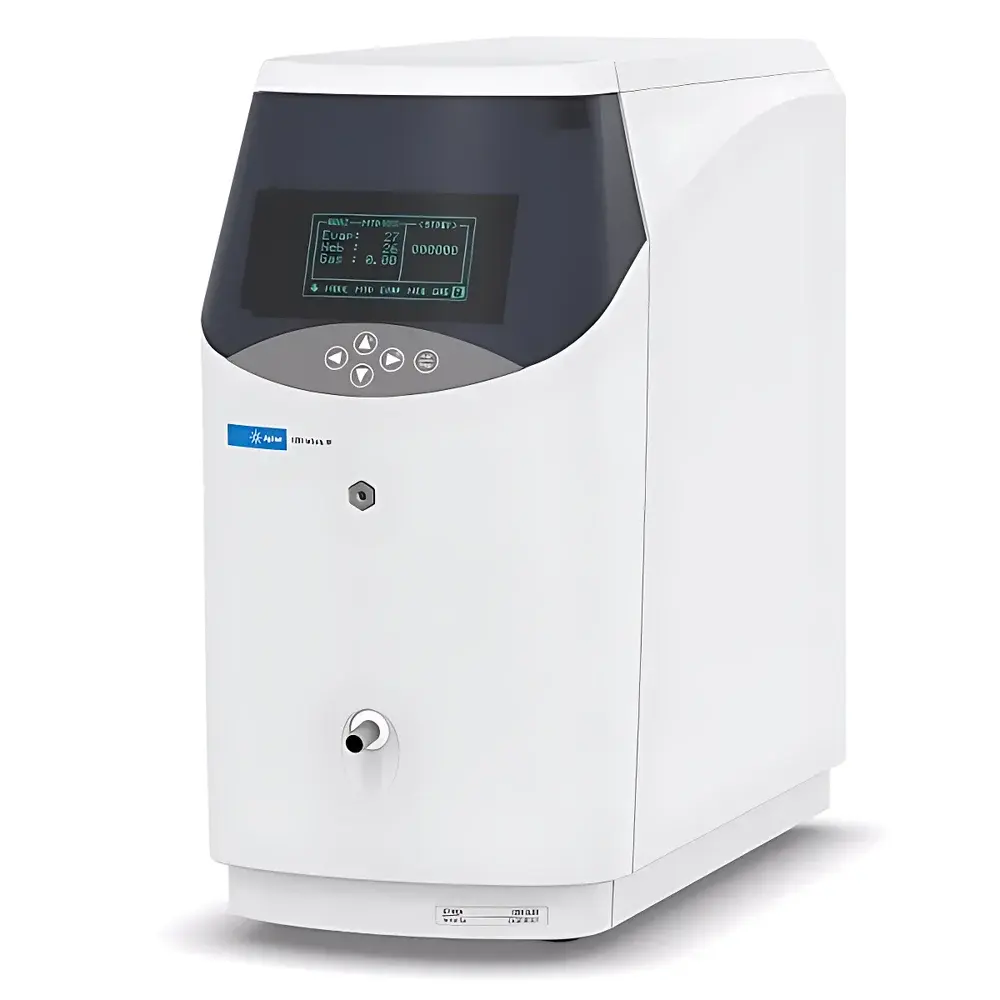
Agilent 1290 Infinity III Evaporative Light Scattering Detector (ELSD)
| Brand | Agilent Technologies |
|---|---|
| Origin | Germany |
| Manufacturer Type | Original Equipment Manufacturer (OEM) |
| Product Category | Imported Instrument |
| Model | 1290 Infinity III ELSD |
| Detection Principle | Evaporative Light Scattering Detection |
| Compatibility | Integrated with Agilent 1290 Infinity III LC Systems and Third-Party HPLC Platforms |
| Sensitivity | Sub-nanogram detection capability for non-UV-absorbing analytes |
| Temperature Control Range | Peltier-cooled evaporator, 10–80 °C |
| Dynamic Range | Four decades (10⁴) |
| Reproducibility | RSD < 2% (n ≥ 6 injections, standard test conditions) |
| Response Time | < 0.1 s |
| Data Acquisition Rate | Up to 100 Hz |
| Gas Flow Control | Programmable, real-time nitrogen or air flow (0–3.0 L/min) |
| Solvent Compatibility | Fully compatible with gradient elution using volatile and semi-volatile mobile phases including acetonitrile, methanol, THF, and aqueous buffers — DMSO-free operation enabled |
Overview
The Agilent 1290 Infinity III Evaporative Light Scattering Detector (ELSD) is a high-performance, universal mass-sensitive detector engineered for robust quantitation of non-chromophoric, semi-volatile, and thermally labile compounds in liquid chromatography workflows. Unlike UV-Vis or fluorescence detectors, the ELSD operates on the principle of nebulization, solvent evaporation, and light scattering from dried analyte particles—making it inherently insensitive to optical properties and ideal for carbohydrates, lipids, polymers, surfactants, natural products, and synthetic intermediates lacking strong UV absorbance. Its core architecture integrates a precisely temperature-regulated Peltier-cooled evaporator tube and a low-noise photomultiplier tube (PMT) detection system, enabling stable operation across a wide thermal range (10–80 °C) and delivering consistent signal generation even under aggressive gradient conditions. Designed as a native module within the Agilent 1290 Infinity III LC platform, it maintains full hardware synchronization with pump, autosampler, and column compartment—ensuring time-aligned data acquisition and minimizing dwell volume effects.
Key Features
- Peltier-controlled evaporator with programmable setpoints from 10 °C to 80 °C—preserves integrity of heat-sensitive molecules and extends retention window for early-eluting volatiles
- Real-time, software-driven gas flow programming—dynamically adjusts nebulizer gas rate during gradient elution to suppress solvent enhancement artifacts and maintain linear response
- Extended dynamic range of four orders of magnitude (10⁴), supporting simultaneous detection of major components and trace impurities without re-injection or dilution
- Ultra-low diffusion optical path and high-speed analog-to-digital conversion (100 Hz sampling)—optimized for UHPLC separations with sub-2-µm particles and flow rates up to 2 mL/min
- Native compatibility with OpenLab CDS, MassHunter, and third-party chromatography data systems (CDS) via standard AIA/ANDI interfaces
- DMSO-free operation mode—eliminates baseline drift and ghost peaks associated with high-boiling solvents, enabling reliable detection of early-eluting analytes
- Automated calibration and diagnostic routines compliant with ASTM E2657-22 and ISO/IEC 17025 traceability requirements
Sample Compatibility & Compliance
The 1290 Infinity III ELSD supports a broad spectrum of sample matrices, including aqueous extracts, organic solvent fractions, lipidomic profiles, oligosaccharide digests, and polymer dissolution blends. It is fully compatible with common HPLC and UHPLC mobile phases—methanol, acetonitrile, tetrahydrofuran, isopropanol, and ammonium acetate/formate buffers—provided they are volatile and fully miscible. Non-volatile additives (e.g., SDS, TFA > 0.1%, phosphates) must be avoided to prevent nozzle clogging and signal suppression. The detector meets design and performance criteria aligned with USP , ICH Q2(R2), and FDA 21 CFR Part 11 when deployed with validated OpenLab CDS configurations. Audit trail, electronic signature, and instrument qualification documentation (IQ/OQ/PQ) templates are available through Agilent’s GxP-compliant service portfolio.
Software & Data Management
Control and data acquisition are managed through Agilent OpenLab CDS (ChemStation Edition or Modern Version), offering method-driven instrument control, real-time parameter adjustment, and automated sequence validation. ELSD-specific parameters—including evaporator temperature ramping, gas flow profiling, PMT voltage optimization, and baseline subtraction algorithms—are fully scriptable and embeddable into sequence methods. Raw signal data are stored in vendor-neutral .D format, exportable to CSV, ASCII, or AIA-compliant .CDF for integration with LIMS, statistical analysis tools (e.g., JMP, Simca), or regulatory submission packages. All configuration changes, calibration events, and maintenance logs are captured in a secure, time-stamped audit trail satisfying GLP and GMP documentation requirements.
Applications
- Quantitative analysis of sucrose, lactose, and fructose in food and beverage matrices per AOAC 2012.03
- Residual monomer and initiator quantification in acrylic and styrenic polymer synthesis (ISO 11343)
- Impurity profiling of peptide therapeutics where UV response is inconsistent across sequence variants
- Phospholipid class separation and relative quantitation in plasma lipidomics (LIPID MAPS compliant workflows)
- Release testing of non-UV-absorbing excipients (e.g., polysorbates, PEGs) in biopharmaceutical formulations
- Stability-indicating assay development for degradation products lacking chromophores
FAQ
What types of compounds are best suited for detection with the 1290 Infinity III ELSD?
Compounds that lack strong UV absorbance or native fluorescence—such as carbohydrates, triglycerides, saponins, glycosides, surfactants, and many synthetic polymers—are ideal candidates. Volatile and semi-volatile analytes benefit significantly from the Peltier-cooled evaporator.
Can this ELSD be used with gradient elution methods?
Yes—real-time gas flow programming compensates for changing mobile phase composition, ensuring uniform droplet formation and eliminating solvent enhancement effects across gradients.
Is the detector compatible with non-Agilent HPLC systems?
It supports analog voltage input/output (±10 V) and digital RS-232/USB interfaces, enabling integration with most third-party LC platforms via external trigger and signal synchronization.
How is calibration performed, and is it traceable?
Calibration uses certified sucrose or triolein standards; Agilent provides documented calibration kits with NIST-traceable certificates and SOP templates aligned with ISO/IEC 17025.
What maintenance intervals are recommended for optimal performance?
Nebulizer capillary cleaning every 200 injections; evaporator tube inspection quarterly; PMT gain verification semi-annually. Full preventive maintenance is recommended annually by Agilent-certified engineers.
Related Products






