
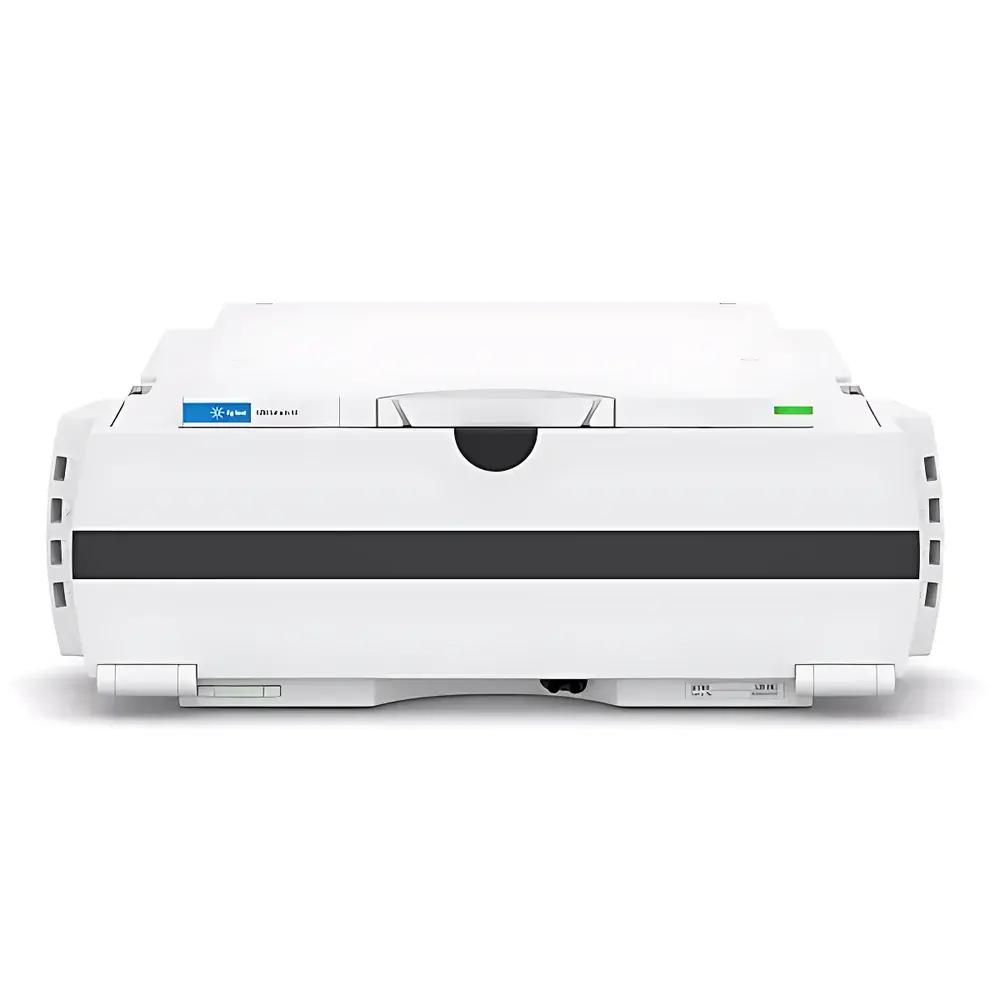
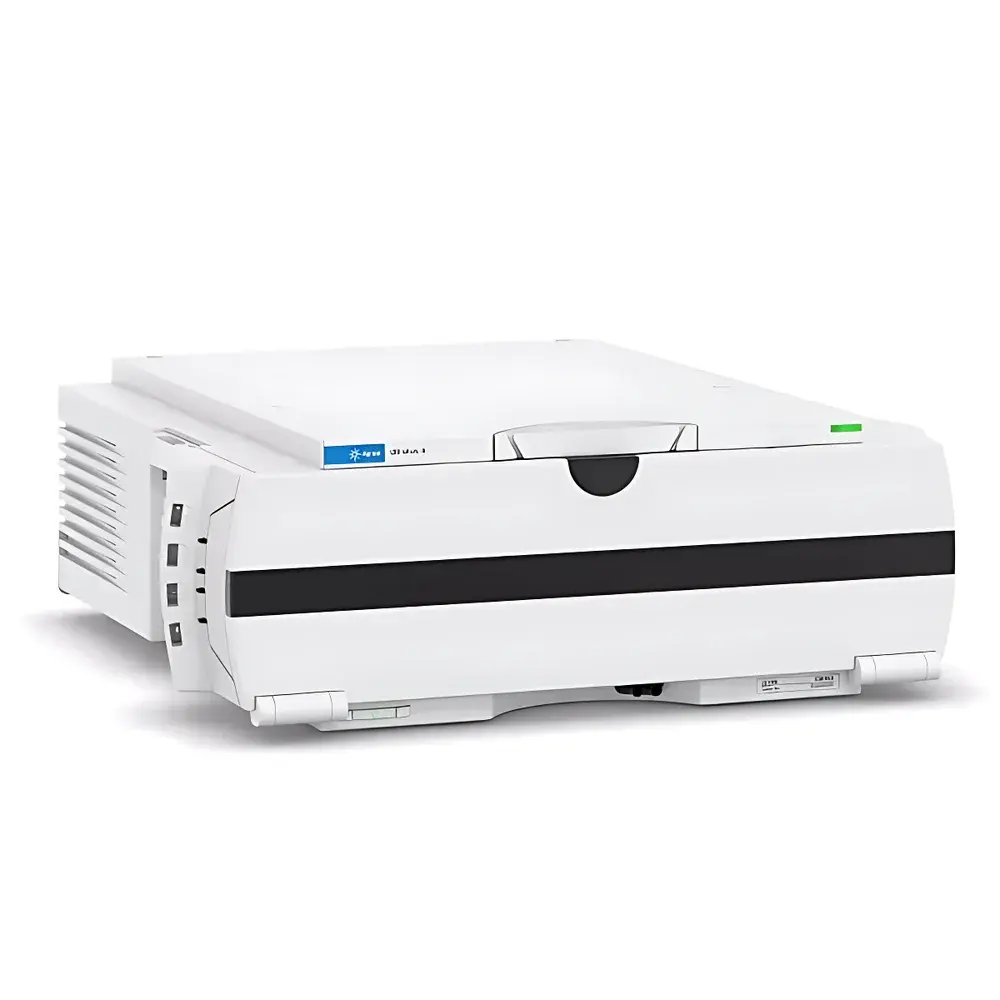
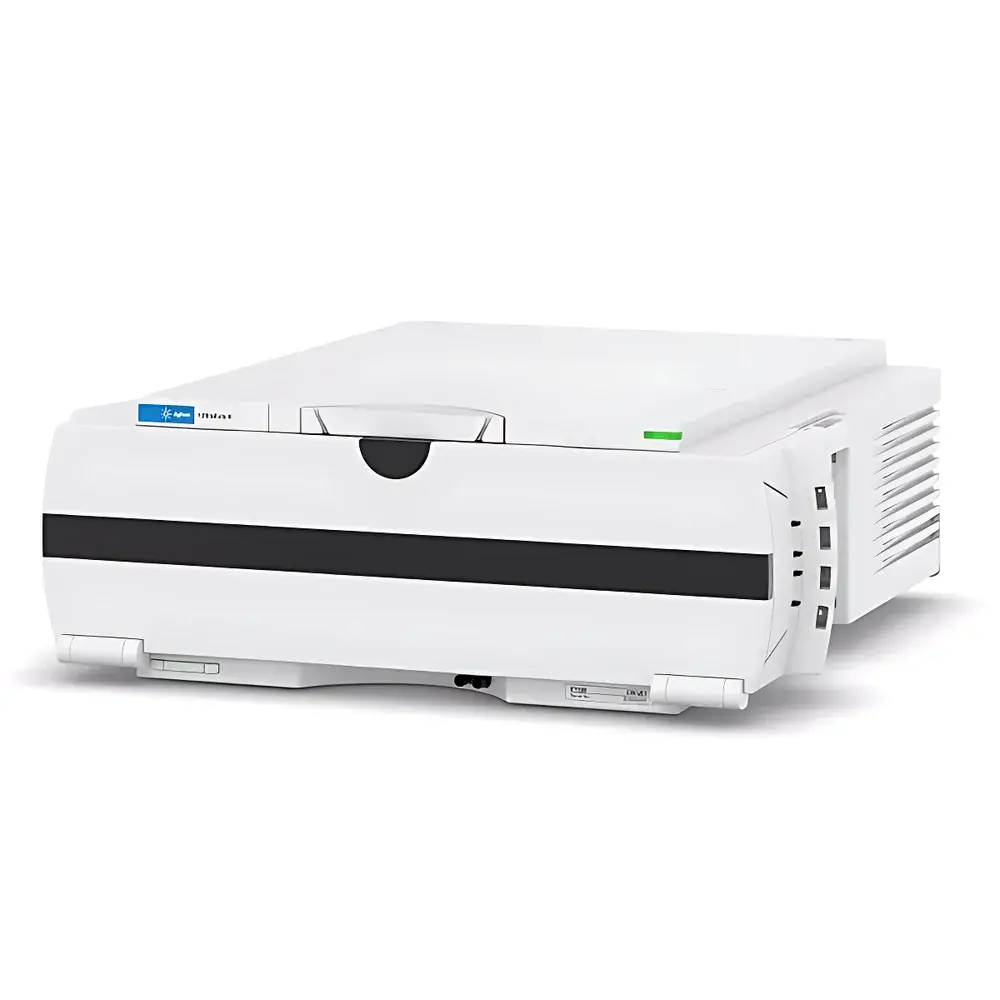
Agilent 1290 Infinity III High-Capacity Column Oven (MCT)
| Brand | Agilent Technologies |
|---|---|
| Origin | Germany |
| Manufacturer | Agilent Technologies |
| Product Origin | Imported |
| Model | 1290 Infinity III MCT |
| Temperature Control | Peltier-based cooling and heating |
| Temperature Range | −20 °C below ambient to 110 °C |
| Maximum Column Capacity | 8 × 10 cm or 4 × 30 cm columns |
| Pressure Rating | 1300 bar |
| Column Identification | RFID-based tracking for up to 8 columns |
| Door Orientation | 90° or 180° configurable, removable for full access |
| Quick Connect Compatibility | InfinityLab Quick Connect fittings and thermal exchangers |
Overview
The Agilent 1290 Infinity III High-Capacity Column Oven (MCT) is an engineered thermal management module designed specifically for ultra-high-performance liquid chromatography (UHPLC) systems. It operates on solid-state Peltier thermoelectric technology, enabling precise, bidirectional temperature control—from 20 °C below ambient temperature up to 110 °C—with stability better than ±0.1 °C under dynamic flow conditions. Unlike passive ovens or single-zone heaters, the MCT features two independently controlled thermal zones, allowing simultaneous operation of multiple columns at different temperatures—a critical capability for method development, column switching workflows, and multi-dimensional separations. Its structural architecture integrates seamlessly with the Agilent InfinityLab LC platform, maintaining full compatibility with 1260 and 1290 Infinity series modules while supporting pressure-rated operation up to 1300 bar—ensuring robust performance in modern high-pressure UHPLC applications.
Key Features
- Dual-zone Peltier temperature control with independent setpoints per zone, supporting heterogeneous column configurations and temperature-gradient methods.
- High-capacity chamber accommodating up to eight 10 cm columns or four 30 cm columns—expandable to 16 or 32 columns respectively via optional four-module stacking configuration.
- InfinityLab Quick Connect interface standard across all fluidic connections, enabling tool-free column installation, reproducible solvent pre-heating via integrated thermal exchangers, and leak-free engagement at pressures up to 1300 bar.
- RFID-enabled column recognition system that automatically logs column type, serial number, maximum operating pressure, temperature limits, and cumulative injection count—supporting audit-ready traceability in GLP/GMP environments.
- Modular door design with selectable 90° or 180° hinge orientation; fully removable for unobstructed access during maintenance, column packing, or custom manifold integration.
- Integrated valve drive option compatible with user-replaceable InfinityLab Quick Change valve heads—enabling automated column selection, trap-and-elute workflows, and online sample cleanup without manual tubing reconfiguration.
Sample Compatibility & Compliance
The MCT oven supports a broad range of reversed-phase, HILIC, ion-exchange, and size-exclusion columns—including sub-2 µm particle-packed, superficially porous, and monolithic formats—without compromising thermal homogeneity or pressure integrity. Its chamber geometry and airflow management minimize axial temperature gradients (<0.3 °C across 30 cm column length), ensuring retention time reproducibility <0.05% RSD over 100 injections. The system complies with ISO/IEC 17025 requirements for equipment qualification and supports IQ/OQ/PQ documentation packages. When deployed in regulated environments, its column tracking and event logging capabilities align with FDA 21 CFR Part 11 expectations for electronic records and signatures—particularly when paired with OpenLab CDS software configured for audit trail enforcement.
Software & Data Management
The MCT interfaces natively with Agilent OpenLab CDS (ChemStation Edition and OpenLab ECM), providing real-time monitoring of zone temperatures, column identification status, valve position, and thermal history. All parameter changes—including temperature setpoint adjustments, zone enable/disable states, and valve actuation—are timestamped and logged with operator ID and reason-for-change fields. Column metadata (e.g., manufacturer, dimensions, stationary phase, lot number, and usage metrics) is stored in the instrument’s embedded database and synchronized to the LIMS upon method execution. Remote diagnostics and firmware updates are supported via HTTPS-secured Ethernet connection, facilitating centralized fleet management across multi-site laboratories.
Applications
This column oven is routinely deployed in pharmaceutical QC labs for forced degradation studies requiring low-temperature stabilization of labile analytes; in biopharma workflows for orthogonal SEC-MALS coupling where column temperature must remain stable within ±0.05 °C during extended runs; and in environmental testing labs performing EPA Method 8330B analysis, where column-switching protocols demand simultaneous conditioning of extraction and analytical columns at distinct temperatures. Its high-pressure rating and modular valve integration also support advanced applications such as heart-cutting 2D-LC, online SPE-LC, and automated column regeneration cycles—reducing manual intervention and improving inter-day precision.
FAQ
Does the MCT support both heating and cooling simultaneously across zones?
Yes—the dual-zone architecture allows one zone to be actively cooled while the other is heated, enabling isocratic or gradient temperature programming across parallel columns.
Can the MCT be used with non-Agilent LC systems?
Mechanically, it accommodates standard 1/4″–28 threaded column fittings; however, full functionality—including column RFID reading, valve control, and software-integrated temperature scheduling—requires Agilent InfinityLab hardware and OpenLab CDS.
What is the thermal equilibration time for a 30 cm column from 25 °C to 80 °C?
Typical equilibration time is ≤12 minutes under flowing conditions (1 mL/min, water/acetonitrile), verified per ASTM E2915-21 guidelines for thermal stability assessment.
Is the column tracking system compliant with 21 CFR Part 11?
Yes—when configured with OpenLab ECM and enabled audit trail settings, all column events meet electronic record and signature requirements including user authentication, immutable logging, and retention controls.
How is calibration performed and documented?
Temperature verification follows ISO 17025-compliant procedures using NIST-traceable PT100 sensors; calibration certificates include uncertainty budgets and are generated using Agilent’s Qualification Manager software.
Related Products





