
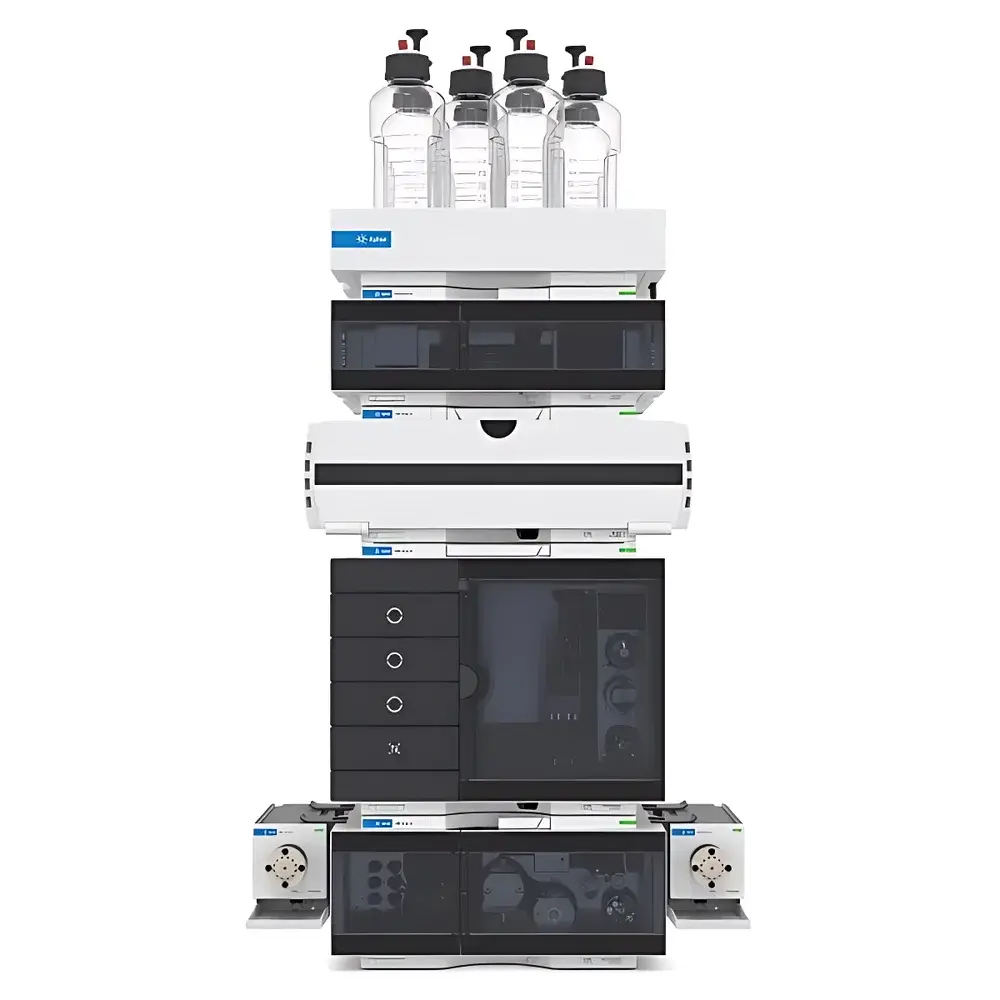
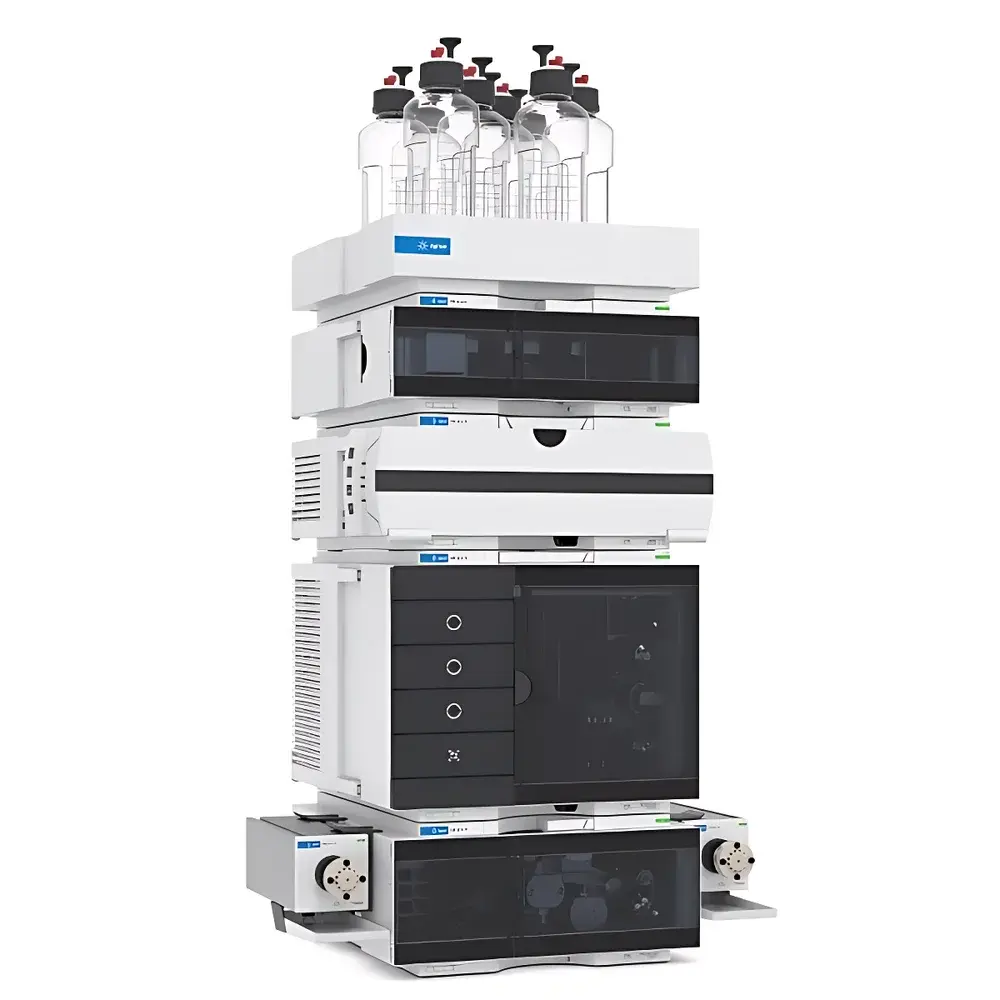
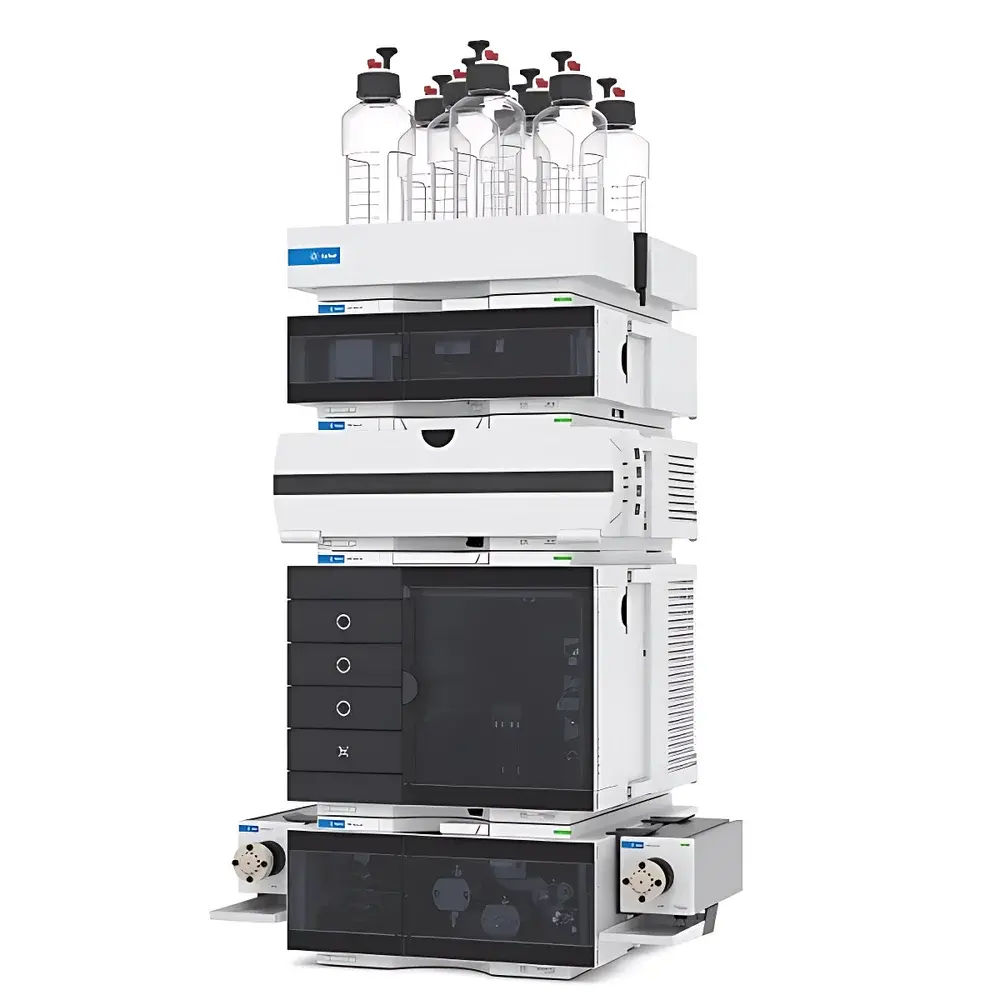
Agilent 1290 Infinity III Method Development System
| Brand | Agilent Technologies |
|---|---|
| Origin | Germany |
| Manufacturer Type | Original Equipment Manufacturer (OEM) |
| Origin Category | Imported |
| Model | 1290 Infinity III Method Development System |
| Instrument Type | Ultra-High-Performance Liquid Chromatograph (UHPLC) |
| Application Scope | Universal Method Development Platform |
| Flow Rate Range | up to 5 mL/min (with G7120A binary pump and G7104A quaternary pump) |
| Maximum Operating Pressure | 1300 bar |
| Injection Volume Range | 0.1–100 µL (0.1–1500 µL with multi-draw kit) |
| Temperature Control Zones | 2 standard (up to 8 when clustering up to four MCTs) |
| Solvent Selection Capacity | up to 26 solvents (with two external solvent selection valves) |
| Column Capacity | 8 columns per MCT (up to 32 columns with clustered MCT configuration) |
| Column ID Reader | Optional |
| BlendAssist Functionality | Enabled with G7104A pump |
| Power Supply | 100–240 VAC |
| Width | 435 mm |
| Depth | 468 mm |
Overview
The Agilent 1290 Infinity III Method Development System is a purpose-built ultra-high-performance liquid chromatography (UHPLC) platform engineered for systematic, high-throughput method development in pharmaceutical, biopharmaceutical, and analytical R&D laboratories. It operates on the fundamental principle of gradient-based retention modeling under controlled pressure, temperature, and mobile phase composition—enabling rigorous exploration of chromatographic parameter space in accordance with Quality by Design (QbD) principles defined in ICH Q5, Q8, and Q9 guidelines. Unlike conventional HPLC systems, this platform integrates hardware modularity, intelligent system emulation, and standardized column identification to support fully automated screening of over 1,300 distinct separation conditions—including combinations of up to 26 solvents, eight columns (expandable to 32), and gradient profiles across a pressure range extending to 1300 bar. Its architecture supports both reversed-phase and hydrophilic interaction liquid chromatography (HILIC), as well as ion-pairing and chiral separations, making it suitable for small molecules, peptides, oligonucleotides, and mAbs.
Key Features
- Modular high-pressure UHPLC architecture rated for continuous operation at 1300 bar, compatible with sub-2-µm particle columns and core-shell technologies.
- Automated multi-column selection via up to four InfinityLab Multi-Column Thermostats (MCTs), enabling concurrent thermal control across up to eight independent temperature zones (2 standard, scalable to 8).
- Intelligent System Emulation Technology (ISET): dynamically models dwell volume, gradient delay, dispersion, and dwell time characteristics of target LC systems—including non-Agilent platforms—to ensure seamless method transfer and reproducible performance across vendor ecosystems.
- InfinityLab Column ID system: RFID-enabled column tracking ensures traceability, usage history logging, and automatic exclusion of incompatible columns based on temperature limits or chemical stability constraints.
- BlendAssist functionality (with G7104A quaternary pump): enables precise low-volume blending of weak/strong solvents for improved gradient reproducibility and reduced carryover during high-throughput screening.
- Integrated method optimization software suite including Method Scouting Wizard, which generates statistically balanced screening designs minimizing solvent consumption and runtime while maximizing resolution orthogonality.
Sample Compatibility & Compliance
The system accommodates a broad range of sample types—from volatile organic compounds and polar metabolites to thermally labile biologics—when paired with appropriate column chemistries and mobile phase selections. All fluidic pathways are constructed from biocompatible, low-metal-leaching materials compliant with USP Class VI and ISO 10993 standards. The platform meets regulatory requirements for data integrity under FDA 21 CFR Part 11 when configured with Agilent OpenLab CDS and audit-trail-enabled workflows. It supports GLP/GMP-compliant method validation protocols aligned with ASTM E2639, ISO/IEC 17025, and ICH Q2(R2) guidelines. Environmental sustainability is verified through My Green Lab ACT certification, confirming lifecycle assessment transparency, energy efficiency, and responsible material sourcing.
Software & Data Management
Control and data acquisition are managed through Agilent OpenLab CDS v2.5 or later, supporting full integration with third-party QbD tools including ACD/Labs AutoChrom, ChromSword Auto, and S-Matrix Fusion QbD. Raw data files adhere to ANDI/NetCDF format, ensuring long-term archival compatibility. The Method Scouting Wizard implements DoE-driven experimental design logic, automatically generating optimized solvent gradients, column-switching sequences, and temperature ramps. All method parameters—including dwell volume compensation, column switching events, and ISET calibration coefficients—are stored as metadata within the sequence file. Audit trails record user actions, method modifications, and instrument state changes with timestamped, immutable entries compliant with ALCOA+ principles.
Applications
- Rapid development of robust, transferable methods for drug substance and product release testing per USP <621> and Ph. Eur. 2.2.46.
- Orthogonal method development for forced degradation studies and impurity profiling in accordance with ICH Q5 and Q1.
- High-resolution peptide mapping and intact mass analysis of monoclonal antibodies using wide-pore C4 and C18 phases.
- Screening of chiral stationary phases for enantiomeric separation of active pharmaceutical ingredients (APIs).
- Method scouting for oligonucleotide purity assessment under denaturing and non-denaturing conditions.
- Support for DOE-based robustness testing required in analytical procedure validation (ICH Q2(R2)).
FAQ
What is the maximum number of columns supported in a single method development run?
Up to 32 columns can be accessed automatically when four Multi-Column Thermostats (MCTs) are clustered and configured with column-switching manifolds.
Does the system support method transfer to non-Agilent LC instruments?
Yes—via Intelligent System Emulation Technology (ISET), which models system-specific dwell volumes, gradient delays, and dispersion profiles to ensure accurate cross-platform method translation.
Is column tracking mandatory for method execution?
No, but optional RFID-based Column ID reading is recommended to enforce compatibility checks, prevent thermal overloading, and maintain full traceability per ALCOA+ data integrity requirements.
Can the system operate under GLP or GMP-regulated environments?
Yes—when deployed with OpenLab CDS, electronic signatures, audit trail logging, and 21 CFR Part 11 compliance packages, it satisfies inspection readiness for regulated QC/QA laboratories.
What solvent selection flexibility does the system provide?
With two external solvent selection valves, up to 26 discrete solvents can be integrated into a single screening workflow, enabling comprehensive mobile phase space exploration including pH-modified and additive-containing eluents.
Related Products





