
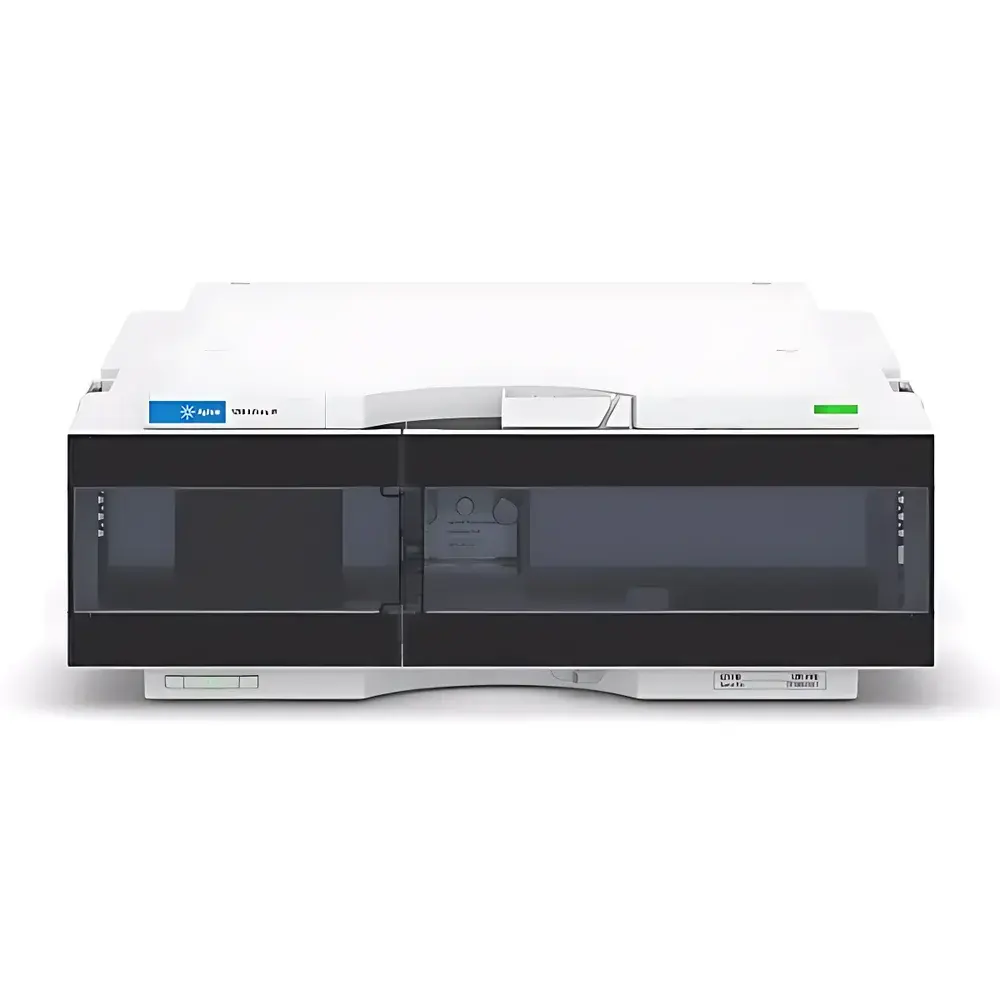
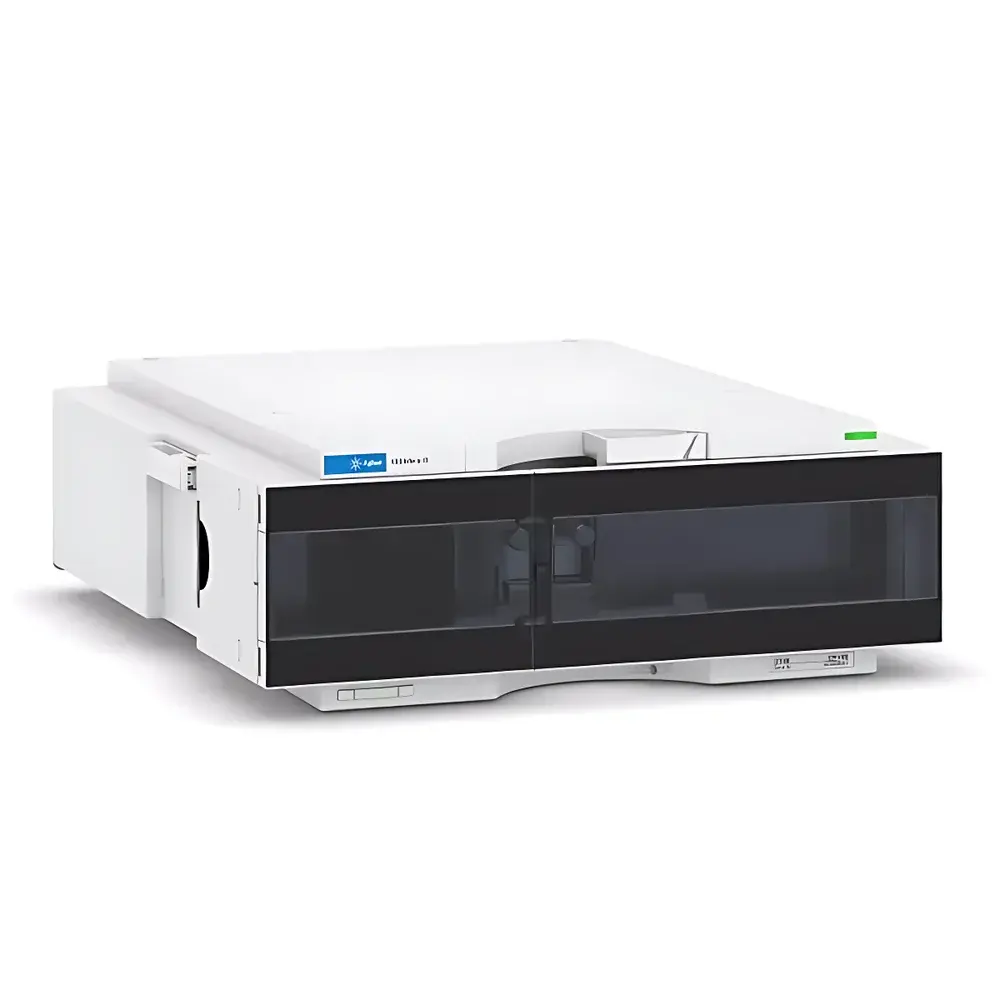
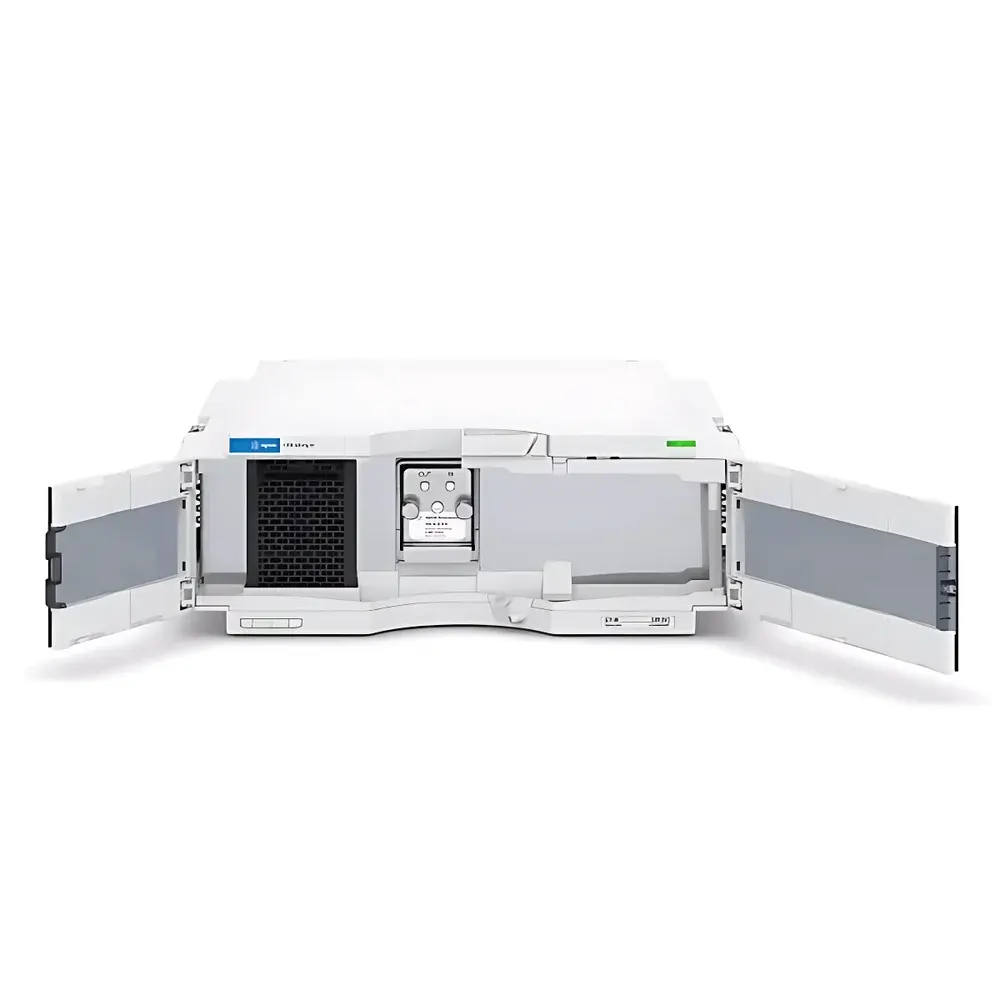
Agilent 1290 Infinity III Variable Wavelength Detector
| Brand | Agilent Technologies |
|---|---|
| Origin | Germany |
| Manufacturer Type | Original Equipment Manufacturer (OEM) |
| Product Category | Imported Instrument |
| Model | 1290 Infinity III Variable Wavelength Detector |
| Compatible System | High-Performance Liquid Chromatography (HPLC) and Ultra-High-Performance Liquid Chromatography (UHPLC) |
| Detector Type | UV-Vis Absorbance Detector |
| Data Acquisition Rate | Up to 240 Hz |
| Baseline Noise | < ±0.25 × 10⁻⁵ AU |
| Drift | < 0.5 × 10⁻⁴ AU/h |
| Linear Dynamic Range | > 2.5 AU |
| Wavelength Range | 190–950 nm |
| Wavelength Accuracy | ±0.1 nm (verified via built-in holmium oxide filter) |
| Temperature Control | Electronic Temperature Control (ETC) with ±0.05 °C stability |
| Flow Cell Identification | RFID-enabled stainless steel or fused silica flow cells |
| Lamp Life Monitoring | Real-time EMF tracking with user-defined thresholds |
| Software Integration | Fully compatible with OpenLab CDS, MassHunter, and compliant with FDA 21 CFR Part 11 audit trail requirements |
Overview
The Agilent 1290 Infinity III Variable Wavelength Detector (VWD) is a high-performance UV-Vis absorbance detector engineered for precision, reproducibility, and operational robustness in modern liquid chromatography laboratories. Operating on the principle of Beer-Lambert law-based photometric detection, it measures analyte concentration by quantifying wavelength-specific light absorption as eluents pass through a flow cell. Designed specifically for integration with Agilent’s 1290 Infinity III LC systems—and fully backward-compatible with prior 1200/1260/1290 platforms—it delivers exceptional baseline stability, ultra-low noise performance, and rapid spectral responsiveness essential for UHPLC method development, stability-indicating assays, and multi-component quantitation. Its optical architecture incorporates a high-intensity deuterium lamp for deep-UV sensitivity and a tungsten-halogen lamp for visible-range coverage, enabling seamless 190–950 nm scanning without manual lamp switching.
Key Features
- Ultra-high data acquisition rate of up to 240 Hz ensures full peak fidelity even under sub-second peak widths typical of UHPLC separations.
- Dual-wavelength detection mode enables simultaneous monitoring at two independently programmable wavelengths—critical for ratio-based quantitation, peak purity assessment, and co-elution resolution.
- Electronic Temperature Control (ETC) actively stabilizes the optical bench and flow cell at ±0.05 °C, minimizing thermal drift and preserving long-term baseline integrity across ambient temperature fluctuations (15–35 °C) and humidity variations.
- Automated wavelength verification using an integrated holmium oxide reference filter provides traceable, NIST-traceable calibration without external standards or manual intervention.
- RFID-tagged flow cells and lamps store serial numbers, usage hours, maintenance history, and calibration logs—enabling full instrument component traceability per ISO/IEC 17025 and GLP documentation requirements.
- Early Maintenance Feedback (EMF) continuously monitors lamp energy output, detector voltage, and optical alignment metrics, triggering configurable alerts before performance degradation impacts data quality.
Sample Compatibility & Compliance
The detector supports standard 1 µL and 6 µL flow cells (stainless steel or fused silica), accommodating aqueous, organic, and corrosive mobile phases—including TFA, HFBA, and high-pH buffers—without compromise to optical path integrity. It complies with ICH Q2(R2) guidelines for analytical instrument qualification and meets essential regulatory expectations for chromatographic detectors under USP , EP 2.2.46, and ASTM E260. Its firmware and data handling architecture support full 21 CFR Part 11 compliance when deployed with Agilent OpenLab CDS v3.x or later, including electronic signatures, role-based access control, and immutable audit trails for all wavelength programming, calibration events, and maintenance logs.
Software & Data Management
Native integration with Agilent OpenLab CDS enables method-driven wavelength programming—including time-segmented wavelength switching, stop-flow scanning, and real-time spectral overlays—directly within sequence tables. The detector’s embedded diagnostics engine communicates seamlessly with Agilent Lab Advisor software to deliver predictive error reporting, automated troubleshooting workflows, and remote health monitoring. All raw absorbance data are stored in vendor-neutral .D format, supporting third-party reprocessing via AIA-compliant tools. Audit trail records capture timestamped user actions, parameter changes, and system events—retained for ≥10 years per configurable retention policy.
Applications
This VWD is routinely deployed in pharmaceutical QC/QA labs for assay validation, impurity profiling, and forced degradation studies; in biopharmaceutical environments for mAb aggregation analysis and excipient compatibility testing; and in environmental and food safety labs for multi-residue pesticide screening and mycotoxin quantitation. Its wide linear range (>2.5 AU) allows accurate simultaneous quantification of major actives, process-related impurities, and genotoxic degradants without sample dilution or detector gain adjustment. The dual-wavelength capability supports pharmacopeial methods requiring reference-to-analyte ratio monitoring (e.g., USP Method B for related substances).
FAQ
What is the maximum data acquisition rate supported by the 1290 Infinity III VWD?
Up to 240 Hz—sufficient to digitize peaks narrower than 0.5 seconds with ≥20 data points per peak.
Does the detector support wavelength scanning during gradient runs?
Yes—time-programmable wavelength switching allows dynamic adjustment throughout the run, optimizing selectivity and signal-to-noise for each analyte window.
How is wavelength accuracy verified?
Via an onboard holmium oxide filter, which generates characteristic absorption peaks at certified wavelengths (e.g., 241.15 nm, 279.40 nm); verification occurs automatically during startup or on-demand.
Can the detector be used with non-Agilent LC systems?
Yes—when configured with analog voltage output (±1 V) or digital RS-232/USB interface, though full EMF, RFID, and OpenLab integration require native Agilent hardware handshake protocols.
Is the flow cell temperature actively controlled?
No—the ETC system regulates the optical bench and detector electronics only; flow cell temperature is governed by the column oven and system dwell volume management.





