
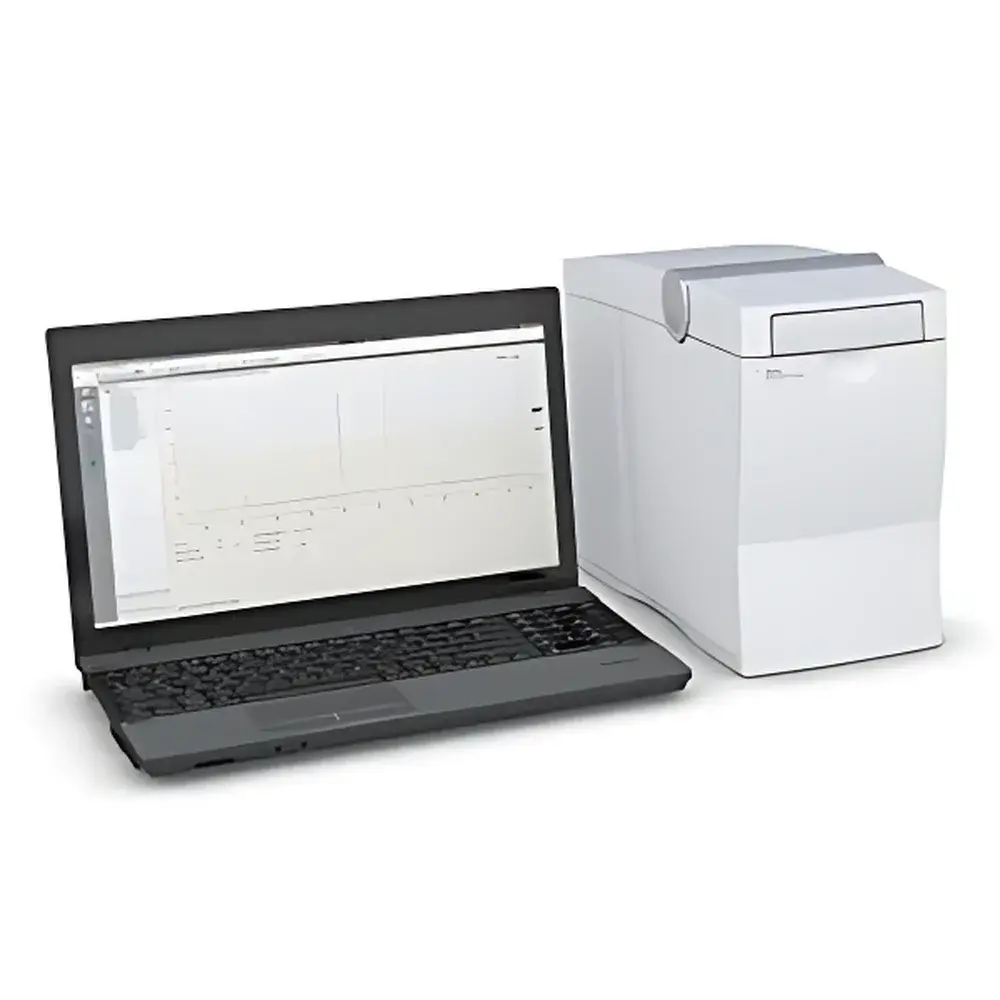
Agilent 2100 Bioanalyzer System
| Brand | Agilent Technologies |
|---|---|
| Origin | USA |
| Manufacturer Type | Original Equipment Manufacturer (OEM) |
| Product Category | Imported Instrument |
| Model | 2100 |
| Instrument Type | Protein Electrophoresis System |
| Primary Device | Microfluidic Capillary Electrophoresis Platform |
| Sample Throughput | Up to 12 Samples per Run |
| Sample Volume | 1–5 µL (varies by assay type) |
| RNA Quality Metric | RNA Integrity Number (RIN) |
| Power Consumption | 60 VA |
| Safety Compliance | IEC 61010-1, Installation Category II, Pollution Degree 2 |
| Laser Classification | Class 1 |
| Operating Temperature | 15–27 °C |
| Dimensions (W × D × H) | 162 mm × 412 mm × 290 mm |
| Weight | 10 kg |
| Input Voltage | 100–240 VAC |
| Input Frequency | 50–60 Hz |
Overview
The Agilent 2100 Bioanalyzer System is a benchtop microfluidic capillary electrophoresis platform engineered for high-reproducibility nucleic acid and protein quality control (QC) analysis. Unlike conventional slab-gel electrophoresis, the system integrates miniaturized electrophoretic separation with integrated fluorescence detection in disposable LabChip® consumables. Each chip contains pre-fabricated microchannels, buffer reservoirs, and electrodes—enabling automated sample loading, electrophoretic separation, and real-time detection without manual gel pouring or staining. The platform operates on the principle of sieving electrophoresis under controlled electric fields, where biomolecules are separated based on size-to-charge ratio in polymer matrix-filled channels. Fluorescently labeled analytes are excited by a solid-state laser (Class 1), and emitted light is captured via high-sensitivity CCD detection. This architecture delivers quantitative, digital electropherograms with objective metrics—including RNA Integrity Number (RIN) for total RNA, DNA Integrity Number (DIN), and protein purity profiles—essential for regulatory-compliant upstream QC in NGS library prep, biopharmaceutical development, and cell line characterization.
Key Features
- Microfluidic LabChip® technology enabling fully automated, walk-away electrophoretic analysis with minimal hands-on time
- Replaceable electrode cartridges ensuring method-to-method isolation and eliminating carryover between RNA, DNA, and protein assays
- Low sample consumption (1–5 µL per assay), critical for precious clinical or single-cell-derived samples
- Standardized, algorithm-derived quality metrics: RIN for RNA, DIN for genomic DNA, and % intact protein for therapeutic mAbs
- Integrated thermal management maintaining stable separation conditions across ambient temperature fluctuations (15–27 °C)
- Compliance with IEC 61010-1 safety standards, Installation Category II, and Pollution Degree 2 for laboratory use
- Laser Class 1 design ensures operator safety without interlocks or protective housings
Sample Compatibility & Compliance
The Agilent 2100 Bioanalyzer supports a broad range of biological matrices including total RNA (from FFPE, blood, or cultured cells), genomic DNA (sheared or intact), cDNA, PCR amplicons, and purified proteins (e.g., monoclonal antibodies, recombinant enzymes). Assay-specific LabChip® kits—such as the RNA 6000 Pico/Nano, DNA 1000/7500, and Protein 230—are manufactured under ISO 13485-certified processes and qualified per ASTM D7252 (nucleic acid quantification) and USP (electrophoretic methods). While the instrument itself is no longer available for new purchase as of December 31, 2023, all consumables, software updates (Bioanalyzer Expert Software vB.02.09 and later), and service support—including preventive maintenance, IQ/OQ documentation, and repair—remain available through 2030 per Agilent’s Product Lifecycle Commitment. Data generated meets GLP/GMP documentation requirements when used with audit-trail-enabled software configurations compliant with FDA 21 CFR Part 11.
Software & Data Management
Controlled via Agilent Bioanalyzer Expert Software, the system provides intuitive assay setup, real-time run monitoring, and automated peak detection with embedded calibration algorithms. Raw electropherogram data (.xdr files) and processed reports (.pdf, .csv) are stored locally with timestamped metadata, supporting traceability per ALCOA+ principles. The software includes built-in QC thresholds, customizable pass/fail criteria, and export options compatible with LIMS integration (via CSV or XML schema). Version-controlled firmware and software releases undergo rigorous validation against reference standards traceable to NIST SRMs. All data files retain instrument serial number, chip lot ID, reagent expiration, and user-defined sample annotations—ensuring full analytical traceability for regulatory submissions.
Applications
- RNA integrity assessment prior to qRT-PCR, microarray, or RNA-seq library construction
- NGS library QC: fragment size distribution, adapter dimer detection, and molarity estimation
- Biologics characterization: antibody aggregation analysis, SDS-PAGE replacement for reduced/non-reduced mAb profiling
- CRISPR editing verification: detection of indels and HDR products via fragment analysis
- Cell therapy process monitoring: viability-associated RNA degradation patterns in CAR-T manufacturing
- Stability studies: real-time tracking of nucleic acid or protein degradation under accelerated stress conditions
FAQ
Is the Agilent 2100 Bioanalyzer still supported for existing users?
Yes. Agilent continues to supply consumables, software updates, technical support, and certified service—including preventive maintenance and IQ/OQ—through December 31, 2030.
Can data from the 2100 Bioanalyzer be used in FDA submissions?
Yes, when operated under validated conditions with documented procedures, audit-trail-enabled software, and calibrated instruments, data meets 21 CFR Part 11 and ICH M10 requirements for bioanalytical method validation.
What alternatives does Agilent offer for new installations?
Agilent recommends the TapeStation 4200 (for higher-throughput DNA/RNA QC), Fragment Analyzer™ Systems (for specialized fragment analysis), and ProteoAnalyzer (for high-resolution protein characterization), all designed with enhanced sensitivity, expanded dynamic range, and seamless LIMS connectivity.
Are LabChip® consumables interchangeable across platforms?
No. LabChip® kits are platform-specific and validated only for use with the Agilent 2100 Bioanalyzer; cross-platform use voids assay performance specifications and regulatory compliance.
Does the system require external cooling or ventilation?
No. The instrument is air-cooled and designed for standard laboratory environments (15–27 °C, non-condensing humidity); no dedicated HVAC or exhaust is required.




