
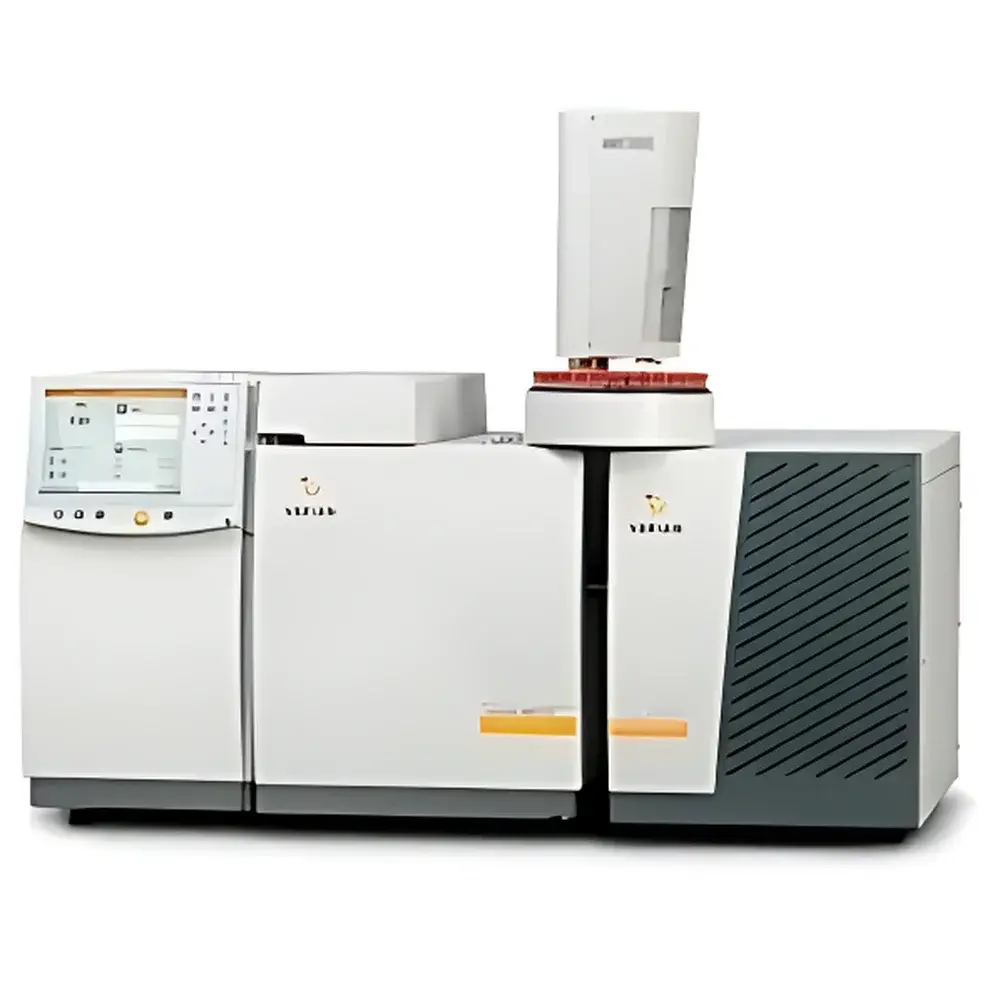
Agilent 240-MS Gas Chromatography Ion Trap Mass Spectrometer
| Brand | Agilent Technologies |
|---|---|
| Origin | USA |
| Manufacturer Type | Original Equipment Manufacturer (OEM) |
| Import Category | Imported Instrument |
| Model | 240-MS |
| Instrument Type | Ion Trap Mass Spectrometer |
| GC Configuration | Conventional Gas Chromatography Coupling |
Overview
The Agilent 240-MS is a high-performance gas chromatography–ion trap mass spectrometry (GC-ITMS) system engineered for structural elucidation, trace-level quantitation, and complex matrix analysis in regulated and research laboratories. It operates on the principle of three-dimensional (3D) quadrupole ion trap physics, where ions are radially confined by RF fields and axially trapped using DC potentials. Its patented Triple Resonance Scan (TRS) technology enables precise isolation, excitation, and ejection of target ions—eliminating spectral artifacts associated with ion–molecule reactions common in conventional single-stage quadrupole systems. With full MSn capability up to n = 10, the 240-MS supports iterative fragmentation pathways critical for unambiguous identification of unknown organic compounds, including pharmaceutical metabolites, environmental contaminants, and synthetic intermediates.
Key Features
- Triple Resonance Scan (TRS) technology for enhanced mass resolution and spectral fidelity, eliminating false positives from in-trap ion chemistry.
- Full MSn (n ≤ 10) capability for deep structural interrogation—including neutral loss, precursor ion, and multiple reaction monitoring (MRM) experiments.
- Dual-mode ionization: Electron Ionization (EI) and Chemical Ionization (CI) with fully automated switching; optional internal/external source configurations.
- Pulsed Ionization Mode dynamically modulates filament emission current based on analyte concentration—reducing carbon buildup and extending filament lifetime by up to 3× versus continuous operation.
- Patented Positive/Negative/Hybrid Chemical Ionization (PNHCI) external source supporting simultaneous or sequential positive- and negative-ion mode analysis without hardware reconfiguration.
- World’s only commercially available liquid chemical ionization (LCI) option for thermally labile or nonvolatile compounds.
- Ultra-inert 3D ion trap chamber constructed from electropolished stainless steel and coated with inert ceramic layers—optimized for reactive species (e.g., organometallics, acid chlorides, peroxides).
- ±10 kV off-axis electron multiplier detector with high gain stability and low dark current for improved signal-to-noise ratio in trace analysis.
Sample Compatibility & Compliance
The 240-MS accommodates volatile and semi-volatile organic compounds across diverse matrices—including biological fluids, soil extracts, polymer leachates, and air sampling cartridges. Its robust ion source design and inert trap architecture ensure reproducible performance with high-reactivity analytes that degrade in conventional systems. The platform complies with key regulatory frameworks: data acquisition and processing meet FDA 21 CFR Part 11 requirements for electronic records and signatures when deployed with Agilent MassHunter Software v10.1 or later. Method validation workflows align with ICH Q2(R2), USP , and ISO/IEC 17025:2017 guidelines. All GC oven and inlet parameters—including temperature ramping, pressure programming, and pulse injection—are traceable and auditable under GLP/GMP-compliant instrument control.
Software & Data Management
Control and data analysis are unified within Agilent MassHunter Workstation Software (v10.1+), which provides automated method development, real-time instrument tuning, and intelligent calibration. The software supports full audit trail logging per 21 CFR Part 11, including user access controls, electronic signatures, and immutable record retention. Quantitative workflows include automatic SIS/SRM/MRM transition setup, isotopic correction, internal standard normalization, and batch processing with QC flagging. Spectral library searching (NIST, Wiley, custom libraries) integrates with MSn fragment trees for confident compound identification. Raw data files (.d format) are vendor-neutral and exportable to third-party platforms (e.g., Compound Discoverer, Skyline) via open XML-based metadata schemas.
Applications
- Pharmaceutical impurity profiling and degradation product identification per ICH M7 and Q5C guidelines.
- Environmental analysis of persistent organic pollutants (POPs), including PCBs, PBDEs, and dioxin-like compounds in sediment and biota.
- Forensic toxicology screening for novel psychoactive substances (NPS) requiring structural confirmation beyond nominal mass.
- Polymer additive migration studies in food contact materials (FCMs), compliant with EU Regulation 10/2011.
- Metabolomics and lipidomics workflows leveraging MS3–MS5 fragmentation trees for isomer differentiation.
- Reaction monitoring in process chemistry, where real-time detection of transient intermediates informs kinetic modeling.
FAQ
What is the maximum MSn level supported by the 240-MS?
The system supports up to MS10 fragmentation cycles, enabling comprehensive structural disassembly of complex molecules.
Does the 240-MS support quantitative analysis under GLP conditions?
Yes—when configured with MassHunter Software v10.1+, it provides full 21 CFR Part 11 compliance, including audit trails, electronic signatures, and secure user authentication.
Can the ion trap be cleaned in situ without breaking vacuum?
No—while the ion trap is designed for long-term inertness and minimal maintenance, routine cleaning requires venting and physical removal per Agilent Service Bulletin IT-240-08.
Is the liquid chemical ionization (LCI) source compatible with all CI gases?
The LCI configuration operates exclusively with reagent liquids (e.g., aniline, triethylamine); it does not interface with traditional CI gases (methane, isobutane, ammonia).
How many GC methods can be stored onboard the 240-MS integrated GC module?
Up to 50 fully parameterized GC methods—including oven programs, inlet settings, and detector configurations—can be saved and recalled directly from the front-panel interface.




