
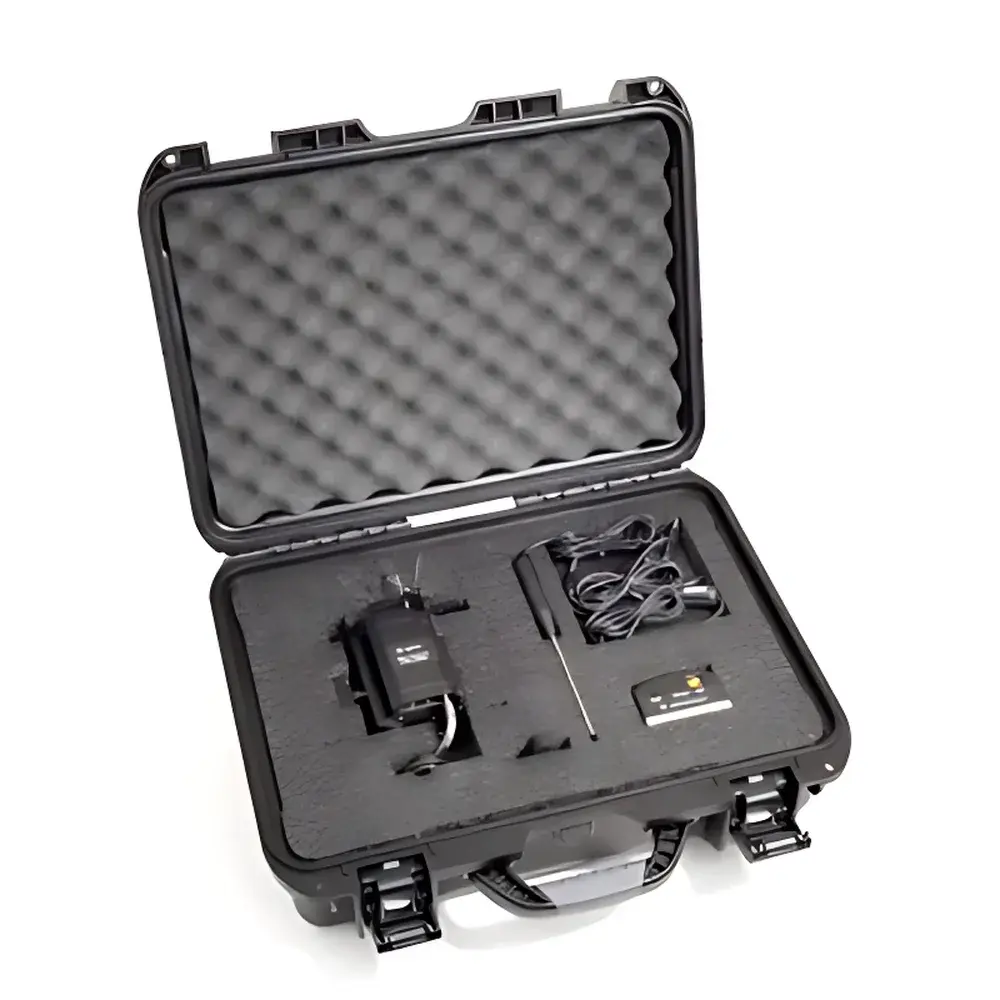
Agilent 280-DS Mechanical Qualification System
| Brand | Agilent Technologies |
|---|---|
| Origin | Imported |
| Manufacturer Type | Manufacturer |
| Instrument Type | Offline Dissolution Tester |
| Model | 280-DS |
| Compliance | Supports eMQ and PVT per USP <711>, <724>, ASTM D6519, and FDA Guidance on Dissolution Equipment Verification |
Overview
The Agilent 280-DS Mechanical Qualification System (MQS) is a precision-engineered platform designed to perform comprehensive physical verification of dissolution testing apparatus in accordance with enhanced Mechanical Qualification (eMQ) guidelines. Unlike traditional manual verification methods—such as dial indicators, spirit levels, and calipers—the 280-DS employs non-contact optical sensing technology to deliver traceable, operator-independent measurements of critical mechanical parameters. It operates independently of any specific dissolution instrument vendor, enabling qualification of open-head dissolution systems—including but not limited to the Agilent 708-DS, Hanson SR8-Plus, Distek 2500, and Sotax AT7—without hardware modification. The system’s architecture is grounded in metrological rigor: all sensors are factory-calibrated against NIST-traceable standards, and measurement uncertainty is quantified per ISO/IEC 17025 principles. Its primary purpose is to support regulatory compliance for pharmaceutical quality control laboratories operating under cGMP, ICH Q5C, and FDA 21 CFR Part 11 requirements.
Key Features
- Optical sensor-based measurement of mechanical parameters with sub-millimeter spatial resolution and ±0.1° angular accuracy
- Dual-module design: Instrument Module assesses base-level horizontal alignment (X/Y axes) and triaxial vibration (X/Y/Z); Dissolution Vessel Module measures shaft rotation speed, wobble (shaft and basket), verticality (shaft and vessel), centering offset, and paddle/basket height relative to vessel geometry
- Automated measurement sequence completed in under 15 seconds per parameter set, eliminating subjective interpretation and inter-operator variability
- Integrated firmware with real-time pass/fail evaluation against configurable acceptance criteria aligned with USP , , and PQRI eMQ recommendations
- Robust aluminum-alloy chassis with magnetic mounting system for rapid deployment on diverse dissolution instrument frames without permanent installation
Sample Compatibility & Compliance
The 280-DS is compatible with all USP Apparatus 1 (basket) and Apparatus 2 (paddle) dissolution systems featuring standard open-head configurations (i.e., no enclosed or pressurized vessels). It supports vessels of 100–1000 mL capacity and accommodates both 10-mm and 14-mm shaft diameters. The system complies with international pharmacopeial standards including USP “Dissolution”, USP “Drug Release”, and EP 2.9.3. All measurement protocols adhere to ASTM D6519-21 (“Standard Practice for Mechanical Calibration of Dissolution Apparatus”) and support audit-ready documentation required under FDA 21 CFR Part 11 and EU Annex 11. Full electronic records—including raw sensor data, timestamps, user IDs, and digital signatures—are retained with immutable audit trails.
Software & Data Management
The Agilent Dissolution Workstation software (v3.2+) provides a 21 CFR Part 11-compliant interface with role-based access control, electronic signature capability, and automated report generation in PDF/A-1b format. Each test session generates a structured XML dataset compliant with ASTM E2500-19 for equipment qualification data exchange. The software enforces procedural integrity via step-by-step guided workflows, preventing skipped or out-of-sequence operations. All calibration events, user actions, and system errors are logged with time-stamped entries. Data export supports CSV, XML, and LIMS-integrated HL7 ADT messages. Audit trail review functionality enables full reconstruction of any qualification event—including who performed it, when, and what values were recorded—meeting GLP/GMP inspection readiness requirements.
Applications
- Initial qualification and periodic requalification of dissolution apparatus per internal SOPs and regulatory expectations
- Root-cause investigation of inconsistent dissolution profiles linked to mechanical drift (e.g., shaft wobble-induced fluid dynamics perturbation)
- Supporting method validation studies where apparatus mechanical stability directly impacts assay robustness
- Facilitating regulatory submissions by providing objective, reproducible evidence of apparatus fitness-for-use
- Training laboratory personnel on standardized mechanical verification practices across multi-site manufacturing networks
FAQ
Does the 280-DS require connection to the dissolution instrument’s electronics or power supply?
No. The system operates autonomously using its own rechargeable lithium-ion battery and optical sensing modules; no integration with the dissolution instrument’s controller is necessary.
Can the 280-DS be used for Apparatus 4 (flow-through cell) verification?
Not natively. Its current mechanical qualification scope is limited to USP Apparatus 1 and 2. Flow-through cell verification requires alternative metrology approaches per USP Annex.
Is firmware update capability available remotely?
Yes. Updates are delivered via secure HTTPS through the Agilent Support Portal and applied offline using signed update packages to maintain system integrity.
How often must the 280-DS itself be recalibrated?
Agilent recommends annual factory recalibration traceable to NIST standards; interim verification using the included reference calibration kit is advised before each qualification campaign.
Does the software support multi-language interfaces?
Yes. English, Japanese, Chinese (Simplified), German, and Spanish language packs are available and configurable per user profile.





