
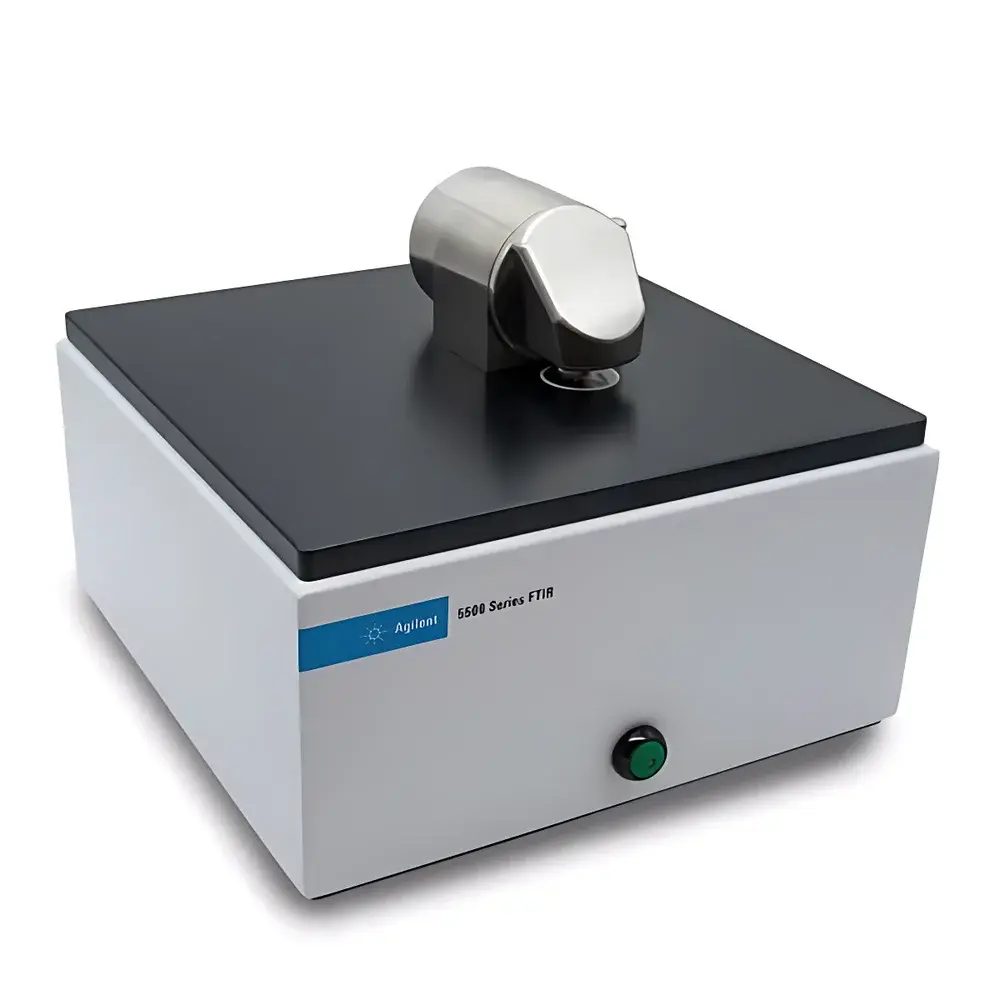
Agilent 5500 Series Compact FTIR Spectrometer
| Brand | Agilent Technologies |
|---|---|
| Origin | Malaysia |
| Manufacturer Status | Original Equipment Manufacturer (OEM) |
| Import Category | Imported Instrument |
| Model | 5500 |
| Instrument Type | Laboratory Benchtop FTIR Spectrometer |
| Spectral Range | 4,000 to 650 cm⁻¹ |
| Dimensions (W × D × H) | 20 cm × 20 cm × 11 cm |
| Weight | 3.6 kg |
| Power Requirement | 100–240 VAC, 50/60 Hz |
| Sampling Modules | Fixed Diamond ATR, Multireflection ZnSe ATR, TumblIR, DialPath |
| Software Platform | MicroLab, MicroLab Expert, MicroLab Quant, MicroLab Pharma (optional) |
| Library Support | Pre-validated application-specific spectral libraries |
Overview
The Agilent 5500 Series Compact FTIR Spectrometer is a benchtop Fourier Transform Infrared (FTIR) instrument engineered for routine, high-reliability molecular identification and quantification in regulated and non-regulated laboratory environments. Based on Michelson interferometry with a permanently aligned optical path and solid-state laser reference, the system delivers high spectral reproducibility and long-term stability without routine realignment. Its compact footprint (20 × 20 × 11 cm) and lightweight design (3.6 kg) enable seamless integration into QC labs, teaching laboratories, and production support spaces where space and workflow efficiency are critical. The instrument operates across a standard mid-infrared range of 4,000 to 650 cm⁻¹ at nominal resolution, supporting both qualitative fingerprinting and semi-quantitative analysis of organic functional groups—ideal for raw material verification, polymer characterization, pharmaceutical excipient screening, and cleaning validation residue identification.
Key Features
- Permanently aligned interferometer with solid-state HeNe laser reference ensures consistent wavenumber accuracy and minimizes drift over extended operation cycles.
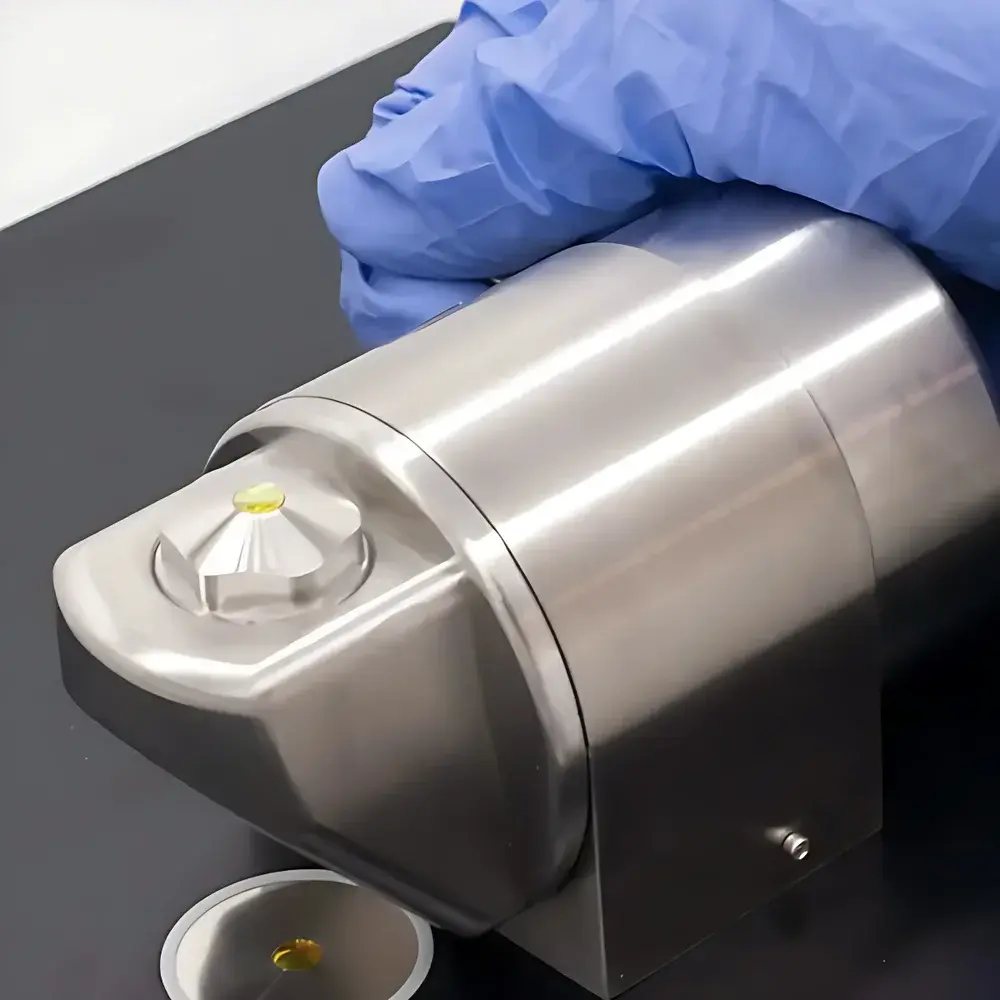
- Modular sampling interface architecture: interchangeable, pre-aligned modules—including single-reflection diamond ATR for solids and viscous liquids, multireflection ZnSe ATR for low-absorbing liquid samples, TumblIR for homogeneous powder analysis, and DialPath for variable-pathlength transmission measurements.
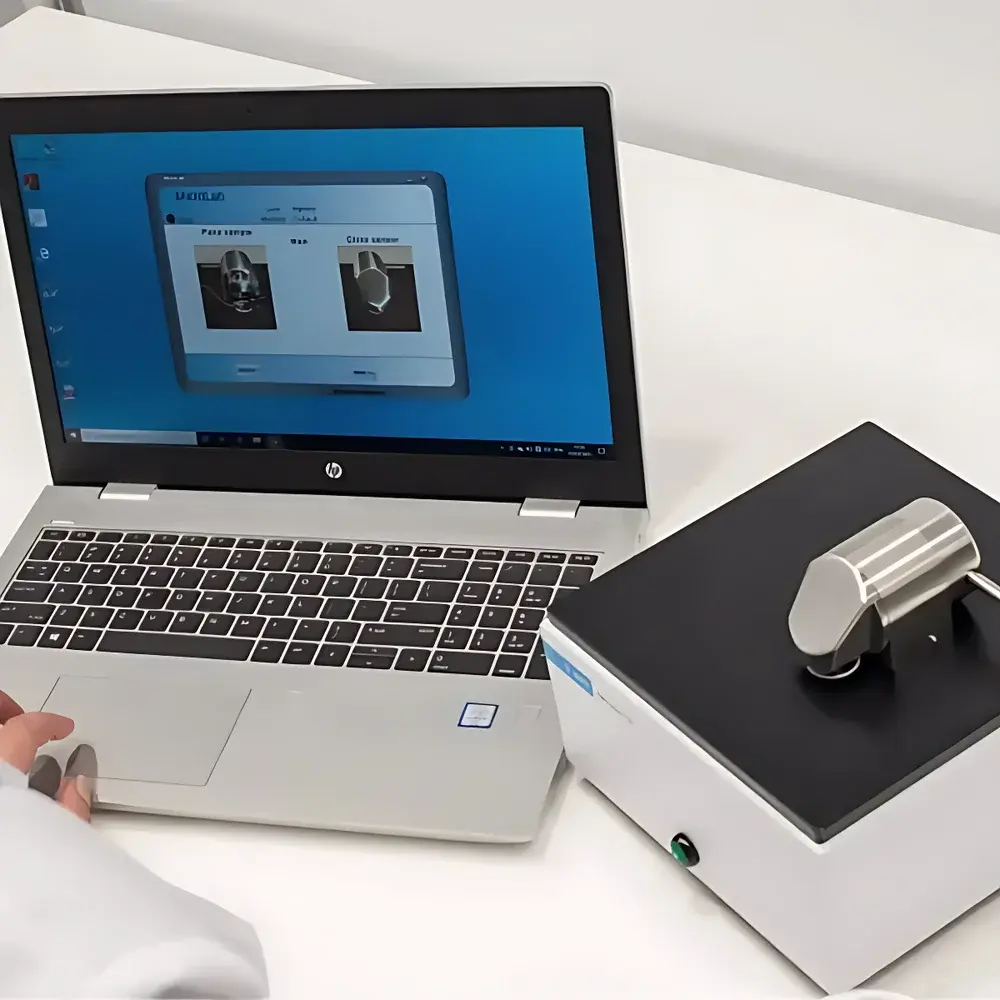
- Intuitive, method-driven software interface available in multiple languages; color-coded pass/fail alerts provide immediate visual feedback against user-defined acceptance criteria.
- MicroLab Quant enables guided quantitative method development without scripting or advanced spectroscopic expertise—supporting linear calibration, peak area/height ratios, and baseline correction protocols.
- Optional MicroLab Pharma edition complies with data integrity requirements per FDA 21 CFR Part 11 and EU Annex 11, including electronic signatures, full audit trail, role-based access control, and secure data export.
- Robust mechanical design with shock-absorbing feet and sealed optical compartment mitigates environmental vibration and dust ingress—critical for shared lab environments.
Sample Compatibility & Compliance
The 5500 Series accommodates diverse physical forms without sample derivatization: free-flowing powders, compressed KBr pellets, thin films, gels, pastes, and neat liquids. Solid samples are analyzed via diamond ATR with minimal surface preparation; liquids require only a single drop applied directly to the crystal surface. The system supports ASTM E1252 (General Techniques for Infrared Identification), ISO 18381 (Polymer Characterization), and USP (Infrared Absorption Spectrophotometry). All firmware and software versions undergo internal verification per Agilent’s GLP-compliant development lifecycle, and documentation packages support GMP audit readiness for pharmaceutical and biotech users.
Software & Data Management
MicroLab serves as the core acquisition and processing platform, featuring automated background subtraction, atmospheric compensation (H₂O/CO₂), spectral arithmetic, and library search with hit-quality indexing. MicroLab Expert extends capabilities with advanced peak fitting, mixture analysis, and custom report templates compliant with LIMS integration standards (ASTM E1702). Data files are stored in vendor-neutral .spc and .jdx formats; raw interferograms and processed spectra retain full metadata (date/time, operator ID, instrument serial number, sampling module used). Audit trails record all user actions—including parameter changes, spectrum deletion, and library modifications—with immutable timestamps and operator attribution.
Applications
- Pharmaceutical: Excipient identity confirmation, blend uniformity assessment, counterfeit drug detection, and cleaning verification swab analysis.
- Polymers & Plastics: Additive identification, degradation monitoring, copolymer composition estimation, and failure analysis of molded components.
- Academic & Teaching Labs: Hands-on instruction in vibrational spectroscopy principles, functional group correlation chart interpretation, and spectral library searching methodology.
- Food & Agriculture: Adulterant screening (e.g., melamine in dairy, starch substitution in flour), authenticity verification of oils and botanical extracts.
- Chemical Manufacturing: Raw material release testing, reaction endpoint determination, and impurity profiling using spectral subtraction techniques.
FAQ
What is the recommended maintenance schedule for the Agilent 5500 Series?
Routine maintenance is limited to periodic desiccant replacement (every 6 months) and external optics cleaning using spectroscopic-grade methanol and lint-free wipes. No internal alignment or lamp replacement is required during normal operation.
Can the instrument be integrated into an existing LIMS or ELN infrastructure?
Yes—MicroLab supports ODBC-compliant database connectivity and exports structured data via CSV, XML, and PDF. API extensions are available under Agilent’s Enterprise Integration Program for validated bi-directional workflows.
Is spectral resolution user-adjustable?
The instrument operates at a fixed nominal resolution optimized for routine analysis (typically 4 cm⁻¹); higher resolution modes are not supported due to its compact interferometer design and thermal management constraints.
Does the system meet ISO/IEC 17025 requirements for accredited testing laboratories?
When operated with documented SOPs, calibrated reference materials (e.g., polystyrene film), and traceable performance verification records, the 5500 Series meets the technical competence criteria outlined in ISO/IEC 17025:2017 Clause 6.4 (Equipment).
Are third-party spectral libraries compatible with MicroLab?
MicroLab natively imports libraries in JCAMP-DX (.jdx) format. Commercial libraries from Bio-Rad, KnowItAll, and Wiley are fully supported after format conversion using Agilent’s Library Migration Utility.





