
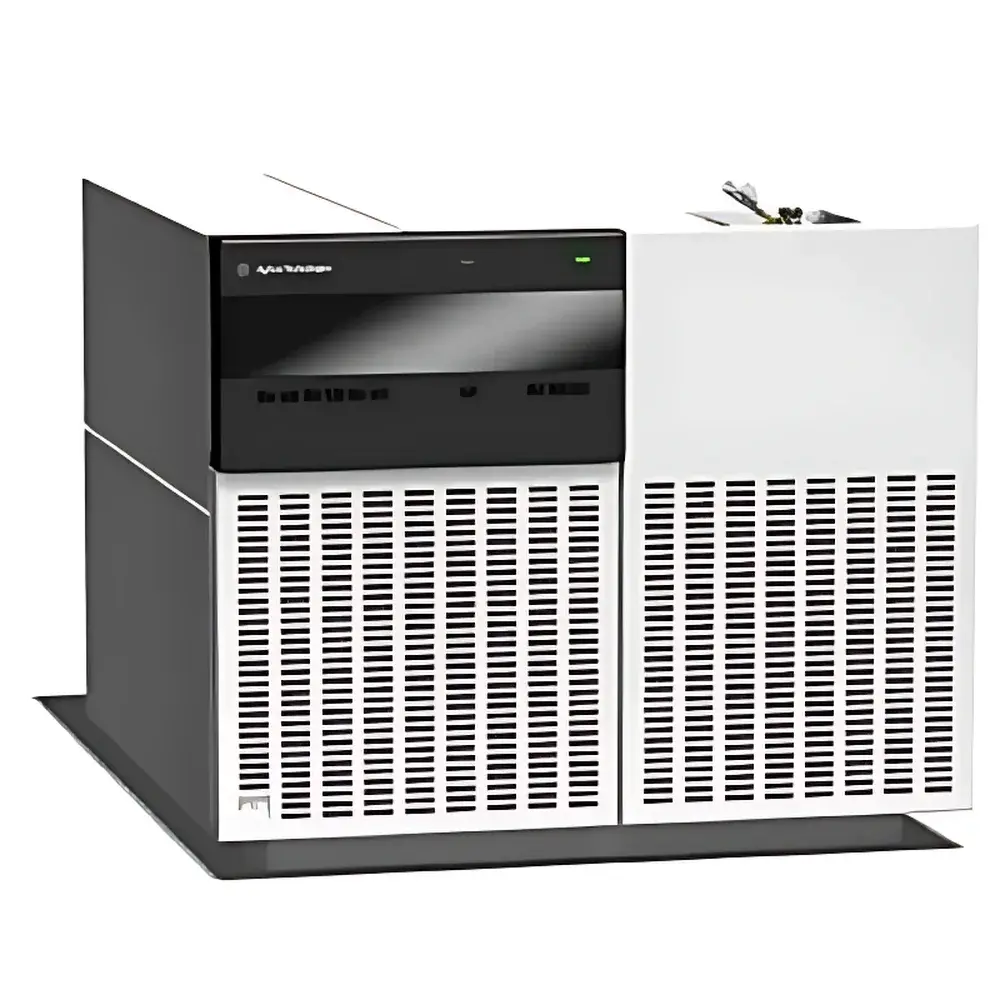
Agilent 5975T Portable Gas Chromatography-Mass Spectrometry System
| Brand | Agilent Technologies |
|---|---|
| Origin | USA |
| Manufacturer Type | Original Equipment Manufacturer (OEM) |
| Origin Category | Imported |
| Model | 5975T |
| Instrument Type | Portable GC-MS |
| Mass Range | 1.8–1050 amu |
| Dynamic Range | 6 orders of magnitude |
| Mass Resolution | Unit mass resolution, tunable via MS calibration |
| Maximum Scan Rate | 12,500 amu/s |
Overview
The Agilent 5975T Portable Gas Chromatography-Mass Spectrometry System is a field-deployable, laboratory-grade analytical platform engineered for real-time, on-site chemical identification and quantification. Built upon Agilent’s proven 5975-series quadrupole mass spectrometer architecture and integrated with Low Thermal Mass (LTM) gas chromatography technology, the 5975T delivers benchtop-level performance in a compact, ruggedized mobile configuration. Its core measurement principle combines capillary GC separation—enabled by rapid, precise column heating/cooling cycles—with electron ionization (EI) quadrupole mass spectrometry for high-fidelity spectral acquisition. Designed for mission-critical environments including environmental emergency response, industrial hygiene monitoring, homeland security screening, and field-based water quality assessment, the system operates without dependency on fixed laboratory infrastructure while maintaining traceable analytical integrity.
Key Features
- Ruggedized chassis with shock-dampening base mount, certified for vehicular transport and operation under vibration conditions per MIL-STD-810G standards
- Agilent Low Thermal Mass (LTM) GC module enabling programmable heating rates up to 1200 °C/min and cooling rates >400 °C/min—reducing typical GC run times by 50–70% versus conventional ovens
- Quadrupole mass spectrometer with inert, heated quartz rods ensuring long-term mass axis stability and reduced surface adsorption of polar analytes
- 70 L/s turbomolecular vacuum pump with oil-free backing—eliminating maintenance-sensitive lubricants and enabling continuous operation in uncontrolled ambient environments
- Vacuum retention technology maintains high-vacuum state (<5×10⁻⁶ Torr) for ≥72 hours after power-down, enabling rapid instrument warm-up and analysis initiation within <15 minutes of startup
- Detection sensitivity validated at 1 pg octafluoronaphthalene (OFN), delivering signal-to-noise ratio ≥400:1 (m/z 272) under standard EI conditions
- Unit-mass resolution tunable across full 1.8–1050 amu range; scan speeds up to 12,500 amu/s support high-temporal-resolution profiling of transient emissions
Sample Compatibility & Compliance
The 5975T accepts direct injection from multiple field-compatible sampling interfaces—including thermal desorption tubes, micro-adsorption air samplers, heated inlet probes, and purge-and-trap concentrators—enabling analysis of volatile and semi-volatile organic compounds (VOCs/SVOCs) in air, water, soil headspace, and wipe extracts. Its EI spectral library compatibility supports NIST MS Search 2.3 and user-customizable RTL (Retention Time Locked) databases, facilitating compound confirmation under variable GC conditions. The system meets ASTM D5762, D6348, and EPA TO-14A/TO-15 requirements for airborne VOC analysis, and its data handling architecture supports audit trails compliant with 21 CFR Part 11 when paired with Agilent MassHunter software in secure networked deployments.
Software & Data Management
Controlled via Agilent MassHunter Workstation Software (vB.08.x or later), the 5975T provides fully integrated GC/MS method development, acquisition, and post-run processing—including automated deconvolution using Deconvolution Reporting Software (DRS). DRS enables selective detection of target analytes in complex matrices (e.g., smoke plumes, wastewater effluents) by separating co-eluting peaks based on spectral uniqueness. All raw data (.D files), processed results, and instrument logs are stored in vendor-neutral formats (mzML-compliant where applicable) and support GLP/GMP-aligned metadata tagging—user ID, location stamp (GPS-integrated optional), calibration history, and QC flagging. Remote diagnostics and firmware updates are supported over secure Ethernet or 4G LTE connections.
Applications
- Rapid identification and quantification of VOCs in drinking water sources during contamination events—validated in collaboration with China Academy of Urban Planning & Design
- In-field detection of N-nitrosamines in ambient air using micro-adsorption sampling coupled with thermal desorption–LTM-GC/MS
- Real-time monitoring of industrial stack emissions and fugitive releases during regulatory inspections
- Chemical threat agent screening (e.g., organophosphates, sulfur mustard degradation products) in first-responder scenarios
- Forensic analysis of ignitable liquid residues at fire investigation sites with minimal sample preparation
FAQ
Is the 5975T compliant with ISO/IEC 17025 method validation requirements?
Yes—the system’s documented uncertainty budget, calibration traceability to NIST SRMs, and built-in performance verification checks (e.g., autotune, retention time locking) support method validation per ISO/IEC 17025:2017 Clause 7.2.
Can the 5975T operate continuously for extended field deployments?
It is rated for uninterrupted operation up to 72 hours on external DC power (24 V) or vehicle battery supply; internal thermal management and vacuum retention minimize downtime between analyses.
Does the system support quantitative analysis with internal standards?
MassHunter Quantitative Analysis module enables multi-level calibration curves, isotope dilution, and response factor normalization—fully compatible with USP , EPA Method 8260D, and ASTM D7011 workflows.
What maintenance intervals are recommended for field use?
Ion source cleaning every 200–300 sample injections; quadrupole rod bake-out every 6 months; turbomolecular pump inspection annually—documented in Agilent’s Field Maintenance Manual P/N G1872-90001.






