
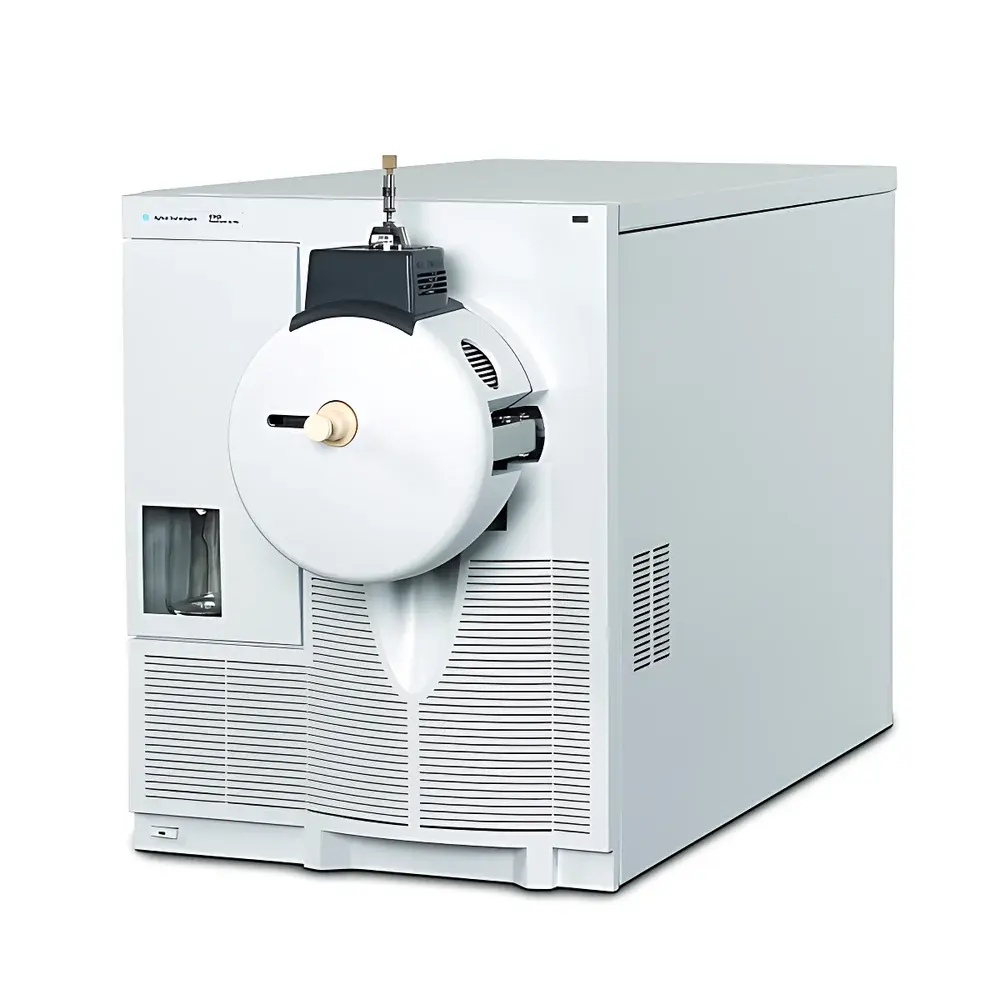
Agilent 6100 Series Single Quadrupole Liquid Chromatography/Mass Spectrometry System
| Brand | Agilent Technologies |
|---|---|
| Origin | Germany |
| Manufacturer Type | Original Equipment Manufacturer (OEM) |
| Origin Category | Imported |
| Model | 6100 |
| Instrument Type | Single Quadrupole LC/MS (not Tandem Quadrupole) |
| Scan Speed | Up to 10,000 u/s |
| Detection Limit | Sub-picogram (with Agilent Jet Stream Technology on 6130/6150 variants) |
| Compatibility | Fully Integrated with Agilent 1220/1260/1290 Infinity LC Systems |
Overview
The Agilent 6100 Series Single Quadrupole Liquid Chromatography/Mass Spectrometry (LC/MS) System is a high-performance, benchtop mass spectrometer engineered for robust quantitative and qualitative analysis in regulated and research laboratories. Based on quadrupole mass filtering technology, the system operates under controlled vacuum conditions and employs electron ionization (EI) and electrospray ionization (ESI) — with optional atmospheric pressure chemical ionization (APCI) — to generate reproducible molecular and fragment ion spectra. Its core architecture features a temperature-stabilized quadrupole mass analyzer, optimized ion optics, and a high-gain electron multiplier detector. Designed for seamless integration with Agilent’s Infinity LC platforms (1220, 1260, and 1290), the 6100 Series delivers exceptional sensitivity, dynamic range, and duty cycle efficiency—enabling reliable detection of low-abundance analytes in complex matrices such as biological fluids, environmental extracts, and pharmaceutical formulations.
Key Features
- Single quadrupole mass analyzer with mass range up to 3,000 Da and resolution sufficient for unit-mass separation across full scan and selected ion monitoring (SIM) modes
- Agilent Jet Stream Technology (standard on 6130 and 6150 models) enhances desolvation efficiency and ion transmission, achieving sub-picogram limit of detection (LOD) for many small-molecule standards under optimized ESI conditions
- Scan speed up to 10,000 atomic mass units per second supports high-throughput UHPLC applications without sacrificing spectral fidelity or isotopic pattern integrity
- Real-time isotopic ratio verification at fast scan speeds enables confident compound identification via natural abundance isotope peak matching (e.g., M, M+1, M+2)
- Fully integrated control architecture allows synchronized operation with Agilent preparative and analytical LC systems, including mass-triggered fraction collection
- Multi-detector compatibility: simultaneous data acquisition from DAD, ELSD, and MSD channels facilitates orthogonal purity assessment and method validation
- Modular design supports field-upgradable ion sources and collision cell options for future workflow expansion
Sample Compatibility & Compliance
The 6100 Series accommodates a broad range of sample types—including polar and thermally labile small molecules, peptides, metabolites, and synthetic intermediates—across reversed-phase, HILIC, and ion-pairing chromatographic methods. It complies with key regulatory requirements for analytical instrument qualification, supporting IQ/OQ/PQ documentation templates aligned with ASTM E2500, ISO/IEC 17025, and USP . Data integrity functionality includes audit-trail-enabled user authentication, electronic signatures, and secure raw data storage—fully compatible with FDA 21 CFR Part 11–compliant environments when deployed with Agilent OpenLab CDS software and appropriate IT infrastructure.
Software & Data Management
Control and data processing are managed through Agilent MassHunter Workstation Software, which provides intuitive method setup, real-time spectrum visualization, and automated peak integration. The software supports batch processing, customizable report generation, and export to LIMS-compatible formats (e.g., .mzML, .csv, .pdf). All acquisition parameters, calibration records, and processing methods are stored with time-stamped metadata. For enterprise-scale deployment, MassHunter integrates with Agilent OpenLab ECM for centralized instrument management, role-based access control, and long-term archival in accordance with GLP/GMP retention policies. Raw data files are cryptographically hashed to ensure immutability and traceability throughout the data lifecycle.
Applications
The 6100 Series serves critical roles in pharmaceutical quality control (e.g., residual solvent analysis, impurity profiling per ICH Q3B), environmental monitoring (e.g., pesticide residue screening in food per EU SANTE/11312/2021), clinical toxicology (e.g., therapeutic drug monitoring and forensic screening), and natural product characterization. Its reliability in routine SIM-based quantitation makes it particularly suited for validated bioanalytical workflows where precision (RSD <5% across 5–1000 ng/mL ranges) and inter-day reproducibility are essential. Method transfer between labs is facilitated by standardized tuning protocols and vendor-supplied reference standards.
FAQ
Is the Agilent 6100 Series a tandem quadrupole (QqQ) system?
No. The 6100 Series is a single quadrupole LC/MS platform. Tandem quadrupole functionality is provided by the Agilent 6400 and 6500 Series systems.
Can the 6100 interface with non-Agilent LC systems?
Yes—via standard analog/digital I/O and MS-Ready trigger signals—but full bidirectional control and advanced features (e.g., mass-triggered fraction collection) require Agilent Infinity LC hardware and OpenLab CDS integration.
What ionization sources are available?
Standard configurations include ESI and APCI; optional configurations support dual-spray probes and nanoflow ESI kits for microscale applications.
Does the system support GLP-compliant data handling?
Yes—when operated with MassHunter in audit-trail mode and paired with OpenLab ECM, the system meets ALCOA+ principles and supports full 21 CFR Part 11 compliance with appropriate procedural controls.
What maintenance intervals are recommended?
Routine source cleaning is advised every 1–2 weeks depending on sample load; quadrupole and detector calibration should be performed weekly or before each analytical batch in regulated environments.






