
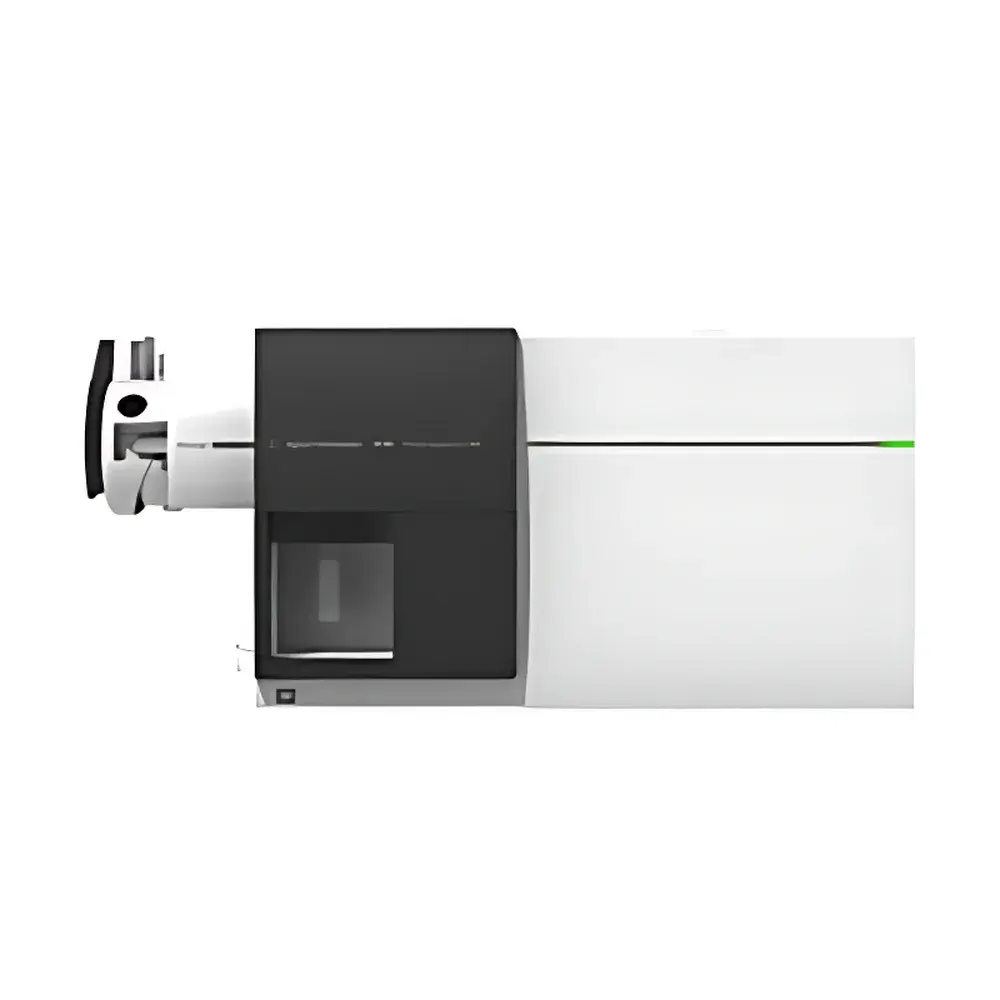
Agilent 6470 Triple Quadrupole Liquid Chromatography Mass Spectrometry System
| Brand | Agilent Technologies |
|---|---|
| Origin | Singapore |
| Manufacturer | Agilent Technologies |
| Import Status | Imported |
| Model | 6470 |
| Instrument Type | Tandem Quadrupole (QqQ) |
| Application Scope | Universal |
| Sensitivity | Up to 5× higher than conventional ESI sources |
Overview
The Agilent 6470 Triple Quadrupole LC/MS System is a high-performance tandem quadrupole mass spectrometer engineered for robust, quantitative analysis in regulated and research laboratories. Built upon Agilent’s proven jet stream electrospray ionization (ESI) technology and optimized collision cell design, the system delivers exceptional sensitivity, precision, and duty-cycle efficiency through rapid polarity switching and dynamic multiple reaction monitoring (dMRM). Its core architecture implements a triple quadrupole mass filter configuration (Q1 → q2 → Q3), enabling selective precursor ion isolation, collision-induced dissociation (CID) in the RF-only quadrupole collision cell, and highly specific product ion detection—ideal for targeted quantitation in complex matrices such as food extracts, environmental samples, biological fluids, and agricultural commodities.
Key Features
- Jet Stream ESI source with dual gas-assisted nebulization and precisely controlled desolvation temperature, delivering up to 5× higher sensitivity versus legacy ESI interfaces across diverse compound classes—including polar, thermally labile, and low-ionization-efficiency analytes.
- Optimized RF-only q2 collision cell with ultra-fast settling time (1,000 MRM transitions per second without signal loss or duty-cycle compromise.
- Integrated dMRM acquisition mode with intelligent scheduling: automatically adjusts retention-time windows and dwell times based on chromatographic peak width and elution profile, maximizing dwell time per transition while maintaining full method coverage.
- Hardware-accelerated polarity switching (positive/negative) within 20 ms, supporting simultaneous quantitation of acidic and basic compounds in a single run—critical for multiresidue pesticide and veterinary drug screening.
- Modular vacuum system with dual-stage turbomolecular pumps and pressure-regulated differential pumping zones, ensuring long-term stability and consistent performance under high-throughput conditions.
- Robust mechanical design validated for >99.5% uptime in 24/7 operation; mean time between maintenance (MTBM) exceeds 6 months under typical QC laboratory usage.
Sample Compatibility & Compliance
The Agilent 6470 supports direct coupling with all major UHPLC platforms—including Agilent 1290 Infinity II—and accommodates standard 2.1 mm × 50–100 mm columns packed with sub-2-µm particles. It is routinely deployed in laboratories adhering to ISO/IEC 17025, FDA 21 CFR Part 11, and EU GMP Annex 11 requirements. Method validation protocols for pesticide residue analysis align with EN 15662:2018 and SANTE/11312/2021 guidelines; veterinary drug quantitation meets Chinese Ministry of Agriculture Announcement No. 235 and EU Commission Regulation (EU) 2021/808. All instrument control, data acquisition, and audit trail functions comply with GLP/GMP traceability standards, including electronic signature support and immutable raw data archiving.
Software & Data Management
Controlled via Agilent MassHunter Workstation Software (version B.09.00 or later), the system provides fully integrated instrument control, acquisition method building, quantitative data processing, and report generation. The MassHunter Quantitative Analysis module supports automated calibration curve fitting (linear, quadratic, weighted), internal standard normalization, and batch-level QC flagging (e.g., IS recovery, carryover, retention time shift). The included dMRM Database contains pre-optimized MRM transitions, collision energies, and retention times for >250 pesticides, >217 veterinary drugs, and >120 central carbon metabolites—each verified in representative matrices (tea extract, milk, plasma, urine). All databases are exportable in open XML format and compatible with third-party LIMS integration via ODBC and HL7 interfaces.
Applications
- Pesticide Residue Analysis: Quantitation of >250 pesticides and metabolites in food commodities at sub-MRL levels (e.g., <10 µg/kg in tea), even in 20× diluted extracts; validated using DMRM with polarity switching and matrix-matched calibration.
- Veterinary Drug Monitoring: Simultaneous quantification of 217 compounds—including β-agonists, sulfonamides, macrolides, and quinolones—in milk, muscle, and honey at 5 ng/mL spiking levels, with inter-laboratory reproducibility RSD <12% (n=6).
- Targeted Metabolomics: High-precision measurement of organic acids, amino acids, nucleotides, and glycolytic intermediates in biological samples; leveraging pH-stabilized reversed-phase chromatography and metabolite-specific CE optimization.
- Environmental Contaminant Screening: Detection of emerging pollutants (e.g., PFAS, pharmaceuticals, mycotoxin derivatives) in water and soil extracts with LODs in the low-fg on-column range.
- Pharmaceutical Impurity Profiling: Structural confirmation and quantitation of genotoxic impurities per ICH M7 guidelines, supported by library-searchable MS/MS spectral libraries.
FAQ
What is the typical lower limit of quantitation (LLOQ) achievable with the 6470 for pesticide analysis in food matrices?
LLOQ values range from 0.1–5 µg/kg depending on analyte class and matrix, validated against EU MRLs using matrix-matched calibration and ≥6-point curves.
Does the system support retrospective data reprocessing without reacquisition?
Yes—raw .d files retain full centroided and profile-mode data; all acquisition parameters (including dMRM scheduling) can be modified post-run in MassHunter Quantitative Analysis.
Is the 6470 compliant with 21 CFR Part 11 for regulated environments?
Yes—when deployed with MassHunter software configured for electronic signatures, audit trails, and role-based access control, it satisfies Part 11 requirements for electronic records and signatures.
Can the system be interfaced with non-Agilent UHPLC systems?
Yes—via standard analog/digital I/O triggers and RS-232/USB connectivity; full synchronization requires vendor-provided driver packages or third-party middleware (e.g., Chromeleon SDK).
What maintenance intervals are recommended for routine operation?
Source cleaning every 2–4 weeks depending on sample load; collision cell cleaning every 6–12 months; annual vacuum pump oil replacement and mass calibration verification.




